

Chemical Physics: Molecular beam microwave spectroscopy; structure and dynamics of weakly bound complexes, conformations of floppy molecules; high resolution spectroscopy of free radicals, refractory materials produced by laser ablation.
The major thrust of our work is the study of “exotic” molecules. These can include highly reactive free radicals; ions; high temperature species; short-lived “intermediates”; and very weakly bound complexes, van der Waals and hydrogen bonded molecules. The free radicals and carbenes we study are important in the chemistry of the interstellar medium.
We use high vacuum techniques to produce molecular beams which are probed by microwave spectroscopy. For example it is possible to reach the low temperature necessary for the production of van der Waals complexes by expansion of a gas through a supersonic nozzle into a vacuum chamber. By exciting molecules exiting the nozzle with a corona discharge, free radicals and other reactive intermediates are produced. We also use the technique of laser ablation in order to introduce refractory materials (high melting point solids with essentially zero vapor pressure) into the gas jet.
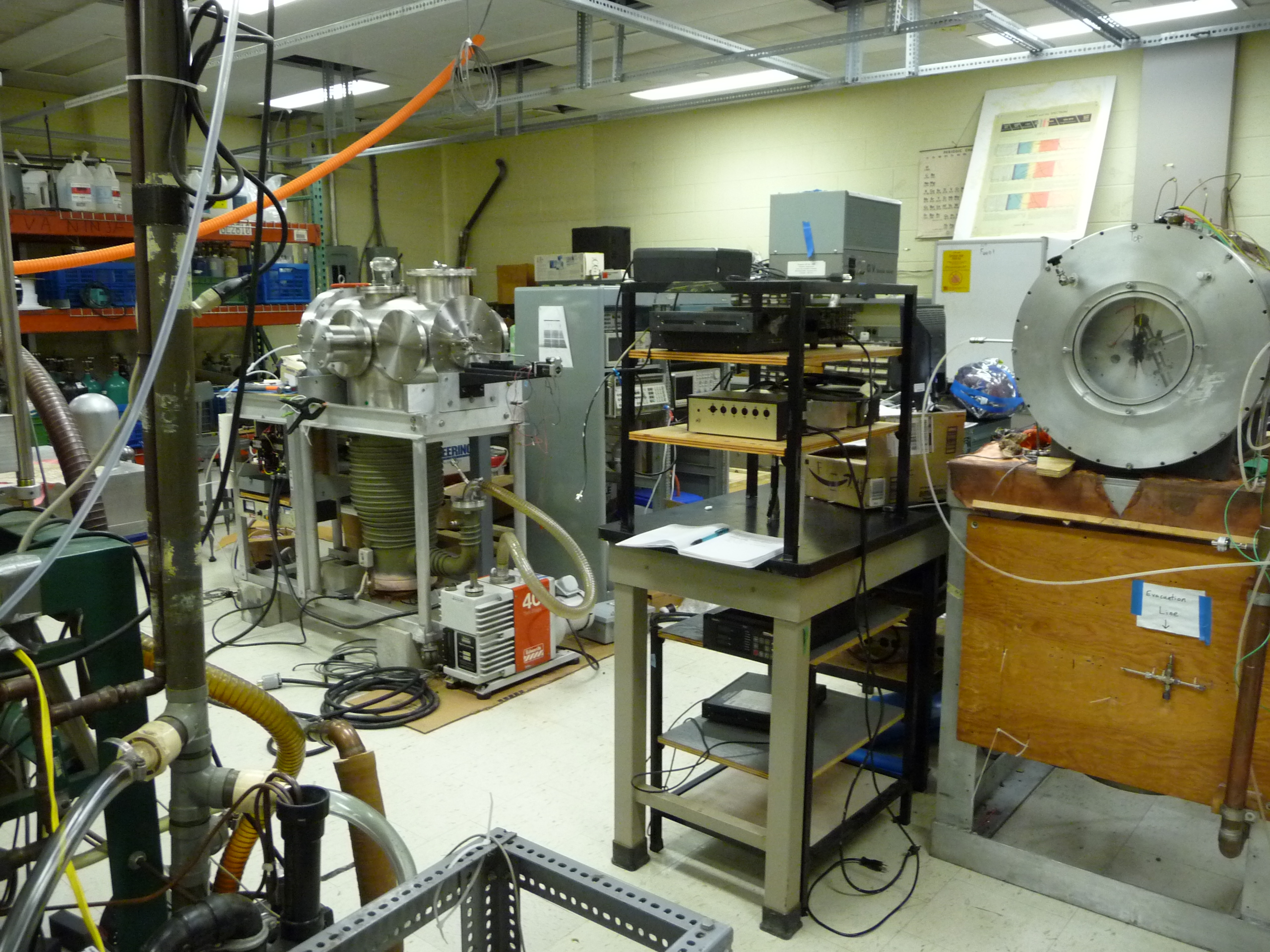
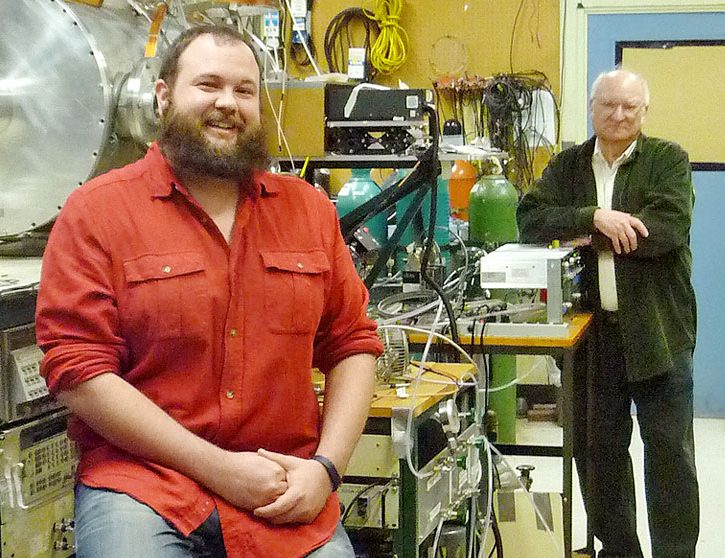
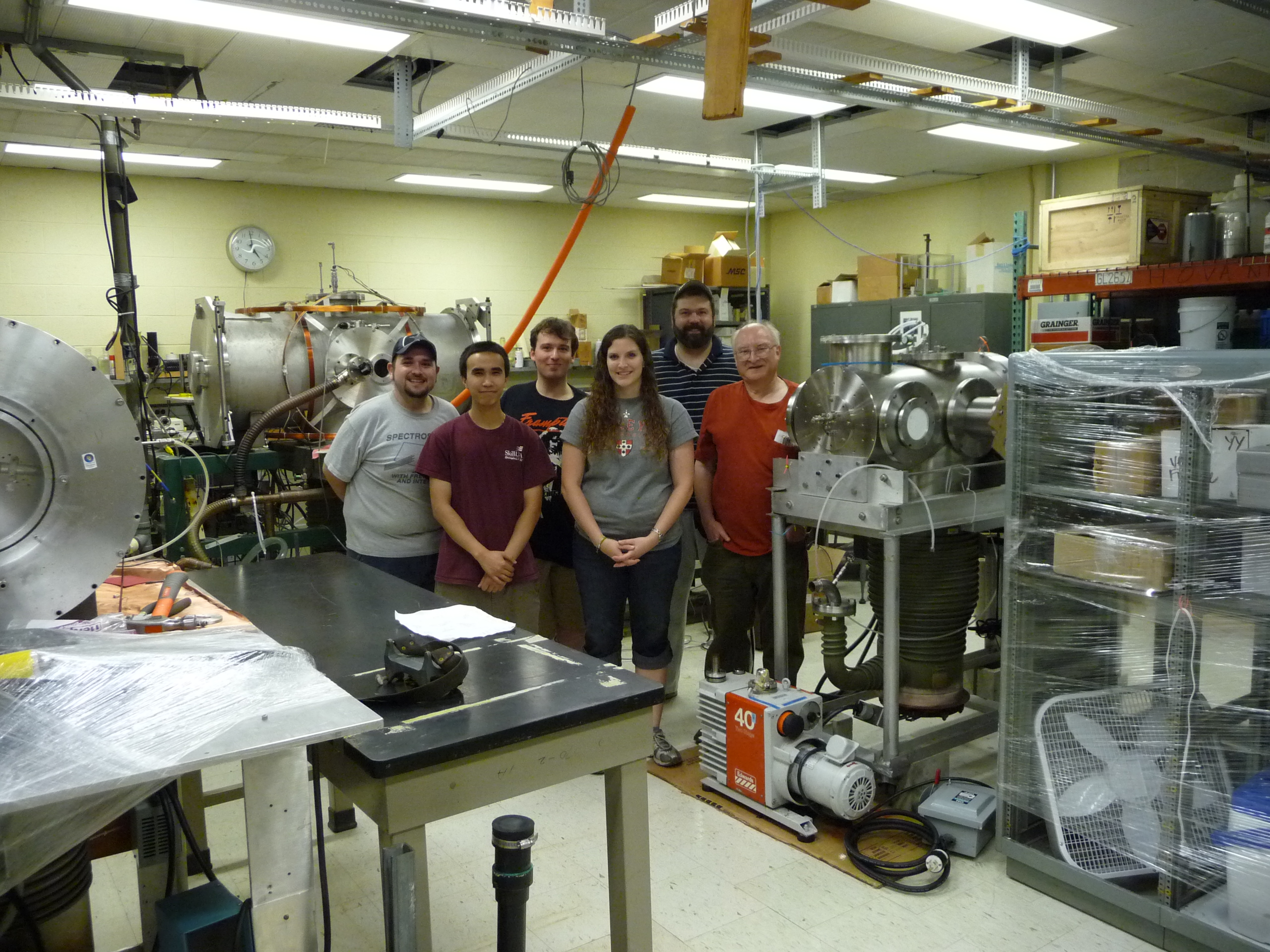
As can be seen in the photos above, there are three spectrometers in the laboratory: our original FTMW spectrometer (left), and two of Stephen Cooke’s spectrometers, a chirp/cavity FTMW spectrometer (left in the third photograph) and a FTMW spectrometer with low frequency capabilities. Stephen Cooke is a professor at the State University of New York at Purchase. Professor Cooke’s research group and my research group are beginning a strong scientific collaboration.
The microwave spectroscopic technique we employ in the laboratory is called pulsed-jet Fabry-Perot Fourier Transform microwave spectroscopy (FTMS). An intense pulsed jet of gas is produced at temperatures within 1 degree of zero Kelvin by standard pulsed supersonic techniques. This cold jet flows through a Fabry-Perot microwave cavity created by two large spherical aluminum mirrors whose separation ensures a high Q cavity tunable within the 6 to 26 GHz range. A pulse of microwave radiation timed to coincide with the arrival of the gas pulse, is introduced into the tuned cavity. If the molecules in the jet have a spectral transition within the 1 MHz spectral width of the cavity they can absorb the radiation and a macroscopic polarization of the molecules is induced. It is the free induction decay (FID) of this radiation that is detected. The results of many pulses and decays can be added together. The jet can be pulsed, say, ten times a second, so the result of two hundred pulses, polarization, FID’s, can be collected within twenty seconds. These summed FID’s are then Fourier transformed to produce a small piece of the molecular spectrum. The full microwave spectrum is gathered by retuning the cavity mechanically with a stepping motor to the next, say, 500 kHz window, stepping the master oscillator up by 500 kHz, and starting the pulsing sequence again. All this is accomplished automatically under computer control.
Weakly bound complexes are indeed rather complex molecules. Due to their extremely weak bonding, the molecules can and so undergo wild internal motions including extremely wide amplitude motions, and even inversions which make and break the weak bond. And yet, for these systems, the bonding geometry seems rather well predicted by chemical models similar to those which have proved so successful for the strongly bound covalent molecules.
A detailed understanding of the nature of these systems will have a fundamental impact on a host of chemical and physical problems including: transition state structures and dynamics, hydrogen bonding selectivity and directionality, crystal structures, reaction mechanisms, catalysis and surface interactions.
Stewart Novick, Google Scholar
Publications since 1990
- “The Structure of Weakly Bound Complexes as elucidated by Microwave and Infrared Spectroscopy” S. E. Novick, K. R. Leopold, W. Klemperer, in Studies in Physical and Theoretical Chemistry, 68, 359 (1990).
- “The Torsional-Rotational Spectrum and Structure of the Formaldehyde Dimer” F. J. Lovas, R. D. Suenram, L. H. Coudert, T. A. Blake, K. J. Grant, S. E. Novick, J. Chem. Phys. 92, 891 (1990).
- “Determination of the Structure of CO2 H2CO” T. A. Blake, S. E. Novick, R. D. Suenram, F. J. Lovas, J. Mol. Spectrosc. 154, 72 (1992).
- “Determination of the Cs Structure of the Conformations of Dipropyl Ether” K. J. Grant, A. R. Hight Walker, S. E. Novick, R. K. Bohn, L. Qi, Ti. Wheeler, J. M. LoBue, M. A. Al-Laham, J. Phys. Chem. 97, 6979 (1993).
- “Determination of the Structure of Ar H2CO” S. E. Novick, J. Chem. Phys. 99, 7506 (1993).
- “Current Themes in Microwave and Infrared Spectroscopy of Weakly Bound Complexes” K. R. Leopold, G. T. Fraser, S. E. Novick, W. Klemperer, Chemical Reviews 94, 1807 (1994).
- “Rotational Spectra of Methyl Ethyl and Methyl Propyl Nitrosamines. Conformational Assignment, Internal Rotation and Quadrupole Coupling” A. R. Hight Walker, Q. Lou, R. K. Bohn, S. E. Novick, J. Mol. Struct. 346, 187 (1995).
- “Determination of the Structure of HBr OCS” A. R. Hight Walker, W. Chen, S. E. Novick, B. D. Bean, M. D. Marshall, J. Chem. Phys. 102, 7298 (1995).
- “Carbon-13 Hyperfine Structure of the CCCCH Radical” W. Chen, S. E. Novick, M. C. McCarthy, C.A. Gottlieb, P. Thaddeus, J. Chem. Phys. 103, 7828 (1995).
- “Laboratory Measurement of the Hyperfine Structure of HCCCO” W. Chen, S. E. Novick, M. C. McCarthy, M. J. Travers, C. A. Gottlieb, A. L. Cooksy, P. Thaddeus, Astrophys. J. 462, 462 (1996).
- “Translational Energy Release Following Multiphoton Dissociation of Organometallics” R. M. Villarica, B. Samoriski, J. Chaiken, S. E. Novick, App. Surf. Sci. 106, 99 (1996).
- “Hyperfine Structure in the Microwave Spectrum of NF3” S. E. Novick, W. Chen, M. R. Munrow, K. J. Grant, J. Mol. Spectrosc. 179 , 219 (1996).
- “Structure of Butatrieneylidene, H2CCCC” M. J. Travers, W. Chen, S. E. Novick, J. Vrtilek, C. A. Gottlieb, P. Thaddeus, J. Mol. Spectrosc. 180, 75 (1996).
- “Determination of the Structure of HBr DBr” W. Chen, A. R. Hight Walker, S. E. Novick, F-M. Tao, J. Chem. Phys. 106, 6240 (1997).
- “Two New Cumulene Carbenes: H2C5 and H2C6” M. C. McCarthy, M. J. Travers, A. Kovacs, W. Chen, S. E. Novick, C. A. Gottlieb, P. Thaddeus, Science 275, 518 (1997).
- “Laboratory Detection of a New Carbon Chain Radical: H2CCCCN”, W. Chen, M. C. McCarthy, M. J. Travers, E. W. Gottlieb, M. R. Munrow, S. E. Novick, C. A. Gottlieb, P. Thaddeus, Astrophys J. 492, 849 (1998).
- “Microwave spectra of the methylcyanopolyynes CH3(CC)nCN, n=2,3,4,5″, W. Chen, J.-U. Grabow, M. J. Travers, M. R. Munrow, S. E. Novick, M. C. McCarthy, P. Thaddeus, J. Mol. Spectrosc. 192, 1 (1998).
- “Microwave spectroscopy of the 2,4-pentadiynyl radical, H2CCCCCH”, W. Chen, S. E. Novick, M. C. McCarthy, P. Thaddeus, J. Chem. Phys. 109, 10190 (1998).
- “Determination of the structure of argon cyclobutanone”, M. R. Munrow, W. C. Pringle, S. E. Novick, J. Phys. Chem. A 103, 2256 (1999).
- “Microwave spectroscopy of the methylpolyynes CH3(CC)6H and CH3(CC)7H”, W. Chen, M. C. McCarthy, S. E. Novick, P. Thaddeus, J. Mol. Spectrosc. 196, 335 (1999).
- “Rotational spectra of argon acetone: A two-top internally rotating complex”, L. Kang, A. R. Keimowitz, M. R. Munrow, S. E. Novick, , J. Mol. Spectrosc. 213, 122(2002).
- “Microwave spectra of four new perfluoromethyl polyyne chains: trifluoropentadiyne, CF3CCCCH, trifluoroheptatriyne, CF3CCCCCCH, tetrafluoropentadiyne, CF3CCCCF, and trifluoromethylcyanoacetylene, CF3CCCN”, L. Kang, S. E. Novick, J. Phys. Chem. A 106, 3749 (2002).
- “Hyperfine Interactions in HSiCl”, W. Lin, S. E. Novick, M. Fukushimsa, W. Jaeger, J. Phys. Chem. A 106, 7706(2002).
- “William A. Klemperer, an Appreciation”, K. K. Lehmann, S. E. Novick, R. W. Field, A. J. Merer, J. Mol. Spectrosc. 222, 1 (2003).
- “Torsional analysis of 2-butynol”, R. Subramanian, S. E. Novick, R. K. Bohn, J. Mol. Spectrosc. 222, 57 (2003).
- “The Microwave spectrum of cyanophosphine”, H2PCN, L. Kang, S. E. Novick, J. Mol. Spectrosc. 225, 66 (2004).
- “The Microwave Spectrum of HGeCl”, W. Lin, L. Kang, S. E. Novick, J. Mol. Spectrosc. 230, 93 (2005).
- “Rotational spectrum, nuclear quadrupole coupling constants, and structure of six isotopomers of the argon-chlorocyclobutane van der Waals complex,” R. Subramanian, J. M. Szarko, W. C. Pringle, S. E. Novick, J. Mol. Struct. 742, 165 (2005).
- “High resolution studies of tropolone in the S0 and S1 electronic states: Isotope driven dynamics in the zero-point energy levels”, J. C. Keske, W. Lin, W. C. Pringle, S. E. Novick, T. A. Blake, D. F. Plusquellic, J. Chem. Phys. 124, 074309 (2006).
- “The microwave spectrum of the 1,1-difluoroprop-2-ynyl radical, F2CCCH”, L. Kang, S. E. Novick, J. Chem. Phys. 125, 054309 (2006).
- The microwave spectrum of phosphaacetylnitrile, H2PCCCN, L. Kang, A. J. Minei, S. E. Novick, J. Mol. Spectrosc. 240, 255-259 (2006).
- Microwave observation of the ‘recently found’ polar OCS dimer, Andrea J. Minei and Stewart E. Novick, J. Chem. Phys., 126, 101101 (2007).
- Rotational spectra of gauche perfluoro-n-butane, C4F10; perfluoro-iso-butane, (CF3)3CF; and tris[trifluoromethyl]-methane, (CF3)3CH, Michaeleen R. Munrow, Ranga Subramanian, Andrea J. Minei, Dean Antic, Matthew K. MacLeod, Josef Michl, Raul Crespo, Mari Carmen Piqueras, Mitsuaki Izuha, Tomohiro Ito, Yoshio Tatamitani, Kenji Yamanoh, Teruhiko Ogata, Stewart E. Novick, J. Mol. Spectrosc. 242, 129-138 (2007).
- The microwave spectrum and structure of the argon trifluoroacetonitrile complex, Wei Lin and Stewart E. Novick, J. Mol. Spectrosc. 243, 32-36(2007).
- Microwave spectra and ab initio studies of Ar-propane and Ne-propane complexes: structure and dynamics, Karen I. Peterson, David Pullman, Wei Lin, Andrea J. Minei, Stewart E. Novick, J. Chem. Phys. 127, 184306 (2007).
- Microwave spectrum and structure of the polar N2O dimer, Nicholas R. Walker, Andrea J. Minei, Stewart E. Novick, Anthony C. Legon, J. Mol. Spectrosc. 251, 153-158 (2008).
- Determination of the structure of methylene cyclobutane confirming a non-planar ethene and the structure of the argon-methylene cyclobutane van der Waals complex, Wei Lin, Jovan A. Gayle, Wallace C. Pringle, Stewart E. Novick, J. Mol. Spectrosc. 251, 210-216 (2008).
- Fourier transform microwave spectroscopy of monobromogermylene (HGeBr and DGeBr), a heavy atom carbene analog, Lu Kang, Fumie Sunahori, Andrea J. Minei, Dennis J. Clouthier, Stewart E. Novick, J. Chem. Phys. 130, 124317(2009).
- Microwave spectra and structural parameters of equatorial-trans cyclobutanol, Wei Lin, Arindam Ganguly, Andrea J. Minei, Glen L. Lindeke, Wallace C. Pringle, Stewart E. Novick, James R. Durig, J. Mol. Struct. 922, 83-87 (2009).
- Microwave spectrum of the argon-tropolone van der Waals complex, Wei Lin, Wallace C. Pringle, Stewart E. Novick, Thomas A. Blake, J. Phys. Chem. A 113, 13076-13080 (2009).
- Determination of the structure of cyclopentene oxide and the argon cyclopentene oxide van der Waals complex, Andrea J. Minei, Jennifer van Wijngaarden, Stewart E. Novick, Wallace C. Pringle, J. Phys. Chem. A 114, 1427-1431 (2010).
- Microwave spectra, structure, and dynamics of the weakly bound complex, N2 CO2, Daniel J. Frohman, Edwin S. Contreras, Ross S. Firestone, Stewart E. Novick, William Klemperer, J. Chem. Phys. 133, 244303 (2010).
- Extended Townes-Dailey analysis of the nuclear quadrupole coupling tensor, Stewart E. Novick, J. Mol. Spectrosc. 267, 13-18(2011).
- Microwave spectroscopy, Dunham analysis, and hyperfine splittings of the isotopomers of zinc monosulfide, ZnS, Daniel J. Frohman, G. S. Grubbs II, Stewart E. Novick, J. Mol. Spectrosc. 270, 40-43(2011).
- Fourier transform microwave spectroscopy of the reactive intermediate monoiodosilylene, HSiI and DSiI, Lu Kang, Mohammed A. Gharaibeh, Dennis J. Clouthier, Stewart E. Novick, J. Mol. Spectrosc. 271, 33-37(2012).
- The rotational spectrum of perfluoropropionic acid, G. S. Grubbs II, A. Serrato III, Daniel. A. Obenchain, S. A. Cooke, Stewart. E. Novick, W. Lin, J. Mol. Spectrosc. 275, 1-4 (2012).
- The microwave spectra of the weakly bound complex between carbon monoxide and cyanoacetylene, OC HCCCN, Lu Kang and Stewart E. Novick, J. Mol. Spectrosc. 276-277, 10-13(2012).
- Methyl group internal rotation and the choice of Hamiltonian for the rotation spectrum of 1,1-difluoroacetone, G. S. Grubbs II, P. Groner, Stewart E. Novick, S. A. Cooke, J. Mol. Spectrosc. 280, 21-26 (2012).
- A bis-trifluoromethyl effect: Doubled transitions in the pure rotational spectra of hexafluoroisobutene, (CF3)2C=CH2, G. S. Grubbs II, Stewart E. Novick, Wallace C. Pringle, Jaan Laane, Esther J. Ocola, S. A. Cooke, J. Phys. Chem. A 116, 8169-8175 (2012).
- Measurement and analysis of the pure rotational spectrum of tin monochloride, SnCl, using laser ablation equipped chirped-pulse and cavity Fourier transform microwave spectroscopy, G. S. Grubbs II, Daniel J. Frohman, Stewart E. Novick, S. A. Cooke, J. Mol. Spectrosc. 280, 85-90 (2012).
- Probing the chemical nature of dihydrogen complexation to transition metals, a case study: H2–CuF, Daniel J. Frohman, G. S. Grubbs II, Zhenhong Yu, Stewart E. Novick, Inorg. Chem. 52, 816-822 (2013).
- Detection of Nitrogen-protonated Nitrous oxide HNNO + by Rotational Spectroscopy, Michael C. McCarthy, Oscar Martinez, Jr., Kyle N. Crabtree, Stewart E. Novick, Sven Thorwirth, J. Phys. Chem. A 117, 9968-9974 (2013).
- Rotational spectrum and structure of cyclohexene oxide and the argon-cyclohexene oxide van der Waals complex, Daniel J. Frohman, Stewart E. Novick, Wallace C. Pringle, J. Phys. Chem. A 117, 13691-13695 (2013).
- The shape of trifluoromethoxybenzene, Lu Kang, Stewart E. Novick, Qian Gou, Lorenzo Spada, Montserrat Vallejo-Lopez, Walther Caminati, J. Mol. Spectrosc. 297, 32-34 (2014).
- The microwave spectra and structure of the argon-cyclopentanone and neon-cyclopentanone van der Waals complexes, Wei Lin, Andrew H. Brooks, Andrea J. Minei, Stewart E. Novick, Wallace C. Pringle, J. Phys. Chem. A 118, 856-861 (2014).
- Fluorination effects on the shapes of complexes of water with ethers: a rotational study of trifluoroanisole-water, Qian Gou, Lorenzo Spada, Monserrat Vallejo-Lopez, Lu Kang, Stewart E. Novick, Walther Caminati, J. Phys. Chem. A 118, 1047-1051 (2014).
- Measurement of the J = 1 – 0 pure rotational transition in excited vibrational states of X 1Σ Thorium (II) Oxide, ThO, B. E. Long, Stewart E. Novick, S. A. Cooke, J. Mol. Spectrosc. 302, 1-2(2014).
- H2 AgCl: a spectroscopic study of a dihydrogen complex, G. S. Grubbs II, Daniel A. Obenchain, Herbert M. Pickett, Stewart E. Novick, J. Chem. Phys. 141, 114306 (2014).
- Internal Dynamics in the Molecular Complex of CF3CN and H2O, Wei Lin, Anan Wu, Xin Lu, Xiao Tang, Daniel A. Obenchain, Stewart E. Novick, Phys. Chem. Chem. Phys. 17, 17266-17270 (2015).
- The position of the deuterium in HOD – NNO as determined by structural and nuclear quadrupole coupling constants, Daniel A. Obenchain, Derek S. Frank, Stewart E. Novick, William Klemperer, J. Chem. Phys. 143, 084301 (2015).
- A study of the monohydrate and dihydrate complexes of perfluoropropionic acid using chirped-pulse Fourier transform (CP-FTMW) spectroscopy, G. S. Grubbs II, Daniel A. Obenchain, Derek S. Frank, Stewart E. Novick, S. A. Cooke, Agapito Serrato III, Wei Lin, J. Phys. Chem. A 119, 10475-80 (2015).
- Rotational spectra and the nitrogen nuclear quadrupole coupling for the cyanoacetylene dimer: H-C≡C-C≡N…H-C≡C-C≡N , Lu Kang, Philip Davis, Ian Dorell, Kexin Li, Adam Daley, Stewart E. Novick, Stephen G. Kukolich, J. Mol. Spectrosc. 321, 5-12 (2016).
- The pure rotational spectrum of a Claisen rearrangement precursor allyl phenyl ether using CP-FTMW spectroscopy, G. S. Grubbs II, Derek S. Frank, Daniel A. Obenchain, S. A. Cooke, Stewart E. Novick, J. Mol. Spectrosc. 324, 1-5 (2016).
- Rotational spectroscopy of 2H,3H-perfluoropentane, Chinh H. Duong, Daniel A. Obenchain, S. A. Cooke, Stewart E. Novick, J. Mol. Spectrosc. 324, 53-55 (2016).
- A study of 2-iodobutane by rotational spectroscopy, Eric A. Arsenault, Daniel A. Obenchain, Yoon Jeong Choi, Thomas A. Blake, S. A. Cooke, Stewart E. Novick, J. Phys. Chem. A 120, 7145-7151 (2016).
- A beginner’s guide to Pickett’s SPCAT/SPFIT, Stewart E. Novick, J. Mol. Spectrosc. 329, 1-7 (2016).
- A study of the conformational isomerism of 1-iodobutane by high resolution rotational spectroscopy, Eric A. Arsenault, Daniel A. Obenchain, Thomas A. Blake, S. A. Cooke, Stewart E. Novick, J. Mol. Spectrosc. 335, 17-22 (2017).
- The Covalent Interaction Between Dihydrogen and Gold: A Rotational Spectroscopic Study of H2-AuCl, Daniel A. Obenchain, Derek S. Frank, G.S. Grubbs II, Herbert M. Pickett, and Stewart E. Novick, J. Chem. Phys. 146, 204302 (2017).
- Nuclear quadrupole coupling in SiH2I2 due to the presence of two iodine nuclei, Eric A. Arsenault, Daniel A. Obenchain, W. Orellana, Stewart E. Novick, J. Mol. Spectrosc. 338, 72 – 76 (2017).
- Rotational spectrum and structure of the T-shaped cyanoacetylene complex, HCCCN … CO2, Lu Kang, Philip Davis, Ian Dorell, Kexin Li, Onur Oncer, Lucy Wang, Stewart E. Novick, Stephen G. Kukolich, J. Mol. Spectrosc. 342, 62-72 (2017).
- Rotational Spectra of 4,4,4-Trifluorobutyric Acid and the 4,4,4-Trifluorobutyric Acid-Formic Acid Complex, Yoon Jeong Choi, Alex Treviño, Susanna L. Stephens, Stephen A. Cooke, Stewart E. Novick, Wei Lin, J. Mol. Spectrosc. 344, 65-70 (2018).
- Torsional splitting and four-fold barrier to internal rotation: the rotational spectra of vinylsulfur pentafluoride, W. Orellana, S. L. Stephens, W. C. Pringle, P. Groner, S. E. Novick, S. A. Cooke, J. Chem. Phys. 149, 144304 (2018).
- Determination and analysis of the nuclear quadrupole coupling tensors of 2-bromopyridine, Angela Y. Chung, Eric A. Arsenault, Susanna L. Stephens, Wallace C. Pringle, Carlos A. Jiménez-Hoyos, S. A. Cooke, Stewart E. Novick, J. Mol. Spectrosc. 356, 28-31 (2019).
- Microwave spectra and ab initio calculations of the methane propane van der Waals complex, Karen I. Peterson, D. P. Pullman, Wei Lin, Andrea J. Minei, Eric A. Arsenault, Stewart E. Novick, J. Phys. Chem. A 123, 5274-5282 (2019).
- Microwave spectra of a potential four-fold internal rotor, phenylsulfur pentafluoride, Joshua A. Signore, Christopher B. Falls, Susanna L. Stephens, Carlos A. Jimenez-Hoyos, Daniel A. Obenchain, S. A. Cooke, Stewart E. Novick, J. Mol. Struct. 1214, 128130 (2020).
- On the experimental measurement of barriers to fourfold internal rotation in pentafluorosulfanyl-containing compounds: The microwave spectra of C3H5-SF5 and C4 H7-SF5, W. Orellana, Susanna L. Stephens, Stewart E. Novick, S. A. Cooke, J. Mol. Spectrosc. 371, 111300 (2020).
- A study of the conformational isomerisim of n-propyl nitrate by microwave spectroscopy, W. Orellana, Susanna L. Stephens, Stewart E. Novick, S. A. Cooke, Carolyn S. Brauer, Tomas A. Blake, J. Mol. Spectrosc. 374, 111376 (2020).
Papers in press or submitted (2022)
- The Microwave spectrum of the 1-1-difluorocyanomethyl radical, CF2CN, Lu Kang, Ha Vinh Lam Nguyen, Christopher B. Falls, Alexander B. Seys, Wallace C. Pringle, Thomas A. Blake, Stewart E. Novick, S. A. Cooke, J. Mol. Spectrosc. (2922), in press.
Some works in progress
- H2 AgCl, twenty isotopologues of para and ortho H2 AgCl measured and assigned; Manuscripts in preparation, on the D2 and HD isotopologues
- Analysis of Transition Doubling in the Rotational Spectrum of Hexafluoroacetone Imine, Daniel A. Obenchain, Daniel J. Frohman, B. E. Long, G. S. Grubbs II, Wallace C. Pringle, Stewart E. Novick, S. A. Cooke, manuscript in preparation.
- H2 CuCl, 4 isotopologues of para H2 CuCl and 1 isotopologue of ortho H2 CuCl measured and assigned
- propen-1-ylsulfur pentafluoride and buten-1-ylsulfur pentafluoride, W. Orellana, Susanna L. Stephens, Wallace C. Pringle, Stewart E. Novick, S. A. Cooke
Education
- B.S. 1967 State University of New York, Stony Brook, Ted Goldfarb (from Francis Bonner, Chemistry at Stony Brook, a Memoir)
- M.A. 1968 Harvard University, Harvard Chemistry
- Ph.D. 1973 Harvard University, William Klemperer
- Post Doctoral Research Associate, Joint Institute for Laboratory Astrophysics Carl Lineberger
BIBLIOGRAPHY OF ROTATIONAL SPECTRA OF WEAKLY BOUND COMPLEXES
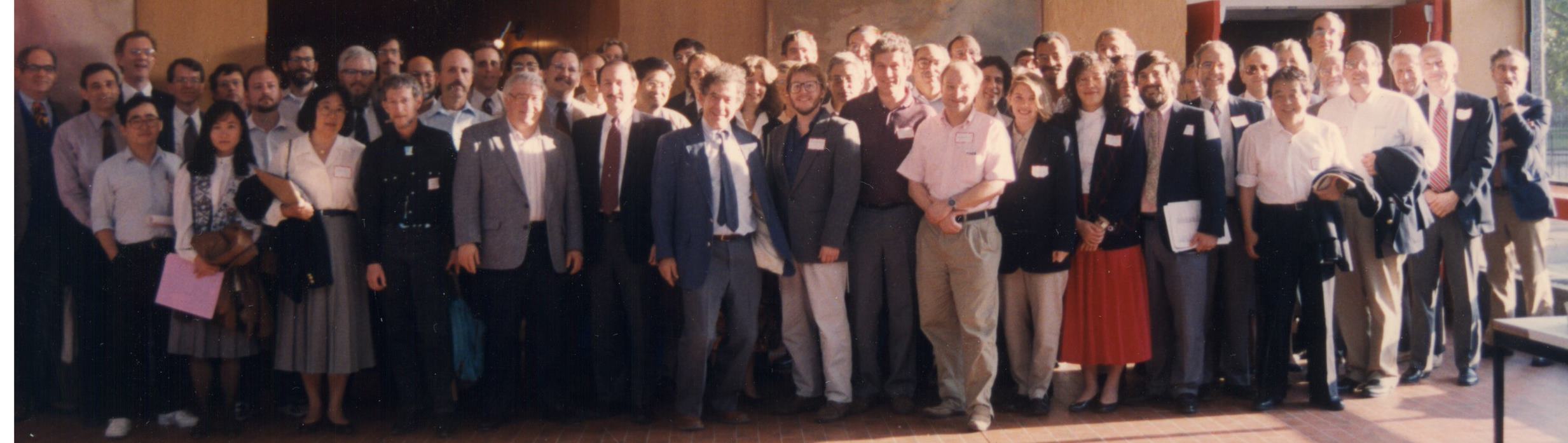
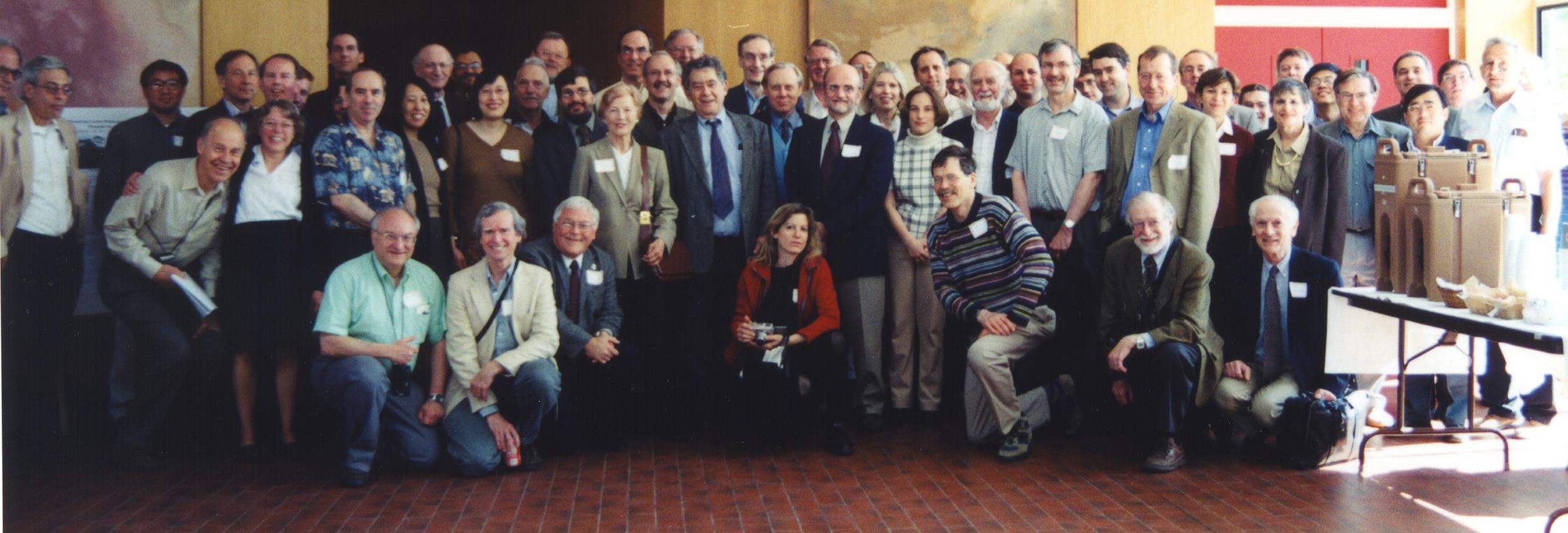
Below are photographs from Professor William Klemperer’s 65th birthday celebration in 1992, from his Retiral celebration in May 2002, and from his 80th birthday symposium on October 6, 2007.
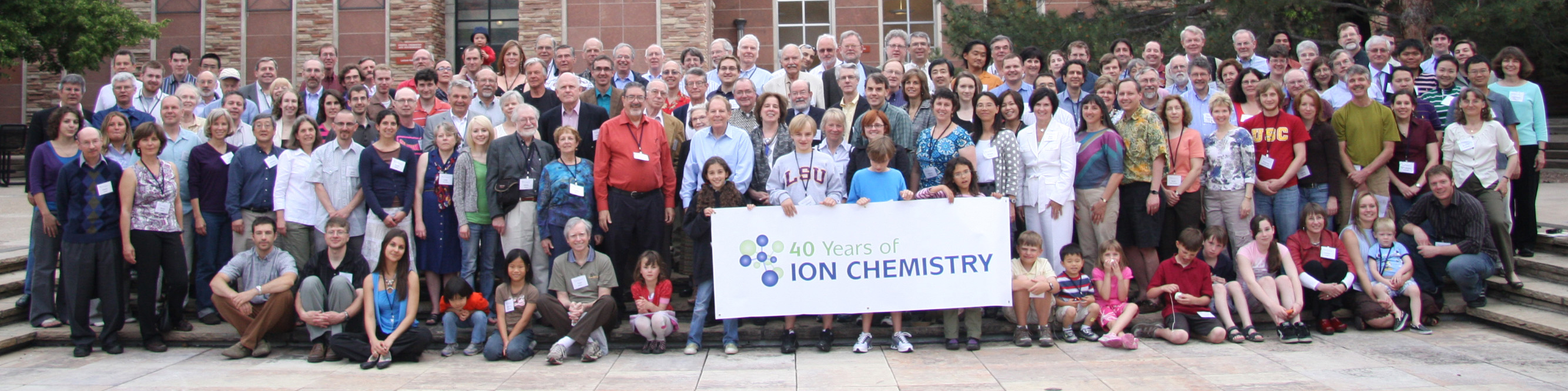
The fourth photo is from the 70th birthday celebration and group reunion for W. Carl Lineberger, held in Boulder, Colorado on June 13, 2009. 40 years of ion chemistry.
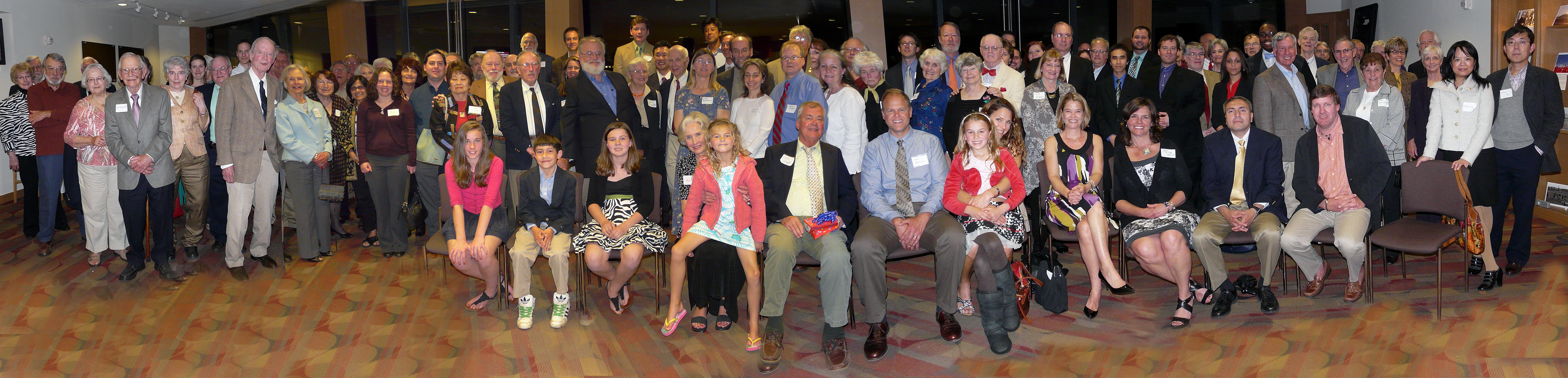
The fifth photo is from my 65th birthday celebration and group reunion, September 2010, organized by Tom Blake and Jim LoBue.
The sixth photo, taken by Russell Smilgys at the celebration, shows me with my former graduate students. Four students are missing from the photo.
The seventh photo was taken at Pete Pringle’s Retirement Party, May 6, 2012. ( Photography and Photoshop wizardry by Ros Brault)
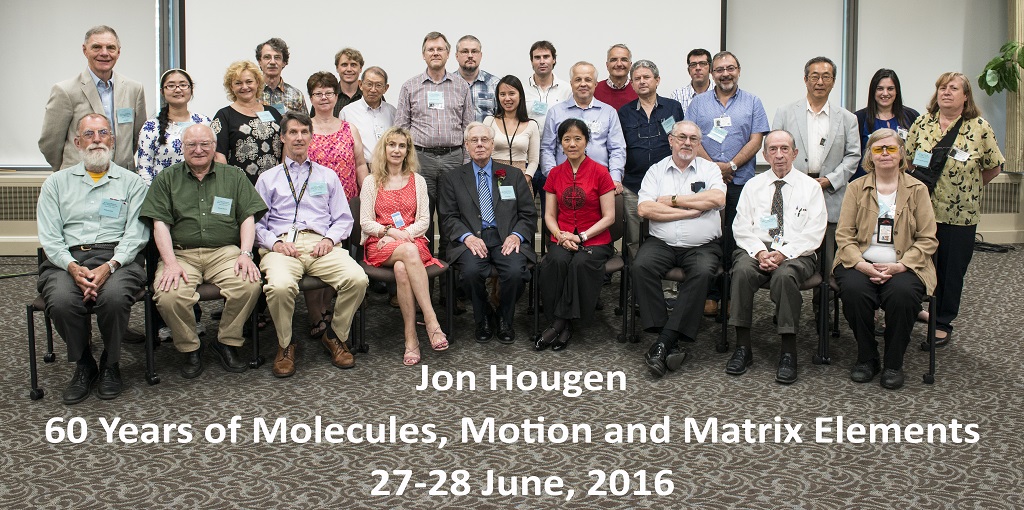
The eighth photo is of the Jon Fest in Gaithersburg MD, June 27-28, 2016, in honor of Jon Hougen



Last updated: April 11, 2021 (sn)