|
 |
 |
 |
 |
| Professor of
Astronomy Bill Herbst observed sand-like grains in space through the
reflection of light from stars. These grains are the building blocks of an
Earth-like planet. |
|
| Posted 03.17.08 |
Professor, Alumna Observe Initial State of Earth-Like Planet Formation
|
For the first time, astronomers have observed the initial phase in the
formation of an earth-like planet.
The
discovery, highlighted in the March 13 issue of Nature, was
documented by a team of astronomers led by William Herbst, the John Monroe
Van Vleck Professor of Astronomy, chair of the Astronomy Department and
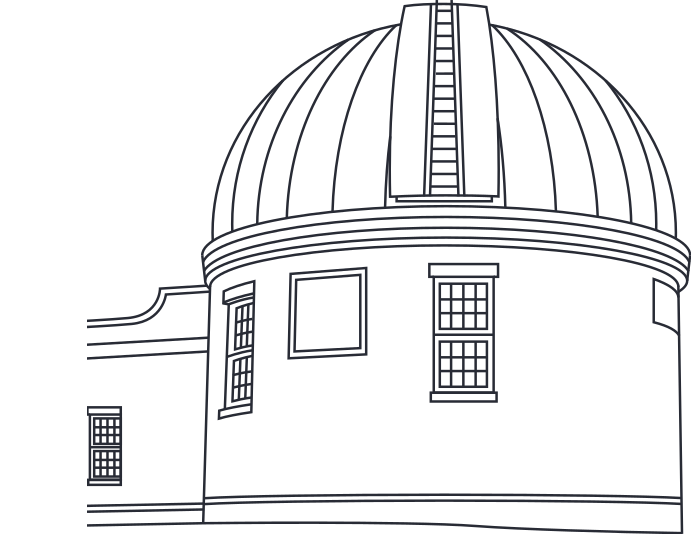
director of the Van Vleck Observatory (pictured at right) and Catrina
Hamilton, Ph.D ’03, assistant professor of physics and astronomy at
Dickinson College in Carlisle, Pa.
What Herbst, Hamilton and other astronomers on the team observed was that a
protoplanetary disk, or ring, around the binary star known as KH 15D, is
composed of solid particles larger than what is usually observed in space.
“For hundreds of years, scientists have been theorizing that Earth-like
planets form when gas and dust around a star get compressed into these disks
and the material begins to coalesce into planets. But until now we never had
the ability to study this process in detail,” Herbst says. “The unique
geometry presented by KH 15D and the way the light was being reflected off
the disk allowed us to get a good look at the structure of the disk. We were
amazed at what we saw.”
The disk orbiting KH 15D is at least the size of Jupiter’s orbit and
composed of sand-sized grains that have grown from microscopic-sized
particles to form the larger grains. These grains are now approximately 1mm
in diameter, much larger than the tiny particles typically seen in space.
This is also the characteristic size of "chondrules,” small glassy spherules
that are found in the most primitive solar system, the so-called
carbonaceous chondrite meteorites.
A Flash animation of what the team observed can be seen here:
http://www.wesleyan.edu/newsrel/kh15d_animation.html.
The observations of the disk were made over several years using some of the
largest telescopes in the world, including the 10-meter telescope of the W.M.
Keck Observatory in Hawaii. More modest telescopes, including the one at
Wesleyan University’s Van Vleck observatory and the Maidanak Observatory in
Uzbekistan, were also used in the study.
Located approximately 2,400 light years from earth and also known within the
astronomical community as the “winking star,” KH 15D was first documented in
1995 by Herbst and his then-graduate student Kristin Kearns '98. An ensuing
Ph.D. thesis by Hamilton further solidified the importance of this star and
brought it to the attention of the astronomical community. In 2004, two
groups of astronomers on opposite coasts showed that KH 15D’s winking was a
result binary star with an orbiting period of 48.36 days within a large
disk. The winking effect was generated as one of the stars alternately rose
above and set below the disk.
What Herbst, Hamilton and the rest of the team observed recently is that the
disk is slowly hiding the stars from view and putting them in a permanent
state of faintness, though still visible by the reflection off the disk.
“Because of how the light is being reflected there are opportunities to make
observations about the chemical composition of these sand-like particles,”
Herbst said. “That’s very exciting because it opens up so many doors for new
type of research on this disk.”
The members of the Herbst's team documenting the observations include
Hamilton, Katherine LeDuc MA ‘07; Joshua Winn of the Massachusetts
Institute of Technology.; Christopher Johns-Krull of Rice University;
Reinhard Mundt of the Max-Planck-Institute for Astronomy in Heidelberg,
Germany; and Mansur Ibrahimov of the Ulugh Bek Astronomical Institute in
Tashkent, Uzbekistan. Support for the work has come over the years from
NASA's Origins of Solar Systems program and from the W. M. Keck Observatory
Principal Investigator's Fund.
For more information, go to
https://wesfiles.wesleyan.edu/home/wherbst/web/KH15D.
|
|
By David Pesci, director of media relations.
Video still and video by Wesleyan's Academic Media Studio. |

|
 |
 |
|
 |