|
"What's beautiful about astronomy is that there are always unanswered
questions, and when you answer one, that will open up five more questions,"
said Eric Williams, the systems and facility manager for the Astronomy Department
and Van Vleck Observatory. "I'm always curious."
An interest in astronomy, physics
and computers led Williams to Wesleyan in 1996. "I've always wanted a job
like this," Williams said, "I get to experiment with all kinds of things."
Before coming to Wesleyan, Williams spent five years hunting for planets
outside our solar system as a sky observer with the planet research team at
San Francisco State University. The team has contributed to the discovery of
more than 100 extrasolar planets.
Williams says he isn't a telescope equipment expert but he can answer just
about any questions regarding how the Wesleyan scopes operate. However, most
his time is currently devoted to, as he refers to it, "babysitting
computers."
At Wesleyan, Williams,
spends about a quarter of his time on research and leading weekly star
gazings for the public and an amateur astronomy group. He uses the
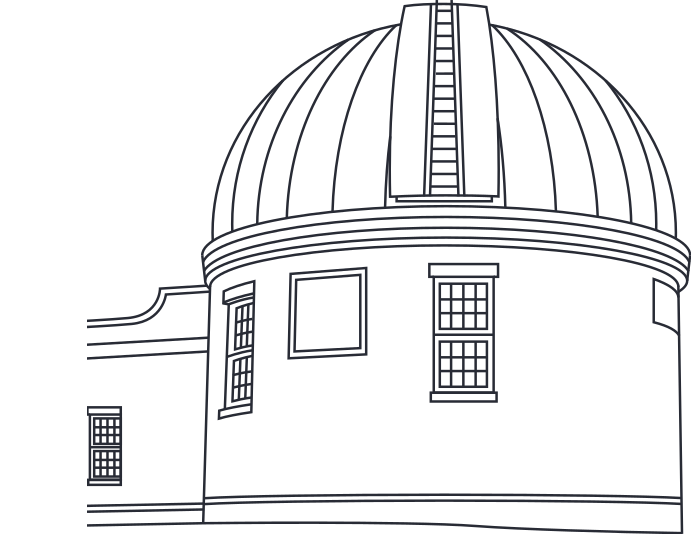
observatory's 24-inch Perkin research reflector, the 20-inch Alvan Clark
great refractor and the 16-inch Meade Schmidt-Cassegrain reflector, all
housed in their own domes on campus.
Formerly a sky observer
for the SFSU planet search team, Williams says he isn't a telescope equipment
expert, but he can answer just about any questions regarding how the
Wesleyan scopes operate.
As the systems
manager, Williams oversees the department's server - appropriately named 'Astro,'
- as well as an array of 10 printers and 40 computers with MacIntosh and
UNIX workstations. He assists students with software questions and checks
for security alerts daily.
"I'm a troubleshooter
and an anticipator," he said. "If a problem comes up, I'll find a solution.
I don't want people to get behind because of computer problems."
Williams works from his
basement office, which also functions as a storeroom. There, heaps of books,
papers, computer monitors, keyboards, network cards and tangled wires dwell
in any available space, including the floor.
Williams, who has a bachelor's and master's degree in physics from San
Francisco State University, acquired most of his programming knowledge on
the job. He self-taught himself programming languages Java, Perl and PHP,
and research software including Interactive Data Language, or IDL.
Nevertheless, Williams
knew he'd never master the programming languages without further education.
"I had an intellectual curiosity. I wanted to fill in the gaps in my
knowledge," Williams said.
Three years ago, he visited the math department and enrolled in a master's
degree program for computer science. He graduated in spring 2004 and learned
what it takes to be a student at Wesleyan. "The kids here at Wesleyan are
very smart. I had to keep up with undergrads in some of my classes," said
the 40-year-old.
Results from his master's thesis, titled "Directional versus Omnidirectional
Antennas for Energy Consumption and k-connectivity of Sensor Networks," was
recently accepted for publication.
At Wesleyan, Williams
supports all research by William Herbst, professor of astronomy, who gained
renown recognition for his discovery of KH15D, a far-off, winking star which
appears to be displaying behavior thought to create our own solar system.
“Eric is highly
respected and valued by all the staff and students of the Astronomy
Department,” Herbst said. “He helps us with all sorts of computer problems,
manages the complex astronomy computer network, runs our public outreach
programs, and participates in some research programs and in the intellectual
life of the department.”
He also volunteers his
time and skills to community projects such as
Project ASTRO, which uses an
activities-based approach to excite third through 12th grade
students about astronomy and help them learn the process of science.
Most recently, Williams
joined a team working with Earth & Environmental Sciences Assistant
Professor Martha Gilmore on developing a Planetary Science Group for the
campus and local community.
Although he’s been
doing research for the last few years in computer science, Williams is
looking forward to the slight change of topic.
"I am excited to
return to doing some of my own astronomy research now," he said. |