Astronomers Discover Unprecedented 3-Year Eclipse of Sun-Like Star

Eclipsing body could be proto-planet or proto-planetary disc

Release date: Monday, May 26, 2003


Contact info: William Herbst, Wesleyan University, 860-685-3672 wherbst@wesleyan.edu

NASHVILLE, TN -- When Roger Cohen first looked at the images he thought there must be some mistake. The dates had to be wrong, or perhaps the images had been mislabeled. But after re-checking the data the realization of what he was looking at began to take hold. He had located a young sun-like star that had undergone an eclipse lasting 3 years. Nothing like this had ever been observed.

"I nearly fell out of my chair," says Cohen.

Cohen immediately brought his findings to William Herbst, an astronomer and the Van Vleck Professor of Astronomy at Wesleyan University, who gained renown last year for his discovery of KH15D - a far-off, winking star which appears to be displaying behavior thought to create our own solar system. Cohen was hoping that Herbst could help him confirm the data on the 3-year eclipse.

The data in fact showed that something very large spent three years passing in front of a young star, HMW15, which is located in IC348, a star cluster in Perseus. The eclipsing body apparently moved at a rate of about 100 meters per second - very slow by cosmic standards. For example, Earth circles the Sun at about 30,000 meters per second; Pluto, the slowest planet in our solar system moves at about 4,000 meters per second.

"When I saw the data I knew Roger had found something special," says Herbst. "It was something never seen before. The longest eclipse observed to this point had been just under two years long. It was very interesting and I was impressed with Roger's work."

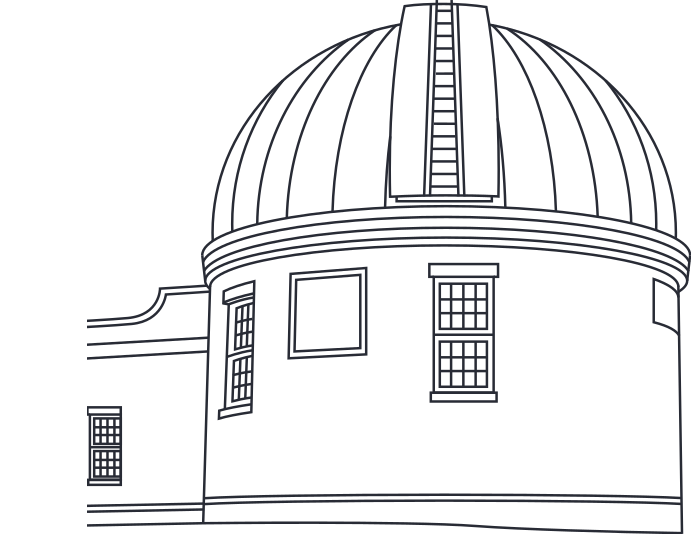
Part of the reason Herbst was impressed was because Roger Cohen is not an astronomer with a Ph.D. working with images from the Hubble telescope or some large earth-bound facility. He's not even a graduate student toiling toward his doctorate. Cohen is an undergraduate at Wesleyan University who was working with a small 0.6 meter telescope at the university's Van Vleck Observatory. The discovery has been detailed in a paper, which Cohen will be presenting at this year's meeting of The American Astronomical Society in Nashville, TN.

It's the type of discovery that many seasoned astronomers dream of. But Cohen wasn't looking for some out of this world finding when he began his analysis. He was just looking for something "interesting" in recent data samples.

"I found this in the course of analyzing data for my senior thesis," he says."The fact that the average brightness of this star changes quite a bit from year to year tipped me off to the fact that something interesting might be going on."

As for what the eclipsing body is, neither Cohen nor Herbst can say for sure. Herbst says the star in question is quite similar to the Sun but only a few million years old - a juvenile as far as stars go. It is possible that the eclipsing body could have been something just passing the star in a one-time event. However, the slow speeds indicate that the object and star are gravitationally bound making it plausible that the eclipsing body is a proto-planet or a feature in a proto-planetary disk.

"It really is fascinating and exciting," says Herbst.

Herbst is also excited about Cohen's discovery, but he's not surprised a Wesleyan undergrad was able to make such a discovery. Since Wesleyan's program to observe young stars began in the early 1990s, undergraduates have been doing the lion's share of the observation and analysis of data.

"It's a product of the academic environment we've created here," Herbst said. "Undergraduates work directly with professors, which gives them the opportunity to do graduate-level work."

Cohen agrees.

"I think the fact that an undergrad at Wesleyan can have all these opportunities speaks to the level of research being done here - the faculty is great, and there's some really fascinating science going on."

As for the chance to present his findings to some of the world's foremost astronomers at the AAS meeting, Cohen is even more enthusiastic.

"It's really cool."

> Back to Press Releases