
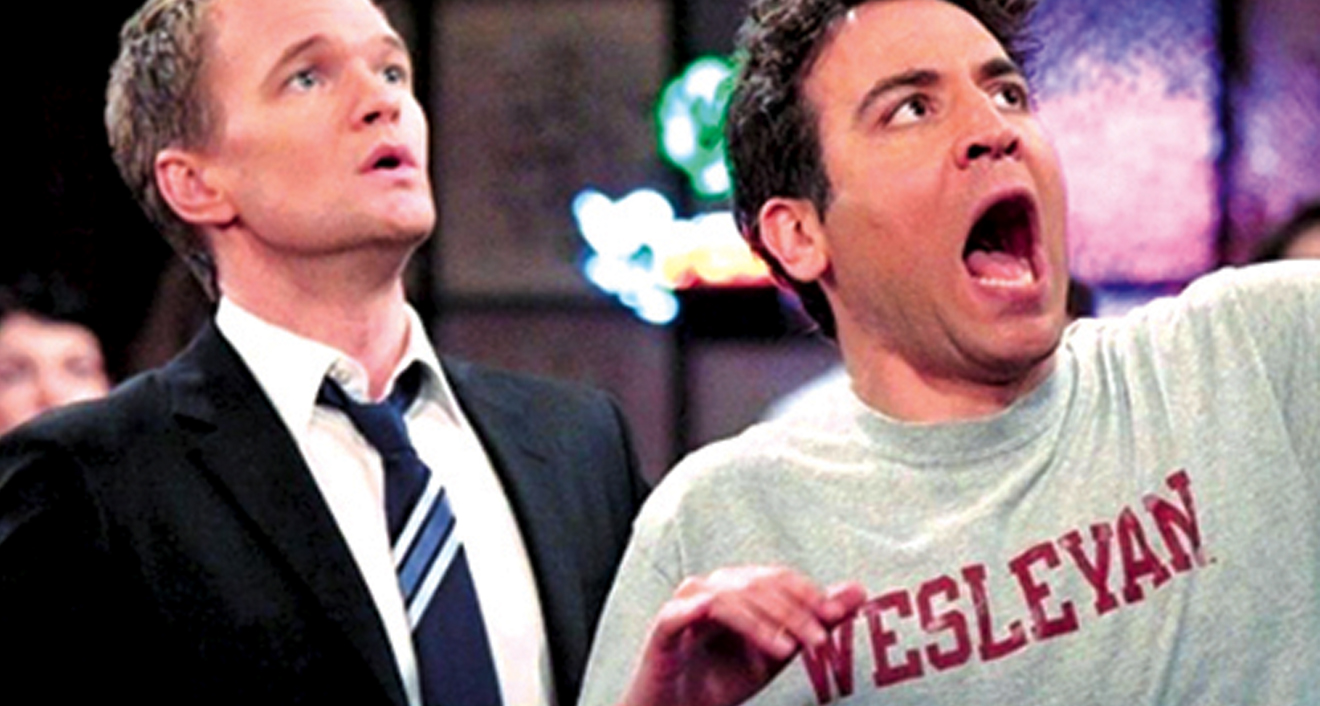
How I Met Your Mother: A 20-Year Reunion
It’s been 20 years since Carter Bays ’97 and Craig Thomas ’97 first premiered their show How I Met Your Mother on TV. During its nine-season run from September 2005 to March 2014, the show cleverly employed the use of flash-forwards and flashbacks to tell the story of five twentysomethings navigating post-college life in New York City. It also introduced scores of young TV watchers to Wesleyan University, where the core trio of the show first cemented their lifelong friendship. Despite ending its run in 2014, the show has maintained its popularity on streaming.
“We get so many young people, in their teens and twenties, discovering the show,” says Thomas. “They love the wisdom offered by future Ted (the narrator) and the idea of ‘I am collecting the stories I’m going to tell later.’”
Since the show wrapped, Bays and Thomas have pursued projects separately—Bays published The Mutual Friend in 2022, and Thomas’s book, That’s Not How It Happened, is available now (see our review)—but they continue to collaborate through their band, The Solids (which is primarily composed of Wesleyan alumni).
The recently launched rewatch podcast How We Made Your Mother reunited Thomas with star of the show Josh Radnor as cohosts (Alek Lev ’97 produces and Bays has guested). They even recorded a live episode on campus in front of the 2025 Reunion & Commencement audience. Here, Thomas and Bays discuss how their vision of the future stacked up to the present and the ongoing influence of Wesleyan in the show and in their lives.
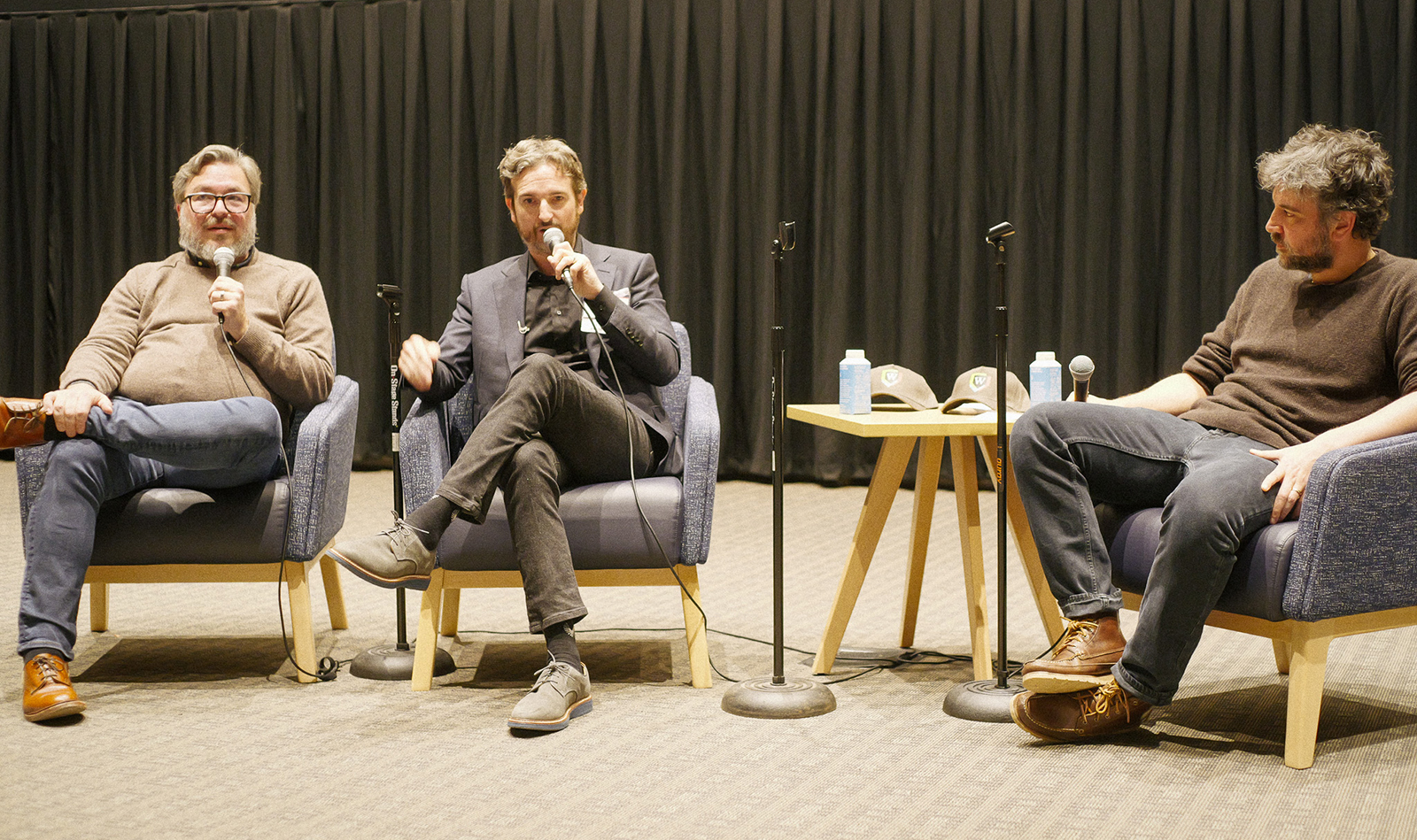
Carter Bays (left) and Craig Thomas (right) reminisce while recording an episode of the rewatch podcast How I Made Your Mother.
It’s been 20 years since the show premiered, 10 years since it stopped. How does it feel to revisit the show through the podcast?
Craig Thomas: What strikes me is how unimaginable all of this would have been in 2005 when Carter and I were 30 years old. To go back in time to 2005 and tell those guys: “You’re going to be hearing from people that learned English in Korea by watching How I Met Your Mother 20 years from now.” It’s surreal and wonderful.
We were new guys in L.A., writing very nostalgically about our twenties in New York City. There was something slightly ridiculous about it, but that’s just who Carter and I are. We’re mythologizing and narrativizing our lives in real time, all the time. I’m listening to what 30-year-old me thought it might be like to be in your 50s. I’m surprised by how much of it seems wise and true, and actually not completely full of [expletive].
Carter Bays: I’m amused by it. There are also things that make me cringe, in a loving, forgiving way. There’s just stuff you don’t know when you’re 30 that you suddenly understand when you’re 50.
Why do you think that How I Met Your Mother has managed to stay so culturally relevant?
Thomas: There’s something special about that idea of looking back on your life and imagining a future version of yourself.
Sure, the world feels far more tenuous in 2025 than I had hoped when we were imagining 2030 in the show. But I still have to believe that we’re going to survive it and that people will still live to become their future selves and tell their story in the most entertaining and yet lengthy way possible, like future Ted is doing. There’s a future you, looking back on all of this absurdity. And there are still parents boring their kids with long stories in the future.
Bays: We made a concerted effort to make something timeless. We wanted to be able to watch this 20 years from now and not cringe. And I feel we pretty much nailed it in that sense. But also, when you’re writing a show about love, you’re writing a show about relationships. That stuff doesn’t change. The world changes, and the way the world steers relationships can change. Ultimately, being in love and having someone drive you crazy, but also not wanting to be without them, that never goes away.
How much is the college, as depicted in the show, true to your real experience?
Bays: The jokes I always love the most in the show, whether it’s about Wesleyan or any other thing, are those that feel not real but true.
For instance, Ted protests that the meal plan is racist. That’s not real. There never was an actual protest like that, but it feels true. It feels like that would have happened.
In this day and age, the world needs Wesleyans. It needs Wesleyan students. It needs people who are active and care about what’s going on and are trying to get to the bottom of it. I was very proud to represent that on our show.
Thomas: A lot of what we show happening at Wesleyan is people doing dumb things, but the larger compliment for Wesleyan is that these are good people. These are lovable humans.
They’re smart. They’re funny. They’re kind. They want to make the world a better place. And we’re somewhat making fun of the fact that when you’re in college, you’re so earnest, you’re going to save the world.
During the live recording of the podcast (to be released in the podcast’s second season), you spoke about how the Wesleyan ethos of self-starting is embedded in the show. How has that ethos influenced your lives?
Bays: When I arrived at Wesleyan, I was really into humor writing. There was no Wesleyan version of The Harvard Lampoon. But Wesleyan is a place where it’s like, “oh, you want a humor magazine? Make one.” And so my buddies and I printed something called the Wesleyan Merkin.
More than anything, that specifically prepares you for show running. Every show has to figure out its own rules of how it’s assembled. And that was a skill that I definitely learned at Wesleyan. I feel like at Wesleyan, pursuing some crazy extracurricular interest took up 90 percent of my time. And I appreciated that, because that prepared me for life after college.
Thomas: When you needed to do something at Wesleyan, you had to figure it out, soup to nuts. Those are the skills of a showrunner. Those are not the skills of somebody who works as a part of a larger machine; those are the skills of somebody who builds a machine. And we both graduated from Wesleyan with that aesthetic and that hunger to do that, and the feeling that we could.