
Notable Moments in Wesleyan's Underground History
Much has been written about the lure and lore of Wesleyan’s tunnels, but there’s more to the story than the famously graffitied passages. Since the founding of the University, subterranean basements and corridors have been adapted and readapted for academic activities, student life, storage, and infrastructure. In the new year, the new science building will write the next chapter in the legend. To celebrate, Wesleyan University Magazine dug up nine milestones and quirky moments in Wesleyan’s underground history.
A Subterranean Timeline
The First Tunnels Are Excavated Beneath College Row
Who knew tunnels would become so central to Wesleyan’s identity and mythology? Certainly not the campus architect who approved the practical solution of constructing passageways that would make steam pipes more accessible for repair and maintenance. The system would be extended under Olin Library and Clark Hall. Early on, the tunnels were used by students to get from one building to another. Today these restricted-use infrastructure corridors are damp, hot, and frequented only by maintenance and contract workers. Because of the pipes, dangling wires, and other obstructions, it’s not possible to walk upright in some sections.
Wesleyan’s Underground Makes The New York Times
An article headlined “WESLEYAN TREND IS ‘UNDERGROUND’” describes the novel development of basement spaces. Winchester House (now home to the Anthropology Department) is depicted as featuring an underground haven for student groups: “The German Club has turned a section of the basement into a German beer cellar, with synthetic spider webs, dust, and cracks in the walls. The French and Spanish Clubs have fitted up rooms with [a] modernistic background, gas piping being much in evidence. The Student Outing Club has fitted up its quarters to present the appearance of a log cabin.” The lowest level of Downey House—now the subdued-beige home of the Classical Studies Department—is reported to have featured “a grill with a Spanish balcony motif,” while the basement of Scott Hall (now Allbritton) contained a “voice-recording laboratory designed to train students to speak distinctly.”
First Official Broadcast of WESU
Would WESU even exist without the tunnels? Probably. But it was only by stringing wires through hundreds of feet of tunnels that Arch Doty ’42 was able to share broadcasts from a homemade radio transmitter in his basement room in Clark Hall to a campus audience. Demand was high for Doty’s transmissions—a music show featuring 78 rpm records he played on a turntable—but the signal was too weak to be received by AM radios beyond Clark. The tunnels connecting to Olin Library and then-dorms Harriman Hall (now the Frank Center for Public Affairs) and North College provided the solution. Doty and friends would later add an underground studio to this network. Their radio station’s first official broadcast included discussion of the upcoming football game against Williams—provided by Captain Bob Murray ’40, cheerleader Dick Landsman ’41, and Coach Jack Blott—an address from President McConaughy, and the Paint and Powder Club’s presentation of two scenes from the anti-war drama Bury the Dead.
Foss Hill Residence Halls Open with a “Basement Recreation Area”
Like those in the Butterfields, which would open in 1965, the Foss Hill tunnels were designed expressly for student use. They provided access to storage areas, kitchenettes, laundry rooms, and spaces for student activities—like ceramics—that were later abandoned or moved to above-ground locations. No one knows when the graffiti began or at what point the passageways’ utility was superseded by their sense of mystery and the allure of unsanctioned exploration. For safety reasons, the University closed these tunnels to students in the 1990s, and today they are primarily used to maintain essential utilities and telecommunications infrastructure.
The Center for the Arts Opens with 11 Buildings and 250+ Yards of Tunnels
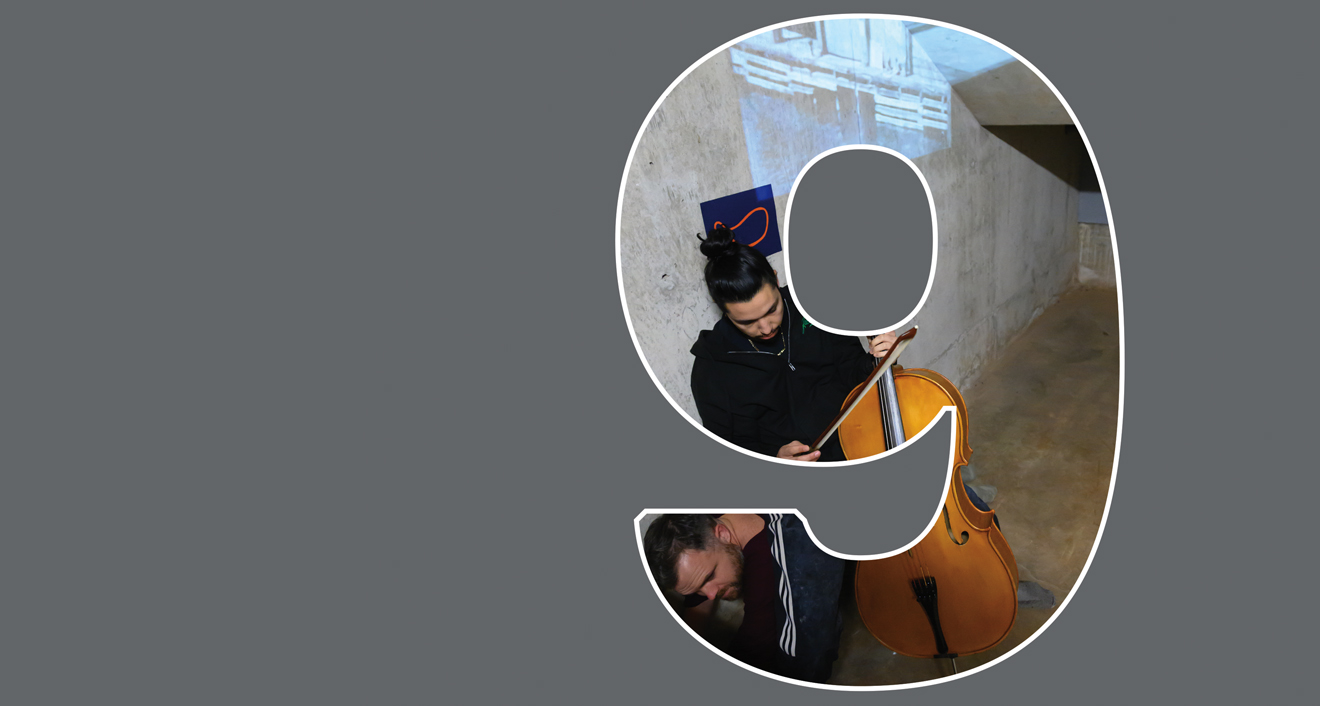
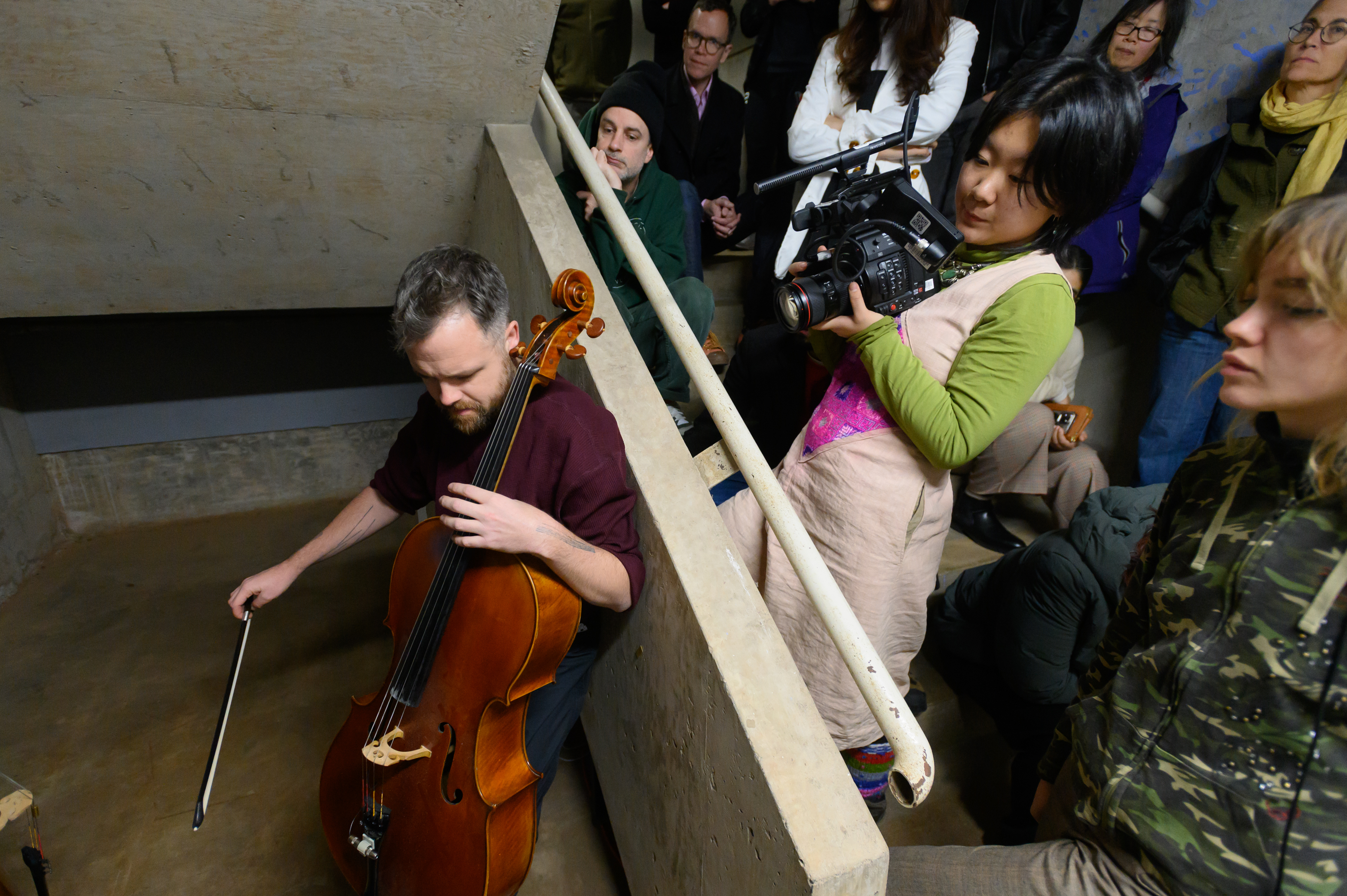
With concrete underground passages connecting arts spaces, the CFA’s ingenious architecture invokes the intangible relationships among arts disciplines. Also, the tunnels are convenient for going from one building to another, especially if the weather is bad or equipment must be rolled from the loading dock to the desired event venue. In contrast to the above-ground, more formal performance spaces, the gray, unadorned tunnels offer an informal, unconventional, blank-slate zone that has been used for student projects, practices, and art exhibits, as well as experimental performances by visiting artists. In a reflection upon the 50th anniversary season of the CFA in 2023–24, Director Joshua Lubin-Levy ’06 wrote: “[E]ach year new students discover the tunnels to their own delight, bringing a sense of wonder and excitement, and dreaming up possibilities for what they might do in a space that feels unmarked by any discipline, department, center, or University priority.”
Student Band’s “Tunnel Music” Is Recorded
A cassette tape featuring the Ventmen is part of the Stephen B. Porter ’87 collection of Wesleyan student music. It is thought to be Olin Library’s only recording of a band playing in the tunnels. However, the Porter collection does include tapes of several student bands from the 1980s—including Food Club, Straight Ahead, Ofaane, and Trees of Mystery—playing to audiences in the tunnel terminus room known as WestCo Café. That underground venue continues to host student music, including the annual Battle of the Bands.
Shelley the Glyptodon Is Liberated from Beneath Foss Hill
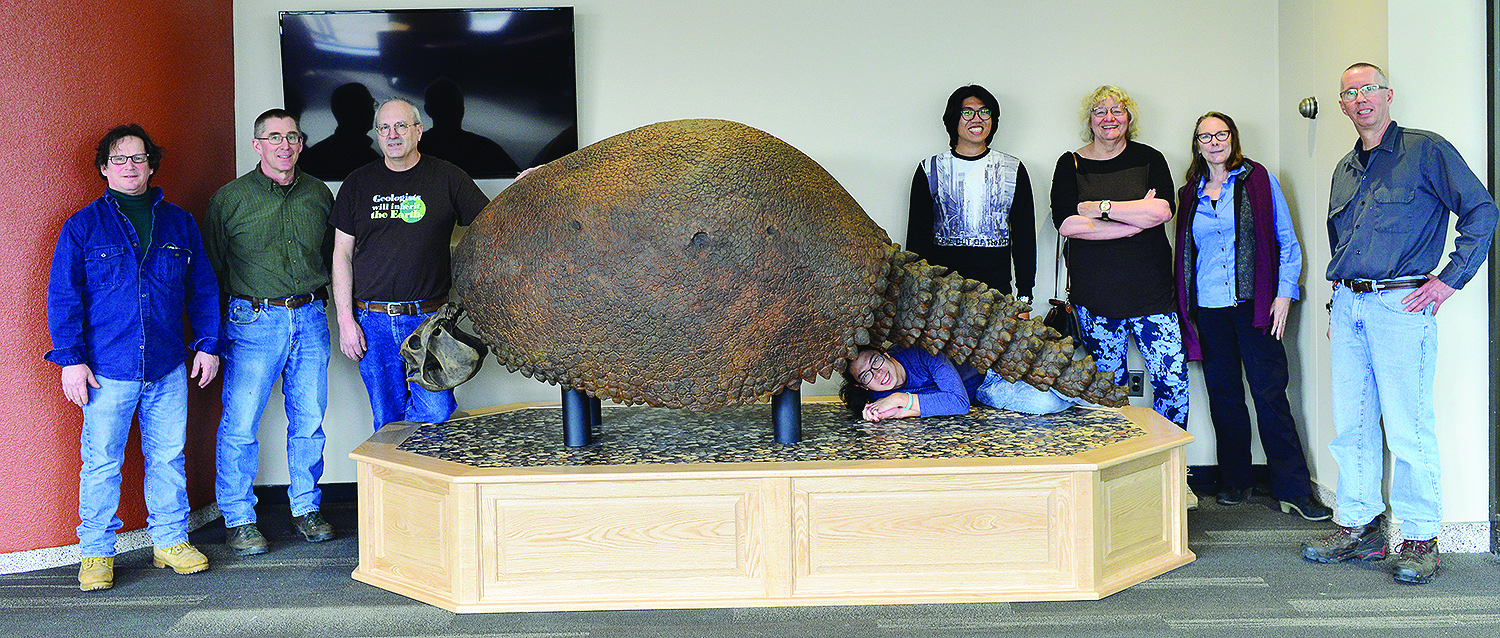
She had been residing there since 1957. That’s when the Natural History Museum in Judd Hall closed, and parts of its collections—including a whole host of fossils and geological samples—were scattered into storage spaces across campus. Foss Hill’s tunnels became home not only to the massive carapace of an armadillo-like creature now known as Shelley, but also to the enormous skull cast of a Deinotherium giganteum, an elephant-like animal whose name means “terrible beast.” Now known as Terry, she was relocated to the Exley penthouse in 1970, leaving Shelley behind. Both artifacts were retrieved in 2017, when student research fellows and faculty worked to reconstitute the old collections for Exley’s Joe Webb Peoples Museum of Natural History. Both Shelley and Terry are now on display on the first floor of Exley.
College Row’s Steam Pipe Tunnels Lose Their Steam Pipes
To the benefit of the planet, work crews replace them with more energy-efficient hot water pipes. The work in Wesleyan’s first tunnels was part of a multi-phase, campus-wide hot water conversion project that began in 2020 and involves swapping out more than 10,000 feet of old pipes. The new heating system enables Wesleyan to take advantage of current and future renewable energy technologies and contributes to the University’s larger goal of becoming carbon neutral by 2035.
New Science Building Puts World-Class Technology Where It Belongs: In the Basement
A $1.8-million nuclear magnetic resonance (NMR) device provides further evidence that the coolest research equipment at Wes is underground. Manufactured in Switzerland, the powerful 600 MHz NMR spectrometer will facilitate research into molecular structures and characteristics. The device’s sensitivity is affected by the normal vibrations of a building, hence its subterranean location. Metaphorically, though, it takes related research at Wes to the next level. Associate Professor of Chemistry Colin Smith says the device’s automation capabilities make it fast and efficient—able to analyze more samples and deliver results more quickly than older models. Even better, it makes possible lines of inquiry not previously available on campus. “We’ll be able to get data to run very advanced computational methods for determining molecular structures,” he says, “potentially more accurately than has ever been done before—hopefully in the world.”