
New Astronomy Research Explores Evolution of Planetary Systems
Billions of years ago when planets formed in our solar system, leftover debris remained, orbiting between the planets in flattened disks made of bits of ice and rock. New research on these debris disks around our Sun’s neighboring stars suggests that many features of our planetary system are shared by other systems, and that there may be more similarities to explore out there, with implications for the development of life.
“It tells us about properties of planets that we can't observe directly,” said Meredith Hughes, chair of astronomy and professor of integrative sciences. “It tells us about how planetary systems evolve at ages of 10 million years to a billion years.”
Astronomy researchers have extensive knowledge about young disks where planets are still assembling, as well as mature planetary systems around adult stars, but less is known about the period in between. In studies published in early 2025, Hughes and her colleagues got a glimpse of systems in what she described as the “adolescent” phase of development, but at a low resolution, which she said was “like looking at them without your glasses on.”
For the most recent research, Hughes’s goal was to push the study of debris disks to sharper resolution, using a program she developed with an international team of more than 50 scientists. The team is led by principal investigator (PI) Sebastian Marino from the UK, and co-PIs Hughes and Luca Matrà from Ireland. Known as ARKS (the ALMA survey to Resolve exoKuiper belt Substructures), the program uses a high-resolution instrument to observe the structure of the disks and analyze the distribution of the debris, providing the first detailed views of planetary systems in their adolescence.
To conduct the survey, Hughes and the research team used a state-of-the-art large millimeter telescope known as ALMA. This instrument—comprised of multiple house-sized antennas spread up to 15 km apart across the high desert plains of Northern Chile—captures data at radio wavelengths, which the researchers translate into an image, said Brianna Zawadzki, a postdoctoral researcher involved in the study. With this technology, the team spent more than 200 hours surveying 24 dust belts.
Key Findings
The researchers studied both the vertical and radial structure of the debris disks. They found that similar to our solar system’s Kuiper belt—a ring of icy bodies beyond the orbit of Neptune, including Pluto and its companions—most of the vertical disks have both a flat component, or classical belt, and a puffy component, or more scattered belt. “That would suggest that the early history of migration through the outskirts of our solar system could be common to many different planetary systems,” said Hughes.
Zawadzki, first author on the study on the vertical structure of the disks, noted the novelty of the research. “We were able to measure the thickness of all of the disks in the study,” she said. “Getting to have that specific scale height, that thickness, that’s something that we haven't really been able to do on a large scale before.”
The research team also examined the radial structure of the disks, or the distribution of dust outward, away from a star. Among their findings, they learned that the debris structure is largely inherited from the earlier “protoplanetary” disk phase when planets were first formed.
“I was looking at the structure, the distribution of the dust, in these debris disks to figure out things like whether there were planets present in these systems, what their histories were like, whether they migrated, and also their masses,” said co-author Elias Mansell ’24, MA ’25. He described evidence of ‘planet sculpting,’ or shaping of the disks by either migrating planets or by the planets’ gravity. “This suggests that there may be additional planets that could be detected at some point there,” he said.
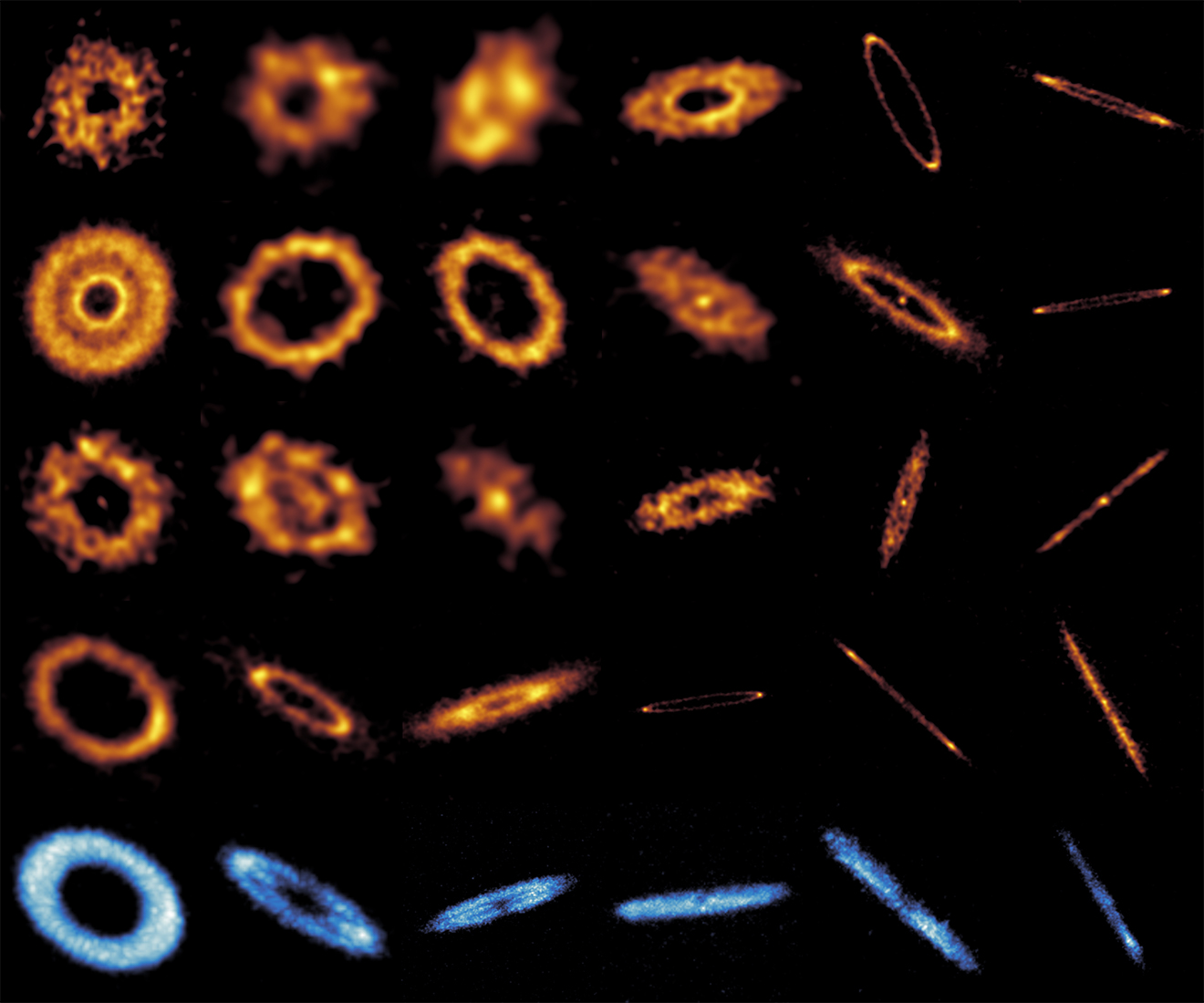
ARKS debris discs: dust (orange) and CO gas (blue). Credit: Sebastian Marino, Sorcha Mac Manamon, and the ARKS collaboration.
Anna Fehr ’23, another co-author, agreed. “Maybe planetary migration is common,” said Fehr, a doctoral candidate at Harvard who started working on the project in her senior year at Wesleyan. “That's one possibility that I think would be super exciting. The other possibility is that there's just some element of the physics that we don't yet understand.”
They also observed a population of disk structures that are much wider and smoother than typical protoplanetary disks, as well as some that contain a surprising amount of gas. “That's indicating that there is some amount of evolution in the structure of planetary systems as well,” said Hughes.
What It Means
Taken together, their findings add pieces to the puzzle of planetary systems evolution. “All of this is part of searching for the Holy Grail of planet formation,” said Hughes. “We're really trying to get at these questions of what's the diversity of outcomes of planetary systems and how does that help us understand the frequency of habitable environments in our galaxy?”
The ARKS research has uncovered some surprises, but much of its impact is in helping to identify commonalities across planetary systems. “That's reason to believe that our solar system is not that unusual, that environments where life could form and evolve are probably pretty common,” said Hughes, “and we're starting to understand common features of planetary system formation.”
The series of research papers are a partnership between more than 50 scientists at over 30 universities around the world, including eight Wesleyan student authors. The papers were published in Astronomy & Astrophysics and are available at the ARKS website.