

Study: Optimizing Indoor Wireless Communications
For years Tsampikos Kottos, the Lauren B. Dachs Professor of Science and Society, has sought to address a problem with wireless communications: the difficulty in manipulating indoor signals due to the complexity of the surrounding environment. This can lead to weaker or dropped signals that cause internet slowdowns for consumer devices like cell phones and computers, or in the case of a research lab, slower data transfers or test result readings that drag out the timelines of cutting-edge discoveries.
“Developing efficient indoor wireless protocols is crucial because they let thousands of devices share real-time data reliably, improving safety, productivity, and energy efficiency,” Kottos said. This is especially notable as the wireless communications industry is preparing for the next generation of wireless communications, or 6G, which is expected to launch in the early 2030s.
Currently, system installers—like an internet provider adding a new WiFi network to an office building—must go through a period of trial and error until they find the optimal locations for signal emitters and receivers. Oftentimes in more large-scale or complex spaces full of objects that can deflect a signal away from its target, system installers must make a full computer model of a space with measurements of the size, density, and placement of obstacles in a room. These approaches are both time consuming and inefficient, Kottos said. The systems often need to be recalibrated over time, as any changes to the furniture or decorations in a room alter the landscape for a signal to travel through.
In 2021, Kottos had thought of a framework of a solution to this conundrum but was struggling to hone the idea into a firm concept. Then he heard a talk from Steven Johnson, professor of physics at MIT, about computer algorithms that start with a desired outcome and work backwards to find the right process to achieve that outcome, and it clicked.
Kottos developed an experimental real-time approach that allows a user to control and deliver targeted electromagnetic waves in environments like an office space or data center, known as complex multi-resonant and multi-scattering systems. The proof-of-concept research was published recently in Nature Communications.
“There is an ideal computer that solves these types of complex problems exactly. What is this computer? The environment itself, the room itself, where signals propagate,” Kottos said.
Wireless Communications
Kottos’ inverse-design-informed approach leverages the complexity of the space itself by utilizing reconfigurable elements, like reconfigurable intelligent metasurfaces (RIS), and artificial intelligence schemes to determine the best path for a signal to be transmitted. Not only does his proposed physical computing protocol optimize signal delivery, but the system is scalable to a room of any size, orientation, or structure, he said.
His approach relies on RIS, which are large programmable panels made up of small pixels that can guide electromagnetic signals to targeted areas. Large wireless communications companies have begun investing in this technology and it could play a significant role in 6G technology, Kottos said. RIS can guide an electromagnetic wave to any point within a room, which gives Kottos full freedom to place signaling devices and receivers anywhere without sacrificing the requested communication modalities.
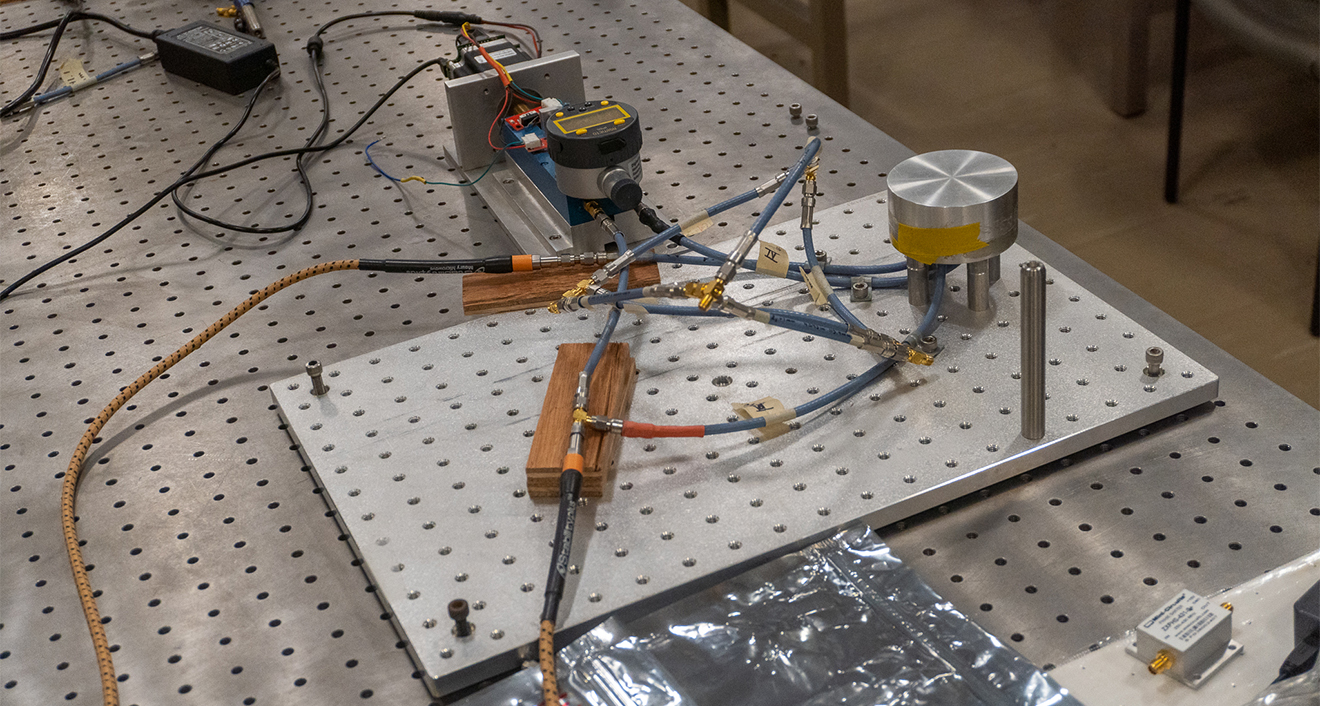
The approach is unique in that it needs minimal information on the electromagnetic environment surrounding the system and skips most of the measurements, which will help to reduce monetary, energy, and time-related costs, he said. Kottos’ methodology also requires minimal modeling, further reducing computer processing time and energy consumption.
“Every time that you make a measurement, you make mistakes,” Kottos said. “There is nothing like accurate measurement. So, the less measurements you do, the fewer mistakes you are making, the less energy you are using.”
Next Steps
Now that Kottos has a theoretical framework backed by a physical demonstration of his concept, his team plans to focus on building a prototype over the next four years. Kottos said this methodology can be applied to other wave-related frameworks, like seismic wave management systems, atmospheric imaging, and medical imaging technology.
Kottos’ approach was developed in collaboration with Zin Lin ’12, assistant professor of electrical and computer engineering at Virginia Tech, Wesleyan graduate student John Guillamon and the Wesleyan postdoctoral associate ChengZhen Wang.