
Wesleyan in the News: December 2025/January 2026
Michael S. Roth ’78 appeared on MS NOW’s Velshi on Jan. 18 for a segment on scholars and students protesting in support of Palestine who were detained by the Trump administration without being charged for a crime. Roth said, “this is an aberration, and we have to call it out and name it as such, because otherwise it gets normalized.”
Roth reviewed former Columbia University president Lee Bollinger’s new book University: A Reckoning for The Washington Post. The book discusses the First Amendment and the unique role of the university as a place that offers students opportunities to advance their knowledge. “Given the authoritarian push by the current administration, we need universities and colleges to address their flaws, and to recommit to an educational mission that serves their students and our country,” Roth wrote.
Roth also wrote about the dangers of flattery and sycophancy in The Washington Post as artificial intelligence platforms have shown a tendency to praise their users regardless of the situation at hand—even in scenarios of self-harm. “Sycophancy may spread like an epidemic, but so can efforts to practice freedom by telling people things they don’t want to hear,” Roth wrote. “This will require less fawning and more fortitude — on campus and beyond. Nothing artificial required.”
Roth joined Fast Politics with Molly Jong-Fast on Dec. 25 to discuss how universities are pushing back against President Donald Trump’s administration and its efforts to regulate higher education. “I think we just need allies to remind people that democracy can be destroyed and that rights can be quickly eroded,” Roth said. “People get used to seeing soldiers in the streets… If you get used to the government intervening in the classroom, lots of other things will change.”
Sadia Shepard, assistant professor of film studies and Global South Asian Studies, published a fictional short story in The New Yorker, “Kim’s Game.” She also discussed the piece in an interview for The New Yorker’s Books and Fiction newsletter and narrated the piece for the publication’s The Writer’s Voice podcast.
Zachary Fine, postdoctoral fellow in criticism, wrote a piece on Finnish painter Helen Schjerfbeck for The New Yorker on Jan. 19. Schjerfbeck's work is on exhibit at The Metropolitan Museum of Art.
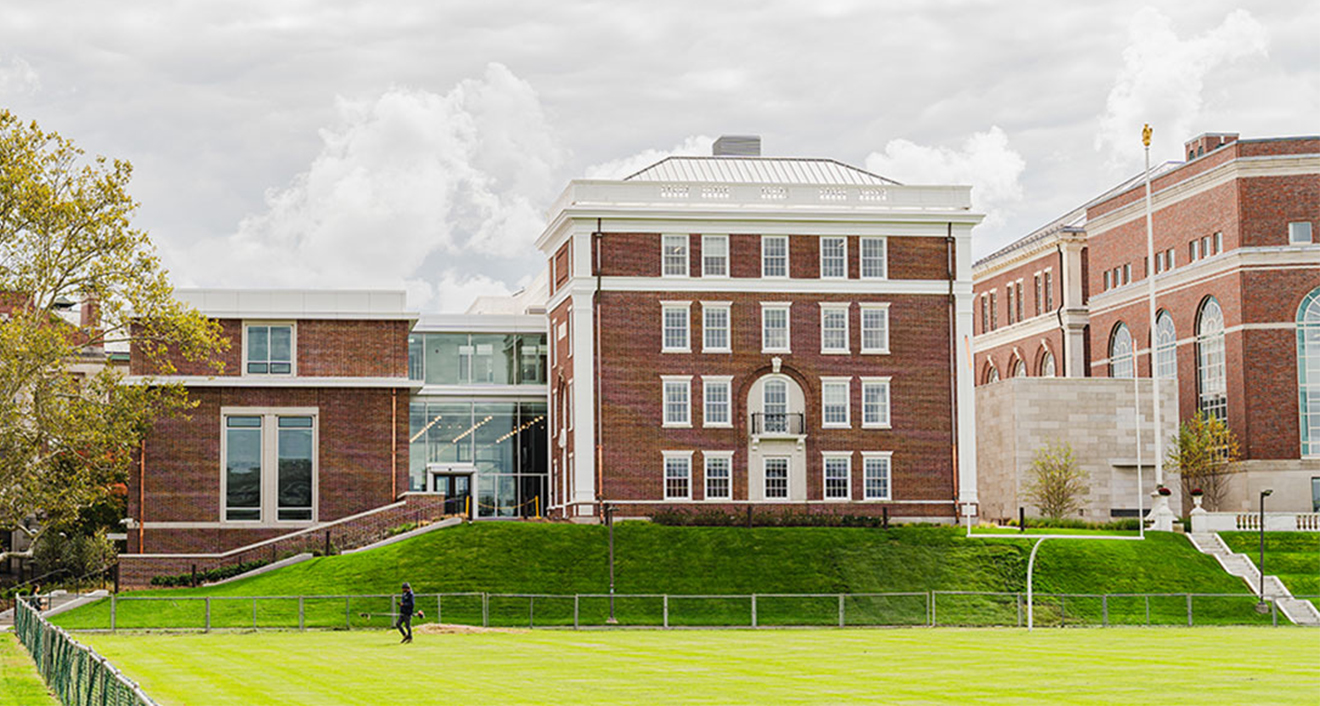
Wesleyan’s new science building, which is set to open in the Fall 2026, was highlighted in a CT Insider story on upcoming development in Middletown. While the federal government is reducing investment in science and research, Roth said, “we still have that confidence at Wesleyan. Our new life sciences building expresses our core belief that research and teaching will lead to discoveries that improve lives while helping us understand the world we live in.”
Mary-Jane Rubenstein, dean of social sciences, professor of religion, and professor of Science and Technology Studies, appeared on Marketplace’s “Morning Report” on Dec. 5 for an episode on the lunar economy. Rubenstein outlined the current rules and some ethical concerns with development on the moon.
Rubenstein also spoke with TechCrunch for a story on the ethics of potential corporate expansion into space, including the fate of worker conditions and who has a right to claim ownership of land in space. “Workers already have a hard enough time on Earth paying their bills and keeping themselves safe . . . and insured,” Rubenstein said. “And that dependence on our employers only increases dramatically when one is dependent on one’s employer not just for a paycheck and sometimes for health care, but also for basic access, to food and to water – and also to air.”
NPR interviewed Associate Professor of Sociology Robyn Autry for a story on why the public gravitates toward the same Christmas songs every year. “Adding something new interferes with the dance people do every year [during the holiday season] ... the tug between remembering and forgetting,” Autry said.
Daniel Steinmetz-Jenkins, assistant professor of history in the College of Social Studies, started Of This World, a monthly podcast with Commonweal on religion and politics. The first episode covered David Hollinger’s book Christianity’s American Fate: How Religion Became More Conservative and Society More Secular.
PoliticsNY published a question-and-answer piece with Phoebe Boyer ’89, P’19, ’23, chair of the Board of Trustees and president and CEO of Children’s Aid, and many other leading figures in the city’s nonprofit space. Boyer outlined the organization’s upcoming goals and gave advice for people looking to start out in the non-profit field.
The New York Times wrote a piece on the calorie as a measurement of nutrition and noted its invention at Wesleyan by Wilbur Atwater in the 1880s.
Ian Bassin ’98, Hon. ’25, founder of the legal advocacy group Protect Democracy, was quoted in a New York Times Opinion piece on instances of public resistance to the Trump administration. One of those forms of resistance has been through the court system, as a handful of grand juries declined to indict protestors and former federal prosecutors. “I think you’re seeing reinvigorated grand jury processes,” Bassin said. “Nobody actually knows what’s going on in those grand juries, but the outcome of them seems to suggest that people are actually holding the government’s feet to the fire and being unwilling to simply be a rubber stamp.”
New York City Mayor Zohran Mamdani named Leila Bozorg ’04 as deputy mayor for housing and planning, according to The New York Times. “When you can’t afford a home — so many of our neighbors cannot — you cannot fathom a life of dignity and security,” said Bozorg, who served as director of housing under former Mayor Eric Adams. “Everything depends on stable housing.”
Lin-Manuel Miranda ’02, Hon. ’15 appeared on The Lonely Island and Seth Meyers Podcast with musician Questlove to decide which Saturday Night Live shorts were best.
Adam Berinsky ’92, a political science professor at Massachusetts Institute of Technology, teaches a class on misinformation on social media with units on artificial intelligence. “A.I. is everywhere these days,” he told The New York Times. “I adjusted teaching accordingly.”
“Track Star,” a viral music show hosted by Jack Coyne ’13, was featured in The New York Times. Coyne was also profiled by The Telegraph. During the show, Coyne has guests listen to songs and guess the names of the artists that create them on the spot. “We are tricking people into telling a story,” Coyne told the Times. “They’re listening to something, they get fired up, and then they get to talk about it.”
The New York Times also profiled Jeff Galloway ’67, a long-distance runner who pioneered a method that made running marathons easier. Galloway, now 80, is setting out to run another marathon, which could make him the first person to do so for eight consecutive decades, the Times said. Galloway said, “doing another marathon, to me, feels like the strongest goal I’ve ever had in my life.” Bill Rodgers ’70 and Amby Burfoot ’68 were quoted in the piece as well.
Gary Yohe, Huffington Professor of economics and the environment, wrote about dogmatic arguments against climate change over the last 40 years in The Conversation and ways to reach people that dismiss climate science. “The shift in public perceptions of climate risks leaves me hopeful that more people are acknowledging the scientific understanding of climate change and catching up with the climate scientists who have produced, questioned, reexamined and reaffirmed their findings through rigorous application of the scientific method.”
Yohe wrote another piece for The Conversation on the Trump administration’s decision to pull out of the United Nations Framework Convention on Climate Change, a global climate treaty, on Jan. 7. Yohe wrote, “the administration’s moves enunciated clearly its strategy to discredit concerns about climate change at the same time it promotes greater production of fossil fuels. It’s ‘damn the torpedoes, full speed ahead!’ with little consideration for what’s at risk.”
Peter Rutland, Colin and Nancy Campbell Professor in Global Issues and Democratic Thought, wrote a piece for Transitions on a new documentary Mr. Nobody Against Putin, which provides insights in how Russian society is responding to the war in Ukraine. “The film is a unique document showing life in an authoritarian regime girding itself for war,” Rutland wrote.
The Baltimore Banner interviewed Peter Gottschalk, professor of religion, during a recent tour of the NS Savannah, a retired nuclear-powered passenger ship. “This vessel was made to be, really, a symbol of the promise of a better tomorrow,” he said.
Trustee Aaron Veerasuntharam ’14 received an Education and Career Mobility Fellowship from The Aspen Institute for the upcoming year.