
Student-Founded NGO Fosters Entrepreneurship in Ghana
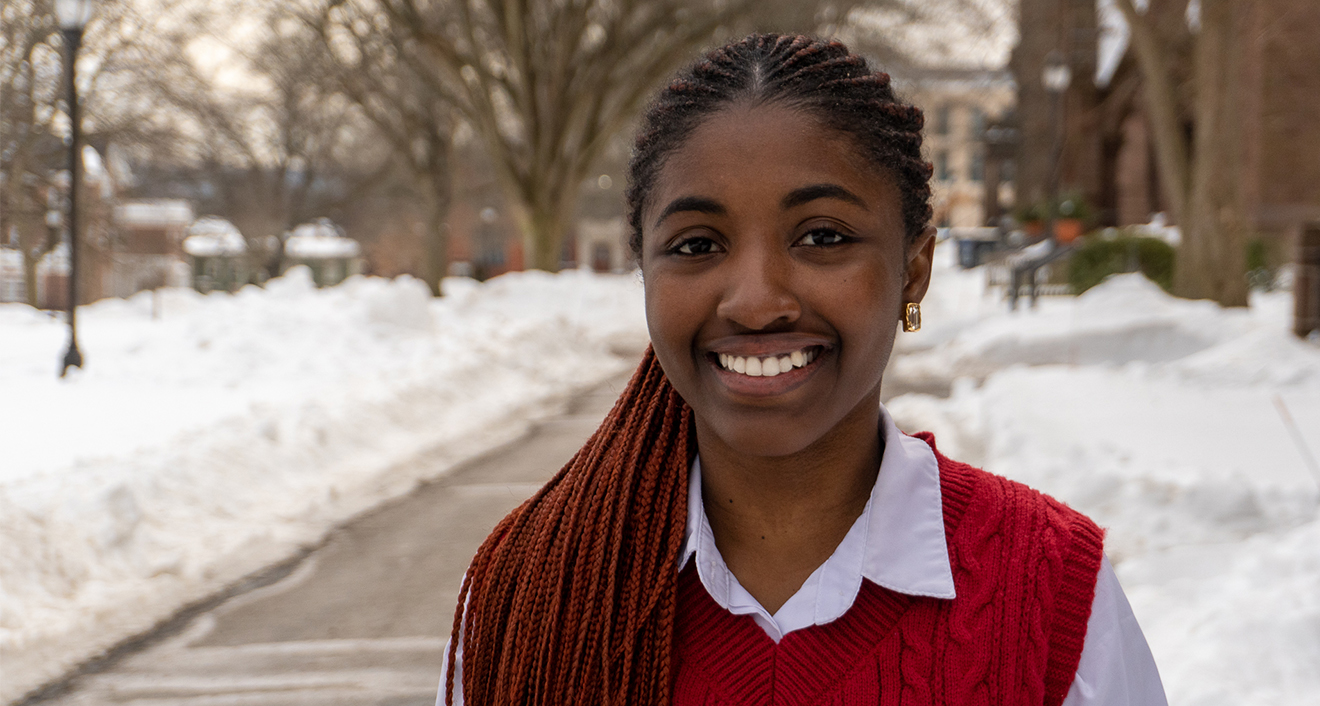
When Lois Amponsah ’27 was a child growing up in Ghana, her father lost his job, forcing the family to move to a rural area. Their new home initially lacked electricity and she recalled leaving school early to avoid returning to a dark home. While her family’s situation improved, the experience left an impression that influences her today. “That is what inspired me to work specifically in unemployment that affects a lot of families in Ghana,” she said.
Winner of the 2026 Davis Projects for Peacegrant, administered by the Patricelli Center for Entrepreneurship, Amponsah continues to focus on addressing unemployment in Ghana, which affects one third of young adults in the West African nation, as a means to alleviating poverty and promoting peace. With the $10,000 grant award, she can expand the reach of Wings of Change, the nongovernmental organization (NGO) she launched in 2023 to empower youth and communities in Ghana through education, entrepreneurship, and innovation.
“The committee selected Lois because she has consistently demonstrated both the vision and the capability to lead meaningful entrepreneurial initiatives in Ghana and to build the infrastructure needed to support them,” said Patricelli Center Director Ahmed Badr. “Her New Venture Award in 2025 was a strong affirmation of the impact and promise of her work, and the Davis Projects grant represents a continued investment in how she has built on that success. At this critical point in her work, Lois is uniquely positioned to make a real difference in strengthening Ghana’s entrepreneurial ecosystem.”
Through its entrepreneurship fellowship program, Wings of Change works with school leaders and partners to identify and train 30 youth from underserved and remote regions in Ghana to turn their ideas into businesses or income-generating opportunities. It accomplishes this mission by providing business workshops, site visits to local businesses, and mentorship.
“It's a fellowship where we bring in student entrepreneurs with little or no skills,” she said, “and then we train [them in] entrepreneurial skills based on mentors and teachers we connect them with.”
Through workshops taught by expert practitioners, student fellows learn about bookkeeping, marketing, proposal writing, pitching, and engaging investors. They participate in interactive site visits at local companies. Wings of Change partners—including the Young Achievers Foundation Ghana, American Field Service Ghana, and Kwame Nkrumah University of Science and Technology’s Medical Student Association and Health Student Association—also match fellows with mentors in their chosen industries.
With the grant, Amponsah plans to scale the reach of the fellowship program beyond the Ashanti region to all 16 regions of Ghana. “To improve access and equity, I want to tour all the other regions in the country, go to all the other high schools, visit the institutions, talk about the program, educate people on entrepreneurial skills, and then … connect with more students and more institutions,” she said. At the end of the program, the fellows will compete for a startup fund.
Amponsah believes that entrepreneurship is a critical skill for young people in Ghana due to high unemployment and the theoretical nature of the secondary education system, which may not translate into economic empowerment. “With entrepreneurship, you don't necessarily have to be employed by someone,” she said. “You can start something by yourself and then you can employ others.”
An example of a venture that Wings of Change has supported is Edible Treats, a family business that manufactures chocolate. This business caught Amponsah’s eye because Ghana is the second largest producer of cocoa, but not a major producer of the chocolate made from cocoa. “We have to always import it from another country,” she said, which incurs an import tax. “And so, in effect, we get nothing from our cocoa because we don't add value to the cocoa.” Edible Treats seeks to change that and is one of the more exciting companies Wings of Change has worked with, she said.
At Wesleyan, Amponsah continues to build on her education and skills in entrepreneurship through coursework and Student Forums like Map the System, where she learned to deeply analyze problems, and Shark Tank, where students practice pitching their ideas to investors. She is also learning about strategies such as storytelling, fundraising, and marketing through a fellowship with the Patricelli Center’s Entrepreneur-in-Residence Shiv Soin.
While Amponsah is majoring in neuroscience and plans to go to medical school, Wesleyan’s liberal arts approach has also nurtured her entrepreneurial vision.
“Entrepreneurs need to be well-rounded individuals,” she said. “Entrepreneurship is more than just the mathematics of doing a business or calculation. It also includes being able to convince people, being able to have the soft skills, communicate, and form partnerships.”
After Wesleyan, Amponsah foresees continuing to strengthen Wings of Change by hiring a strong team to run it while she is abroad. “I'm definitely going to build Wings of Change,” she said. “My hope is to make it one of the leading organizations and companies in Ghana.”
Davis Projects for Peace – Alternate Winner
This year, the Davis Projects for Peace also selected an alternate winner, Dragos Geica ’28. He is working with Alacrity Education, a youth-led NGO for environmental advocacy and STEAM education in Romania, to address the silent conflict of environmental negligence. The project's main goal is to promote data transparency and environmental responsibility by training students to identify and analyze environmental threats and contribute to a fairer, healthier society through community-based science.
Learn more about Davis Projects for Peace.