
MLK Luncheon Highlights Fighting Poverty, Self-Interrogation
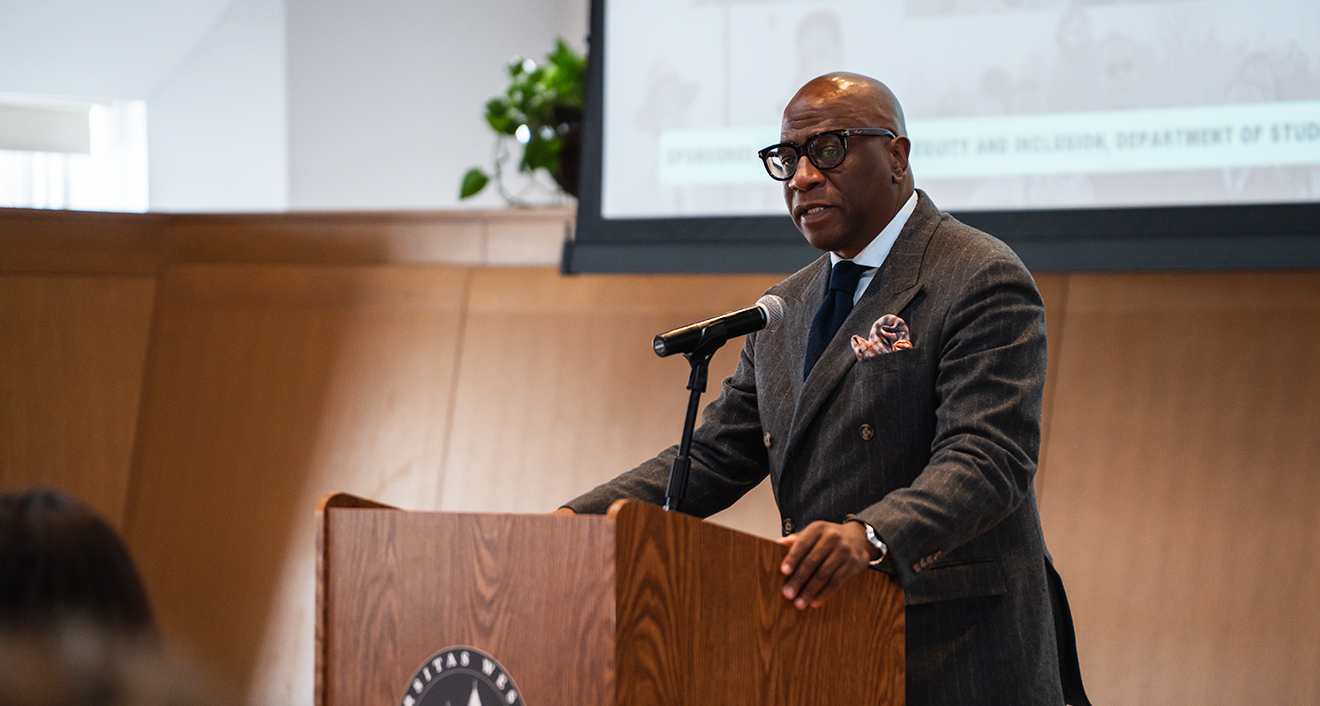
Nearly 60 years after Rev. Martin Luther King Jr. was killed, his message and the days after his assassination still reverberate in our collective memories. Willette Burnham-Williams, vice president of equity and inclusion, distinctly remembers the days surrounding his death. During Wesleyan's 19th annual luncheon honoring King's legacy, she briefly shared her experiences then as a young student at an all-Black, segregated school in Williamsburg County, South Carolina.
"The day after he was assassinated, we didn't have school. We were all summoned to the cafeteria, and there we stayed," she said. "We prayed, we sang, we consoled, and we thought about what the future would be without that great leader. Here we are in 2026, doing much of the same."
Burnham-Williams was the first speaker at the luncheon on Feb. 11, an event highlighted by a keynote address from Erik Clemons, the founding CEO and president of two New Haven-based organizations offering job training, youth programs, and economic development to the community. Clemons's talk focused on his work to fight poverty in New Haven and the lessons he's taken from King and others on self-interrogation.
Fighting Poverty
Alongside his two organizations, Connecticut Center for Arts and Technology (ConnCAT) and Connecticut Community Outreach and Rehabilitation Program (ConnCORP), Clemons leads a $200 million development project in the Dixwell neighborhood of New Haven that will bring $1 billion in value and 700 jobs to the community, he said. When starting the project, he began with the goal of building economic infrastructure for the community but did not want to prescribe what Dixwell residents needed. So he attended as many community meetings as he could and met with residents to determine what gaps his project could fill for the area.
"I wanted to hear what the folks in Dixwell wanted, what they needed, and what they yearn for," Clemons said. "What are those things that you want? Because the last thing we would want to do is deliver what we think you should have."
He kept hearing four things: Locals wanted to improve safety, quality early childcare, fresh food, and the revival of arts and culture in their neighborhood. Clemons listened and worked with a Black-owned real estate development firm to design an 8-acre complex featuring a headquarters for ConnCAT and ConnCORP, a childcare center, an art gallery, a performing arts center, over 180 housing units, retail spaces for Black entrepreneurs, a 15-restaurant food mall, a grocery store, and greenhouses.
Self-Interrogation
Clemons highlighted three people who have made him look inward recently: a young, unhoused woman who died in the basement of a building marked for demolition within his development project in New Haven, a park ranger who famously moved King's microphone during the "I Have a Dream" speech, and Clemons's late mother.
Clemons said he did not talk about the New Haven woman publicly for over two years in fear that her death would affect the work he was doing, but his silence weighed on his conscience. He eventually reversed course, taking partial inspiration from King's "Beyond Vietnam" speech, where King came out against the Vietnam War because of his conscience.
After finding out more about the woman's life and community ties, Clemons now honors her memory in the way he said he should have two-and-a-half years ago, by talking about her. "It was an incredible moment for me because it made me really look at true self-interrogation, which I hope creates self-discovery that who I become is not who I want to be," Clemons said.
Another person Clemons highlighted was Gordon "Gunny" Gundrum, a ranger for the National Park Service who guarded King during his "I Have a Dream" speech. Gundrum noticed King's microphone was too high and the crowd was struggling to hear and see him, so he moved King’s microphone down. Clemons said he's had Gundrum's choice on his mind recently, and in turn asked the audience, "how many times have you created a way for people to be seen and heard at the same time?"
Finally, he pointed to a moment with his mother in the weeks before her passing from dementia and cancer in January. He read to her and she quietly listened along, until she stopped him with a distinct clarity and asked, "Erik, are you being honest?" He challenged the audience to consider the same question as they continue in life, in the same way King spoke up when his conscience would no longer allow him to stay silent.