
Cornel West and Robert P. George on Civil Debate and Democracy
To answer a question about how educators can encourage connectivity and dialogue among students who disagree, Robert P. George, McCormick Professor of Jurisprudence at Princeton University, told a story. He harkened back to a first-year student seminar that he co-taught decades earlier with Cornel West Hon '93, now the Dietrich Bonhoeffer Chair at Union Theological Seminary, while they were both at Princeton.
George recalled a student, who while “earnest, sincere, well-intentioned,” would often “speak in the lingo, with the tropes and the language of the progressive side of these things.” After the student spoke one day, West did not wait for George, the conservative, to challenge him. Instead “Cornel was like Socrates in the City of Athens,” George recalled, “confronting the kid, asking him the hard questions, forcing him to reflect on an ideology, having kind of picked it up, as opposed to having fought his way into these things and raising those questions.”
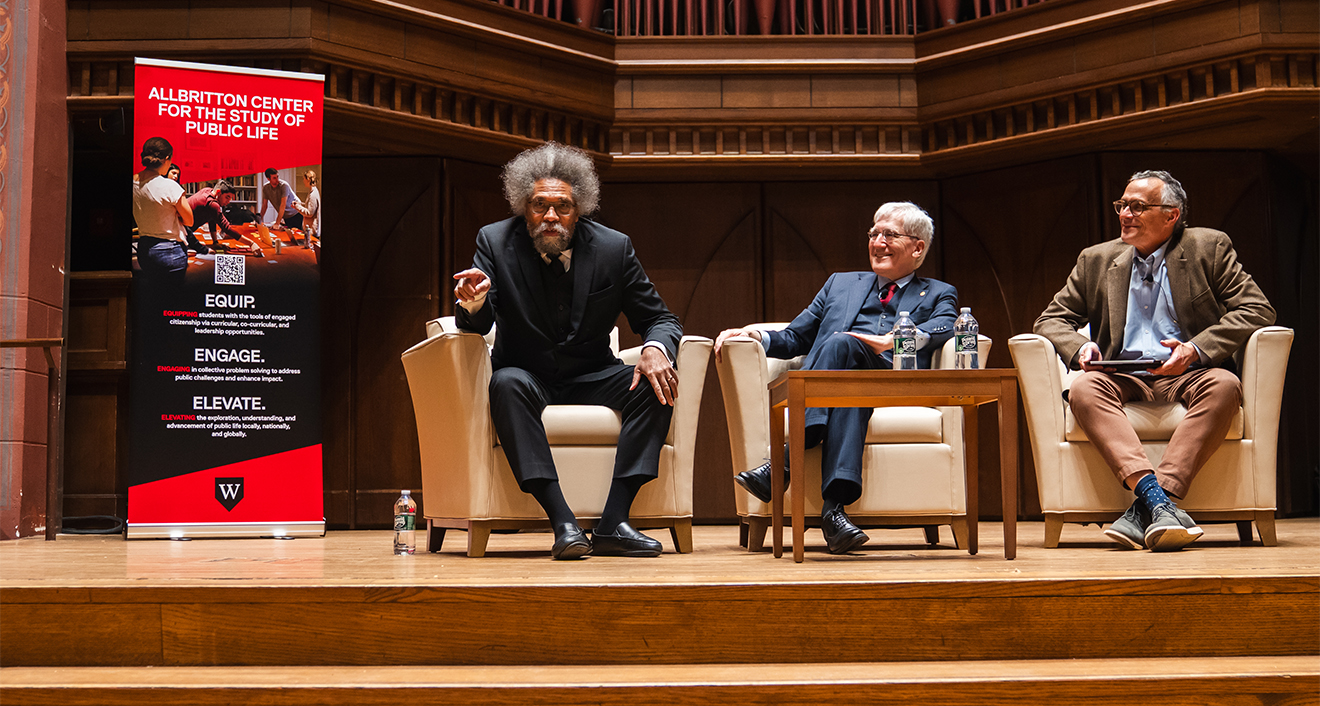
That anecdote was an example of the pursuit of truth that George and West have modeled for years and promoted during the Hugo L. Black Lecture on Freedom of Expression on Friday, March 27, in Wesleyan’s Memorial Chapel. They had come to campus to participate in a conversation about freedom of expression, truth, and democratic life—a practice that the two friends have been engaged in for years despite being on opposite sides of the political spectrum.
With President Michael S. Roth ’78 prompting them with questions, George and West spent over an hour reminiscing about their shared vision for honest dialogue and how it led to their series of lectures and their new book, Truth Matters: A Dialogue on Fruitful Disagreement in an Age of Division.
George detailed how in the ‘90s, West interviewed him for a student publication. What was supposed to be an hourlong interview morphed into a robust debate about politics, philosophy, and religion, among other topics. That stimulating interview led to their seminar and many years of continued conversation, teaching, writing, praying, and even singing together.
In describing what drew them to each other, George pointed to the fact that West would often steer academic discussions that veered into the technical back to the topic at hand, which might be justice, virtue, or liberty. West, for his part, had admired George from afar and came to view him as “committed to integrity, honesty, decency, courage, and trying to be consistent. And this brother is a brother of integrity,” he said.
They also shared, George said, a dedication to seeking the truth. Because of “that commitment to trying to get at the truth of things, both of us recognize that we cannot allow ourselves to fall so deeply in love with our opinions that we prefer them to truth.” Getting too emotionally invested in our opinions can lead to dogmatism, he said.
In response to a question from Roth about how he’s viewed students’ ability to talk across differences over time, West described the role of higher education at a time of democratic fragility. Students come to these institutions, he said, shaped by their families and communities and with “their desires for protection and association and recognition.” Yet, he said, “we say we're going to take those desires and try to transform them, building on the best of what they bring, so that they can become persons who cultivate the capacity for critical thinking and have the courage to think freely.”
Cultivating civic engagement
Toward the end of the discussion, President Roth described Wesleyan’s efforts to strengthen democratic culture, including the summer program supporting students to work on campaigns and the midterm elections. “We're agnostic of who they work for or what side they choose,” Roth said. “We really want to make a contribution to the civic friendship in the heart of society by animating students, not just at Wesleyan, but all over the country, to park their cynicism about the corruption of our system, the challenges of the system, and to engage in it.”
In response to the initiative, West invoked the tradition of jazz music. “I say to these young folk, have the courage to lift your voice. But keep in mind that voting is not the only way to lift your voice. Voting is very important, but it's not enough. You lift your voice in every context—in the civic context; if you're religious, in your religious context; if you're in the sports, in the sports context; if you're an artist in the artistic context.”
George praised the idea but with a cautionary note. “As we try to encourage participation to combat cynicism, let's try to be very careful to avoid falling into the opposite vice of tribalism,” he said. “It's in that engagement with people who challenge us that we overcome that spirit of tribalism, which is so destructive to truth-seeking, and at the end of the day, as we're seeing right now, to democracy.”
A student attendee agreed. Molly Volker ’26, theater and Feminist, Gender, and Sexuality Studies double major, was interested in hearing from West after reading some of his writing in class. “I really appreciated hearing Dr. West be able to have that openness while still be so strongly rooted in his convictions and values,” Volker said. “Watching that balance and seeing those two things exist at the same time was inspiring.”
Growing up in a conservative-leaning suburb of Nashville, the left-leaning Volker expressed difficulty participating in discussions with fellow classmates during her earlier schooling—she said she had a hard time deciding who was trustworthy to engage in fair dialogue with. During the Q&A period after the lecture, she asked the panel how to handle conversations with unfaithful actors.
“I think what I'm taking away has more to do with myself in those conversations,” Volker said. “It's definitely true that when you're a person of conviction with such strong feelings about your opinions that it's easy to love your opinions more than you love the truth. That’s something that they both said that really resonated with me.”
This lecture is part of Renewing Democracy’s Promise, Wesleyan’s three-year initiative to strengthen democratic culture at a moment when polarization is testing communities across the nation.
The Hugo L. Black annual lecture is designed to bring to the Wesleyan campus public figures and scholars with experience and expertise in matters related to the First Amendment and freedom of expression. This lecture is endowed by Leonard S. Halpert ’44 (1922–2017), who believed that the First Amendment to the US Constitution is the basis upon which we enjoy all other Civil Rights. This lecture is named in honor of U.S. Supreme Court Justice Hugo L. Black.