
Theater as a Lab for Citizenship
Can the practice of acting help to develop skills of understanding and deliberation that are needed to navigate difficult political questions and effect change?
That question was posed by Professor of Government Sonali Chakravarti and Brooklyn-based director and producer Awoye Timpo during a discussion about the genesis and evolution of their class, GOVT 397, “Acting and Citizenship,” which explored how the theater can be a laboratory of democracy in troubling political times. Their talk took place on April 23 in the Usdan University Center and was co-sponsored by the Allbritton Center for the Study of Public Life.
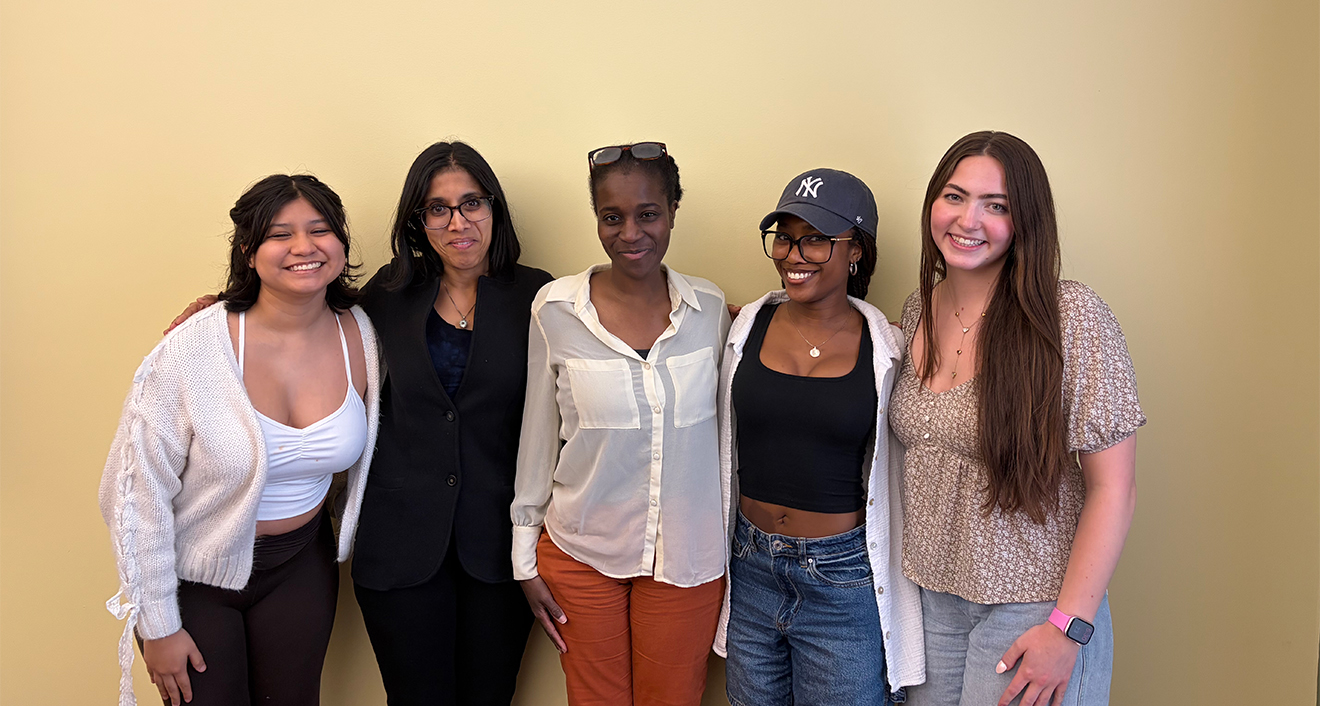
Timpo and Chakravarti went to elementary school totgether in New Jersey but had never collaborated on teaching together before this spring. “I wanted a different way of thinking about my area of political theory, and the questions facing democracy, and I thought that using plays and acting would be a way to activate these questions and make them come alive in a different way,” Chakravarti said. Her focus is on public participation in legal institutions, including the jury system, and the relationship between law and politics.
“How do we tell stories about these things that we're researching?” Timpo asked. “How does that relate to the systems that currently exist, that we think and hope we want to change? It feels like our work as theater makers is so much about life overall and the ways that all these things intersect.”
Drawing on texts from the history of political thought, theater studies, and the psychology of acting, the course was cross-listed with the Theater Department and linked the performance and spectacle of theater to the expectations and demands of democratic citizenship.
Chakravarti said she thought there was a natural connection to using the theatrical form to think about these issues. "I think I've always had the sense that citizenship is itself a type of script, and that it's useful to see it that way, because then maybe I can believe that there are possibilities that you don't have in other parts of your life," Chakravarti said. "I think stepping into a role as juror, as a citizen, is a source of possibility and a sense of dignity and mission."
“As we're making plays, we really think about ‘what's everybody's role here?’” Timpo said. “What's your role inside of the story? What's our role as storytellers inside of the larger society and how can we activate questions for other people?”
The course was supported by the Creative Campus Initiative of the Center for the Arts, which supports cross-disciplinary collaborations that center the arts as a way of teaching, learning, and knowing.
Timpo was excited to work with the interdisciplinary class, and led four workshops, including story exchange exercises. She praised the students’ curiosity and spirit of adventure. “It requires so much openness and vulnerability,” Timpo said.
Chakravarti said she appreciated how reading the plays and going through scenes allowed her to slow down the process of thinking about politics and sit with different emotional moments. “It feels like in this current moment, things are coming at us so fast and we have so many different reactions,” Chakravarti said. “I was very much in need of a place to process some of the political emotions that I'm experiencing in the context of these plays.”
Jasmine Donald '28, a government major and Human Rights Advocacy minor, said the course helped her look at political theory in a different way. "Being a performer myself, doing these performance workshops where we had to act and take on the role of someone else, that's where I really got the opportunity to look at the bigger picture."
Donald described her experience portraying U.S. Air Force veteran and former NSA translator Reality Winner in Tina Satter's play Is This a Room about Winner's FBI interrogation. “I had to really sit and try to work through all the different things that were at stake for her,” Donald said. “That's a political conversation that I'm having internally as I'm working through this piece. I don't think I would have had any way of looking at those works in that lens if it weren't for this class. I feel like this class was able to really expand my breadth of knowledge.”
Some of the other works the class explored included the plays Twilight: Los Angeles,1992 by Anna Deavere Smith Hon. ’97, which was about the aftermath of the L.A. riots, James Graham’s Punch about restorative justice, and Reginald Rose’s Twelve Angry Men about jury deliberations in a homicide trial. Chakravarti and Timpo said all the plays were chosen because they look at political life and democracy from different angles over time.
Chakravarti said the class discussed how the rise of Smith's method of verbatim theater in the '90s was coming from a more hopeful moment of what was possible in terms of theater leading engaged viewers to change their political lives, and that now we're in a much more cynical moment. "We talked about what might be the theatrical responses to the current moment," Chakravarti said. “One of the themes that we kept coming back to was that in politics as in acting, people want and need something to do. In a democracy, we want clear ways to be involved.”
Donald said after taking this class she felt more empowered, and that she has more agency to mobilize with others that want to work for political change. “This class really helped me to realize that there are ways that I can do that without feeling entirely powerless,” Donald said. “It's really about finding our own voice in this form of government, when someone like me feels so silenced.”