
New Finance Research Lab Studies Stablecoins
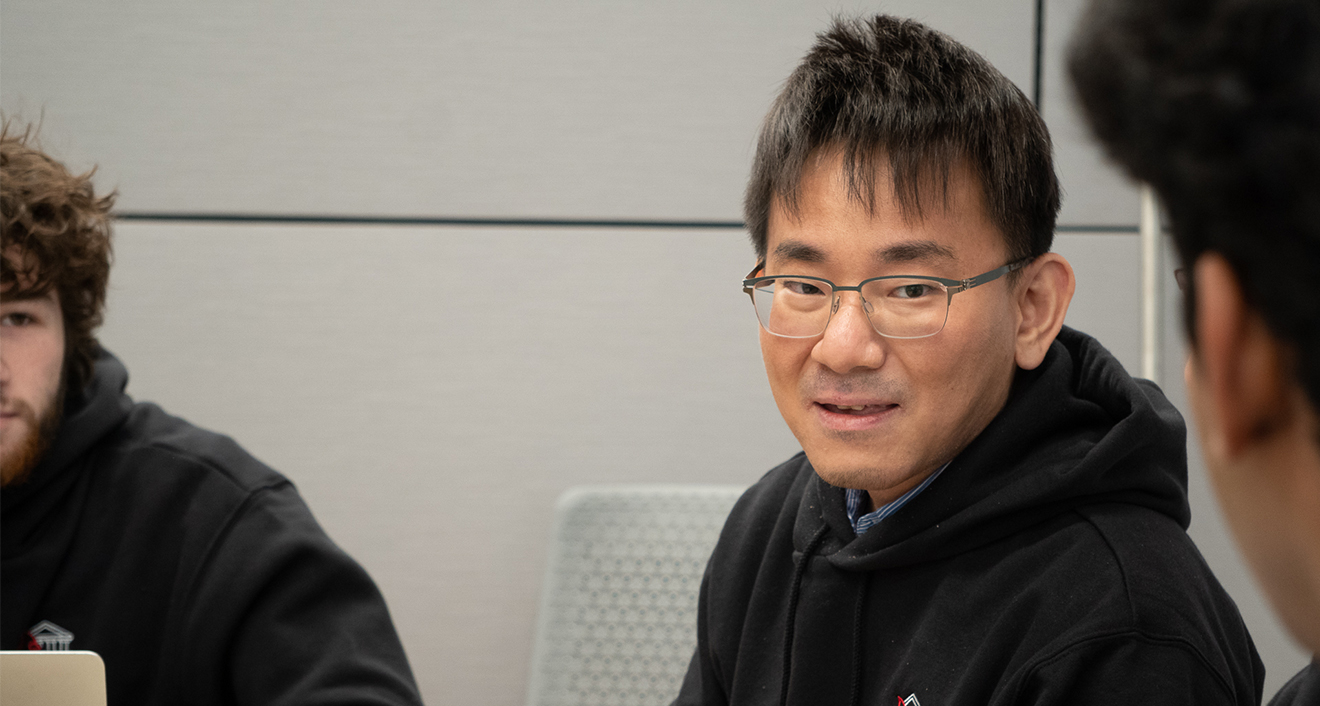
A group of students meet each week in the Frank Center to discuss their economic research as part of Wesleyan’s Financial Intermediation Research Lab (FiLab)—a new research hub that offers students an opportunity to study money, banking, and payments in an era of digitization.
Assistant Professor of Economics Ryuichiro Izumi started FiLab in the fall to offer students a space to collaboratively study a constantly changing global digital financial system. Izumi said he anchors the lab’s agenda to topics currently being discussed by the Federal Reserve, like stablecoins, which is this year’s FiLab theme.
“I think research is a great way, if not the best way, to deepen their understanding and activate their knowledge,” said Izumi, who researches the causes of financial fragility, or the risks posed to the banking system, and ways to improve the efficiency of the system.
Wesley Tan ’26 has focused his senior thesis research on how stablecoins—cryptocurrencies whose value is tied to real-life currency like the U.S. dollar—can be designed more effectively. While many cryptocurrencies, like Bitcoin and Ethereum, can be volatile assets, stablecoins are meant to be safer investments issued by companies whose holdings are low risk, like government bonds. However, selling these investments can be more difficult, which can create a cash flow problem for stablecoin companies if their users decide to sell their stablecoins en masse.
Tan is building an economic model to examine what policy interventions could address this concern. He was one of three Wesleyan seniors to present economic research at the 2026 Alliance to Advance Liberal Arts Colleges (AALAC) Workshop on Monetary Economics in the Digital Era at Grinnell College from March 6 to 8. “The conference reinforced how tightly connected academic research, industry, and institutions like the Federal Reserve actually are,” Tan said. “The conversations happening in conference rooms are the same ones shaping real regulatory decisions, and that makes the work feel meaningful in a way that goes beyond the classroom.”
This connection between policy and research is a bedrock in which the FiLab sits. The FiLab is investigating the benefits and risks stablecoins may pose, such as instability from stablecoin issuers, applications of payment structure, and the efficiency of stablecoin arrangements with governments. One potential benefit is the elimination of third-party companies who charge fees on credit card transactions, which have a cascading effect on the price of all goods, by using stablecoins as payment. Izumi said cash users end up paying extra because businesses in some states cannot charge different prices based on a customer’s payment method, so cash users pay for the fees charged to credit card holders without receiving the benefits that come with credit card purchases.
“There are only four major companies providing payment network; they charge massive fees and are frequently the target of lawsuits,” Izumi said. “Through decentralization and blockchain, maybe we can eliminate these third parties, like VISA and Mastercard, or stimulate competition so that they lower their fees. Currently the fees are too high and are a burden on consumers.”
Modeling Real Life Scenarios
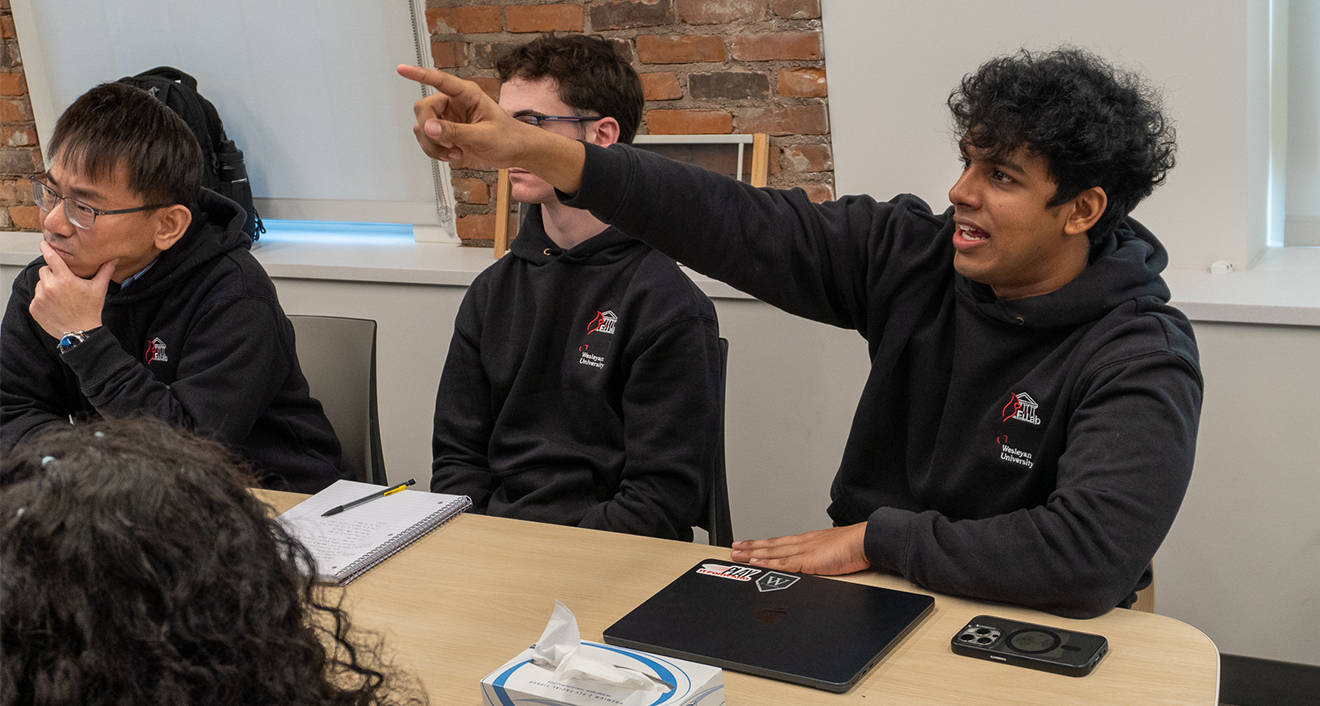
Like Tan, Kaustubh Vasudevan ’26, an economics and mathematics double-major, is also building an economic model for his senior thesis research. Vasudevan is modeling out what a run—when there is a rush of users who sell an asset or try to withdraw their money from a bank—on stablecoins would look like.
“When you're trying to build a model, you're essentially just trying to create a set of equations and scenarios that reflect reality,” said Vasudevan, FiLab student leader. “It's very important that you have multiple perspectives to keep you in line, to help you really focus on your ultimate vision. I think that's where the iterative aspect of having the lab every week really helps.”
Anthony Ganci ’28, an economics and mathematics double-major, joined the lab this year after studying market reactions to polling data from the 2024 presidential election through the Quantitative Analysis Center (QAC) last summer. Later in the spring he plans to start researching corporate use-cases for stablecoins with Izumi.
“Everyone else is a senior, so I can watch them go through the process. I get to see them work through their problems in a nonlinear way,” Ganci said. “You get to understand what the value of knowledge creation is in the first place, and get to see other people go through that.”
Later this semester, a member of the Federal Reserve will visit the FiLab to present their work on stablecoins and spend time with each student advising on their research, Izumi said. The lab will also hold a workshop on campus in April to go over the basics of stablecoins and their research.
“We want to explain what stablecoins are, why they are attracting attention, how they work, why they matter, and how they could potentially affect our daily lives,” Izumi said about the upcoming workshop. The lab will be offered to qualified students of all grade-levels in the upcoming academic years, he said.