


Shapiro Center Hosts Investigative Journalist for Talk
Investigative journalist Sarah Stillman’s Pulitzer Prize-winning career has placed her in some tense situations. She was embedded with the U.S. Army in Iraq during wartime in 2008, where she reported on labor abuses and human trafficking on military bases. Years later, she traveled to a prison located deep within the Florida panhandle for an interview with an incarcerated man, only to deal with prison officials who initially tried to deny her entry before she was eventually let in.
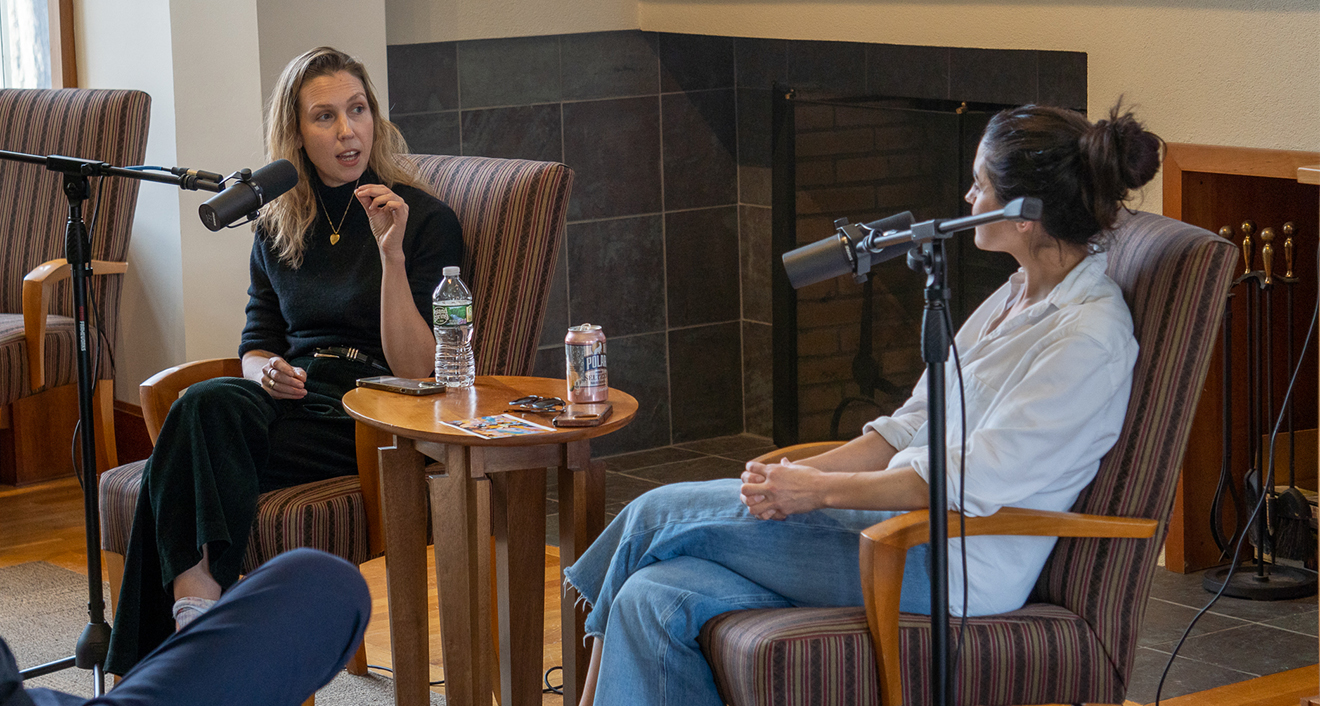
Stillman described these events and others in conversation with Merve Emre, director of the Shapiro Center for Creative Writing and Criticism and Shapiro-Silverberg University Professor of Creative Writing and Criticism, on March 31 in the McKelvey Room at Wesleyan. Their conversation was part of the Shapiro Center’s Speaker Series on “Tell Me More: The Art of the Interview,” which highlights the different approaches taken by interviewers in various fields. Emre and Stillman explored the arc of Stillman’s career, her interviewing strategies, and the reporting process behind some of her most notable pieces.
“We wanted an investigative reporter who balanced relentless reporting with empathy for her subjects,” Emre said about the conversation. “I have always admired how Sarah's writing gives voice to people who have been conscripted into the U.S. national security apparatus, often against their will, and who are afraid to tell their stories because they are in vulnerable positions. Sarah does an exceptional job of using the story of an individual to expose the injustice of an entire system, while never losing focus on that individual as a singular and complex person, and never merely a victim.”
Looking Deeper
Stillman’s journalism career blossomed during an assignment in an investigative reporting class at Yale University. For her senior essay, she investigated the death of a woman, Donna Cook, whose body was discovered while police were investigating a case of a young girl, baby Jessica, who had gone missing in Florida. Once police determined the body was not baby Jessica, news coverage was celebratory that the child was still alive. However, Stillman felt the news did not adequately address Cook’s story. She investigated further and discovered Cook was working with the local police as a confidential informant. This essay later led to a James Polk Award-winning piece in The New Yorker on confidential informants.
“That became pretty central to my whole reporting career,” Stillman said, “thinking about when we're often trained to look at the thing that everyone is paying attention to in the headlines, so often there is a really powerful set of stories that are basically the things that have been pushed aside of that ‘main’ story.”
This same knack for seeing beyond the headlines came up again when Stillman saw a story on foreign workers who were misled into taking jobs on U.S. military bases. The workers—called “third-country nationals”—were hired by third-party subcontractors who told them they would be hired at hotels and salons in other Middle Eastern countries, like Jordan and the United Arab Emirates, but were instead rerouted to Iraq to serve as cooks, cleaners, construction workers, clerks, electricians, and beauticians on U.S. military bases. She went to Iraq and was embedded with a U.S. military police unit in charge of mortuary affairs, or processing the bodies of the deceased, which gave her the access she needed to investigate. Workers recounted the ways they were lied to about pay, injured in the crossfire of war, and, for some, sexually abused by their employers.
Stillman explained the ways she earned the trust of the workers to tell their stories. “I think a lot of it is being alongside the day-to-day moments, and I wound up being in some really critical moments with them,” Stillman said. One night while embedded, she was with a worker who was just sexually assaulted. The military had an emergency hotline dedicated to instances of sexual abuse, but only service members and those with access to U.S. media sources could call it. Stillman called the number, repeatedly, and no one answered, she said.
“That was one of those moments when in journalism you're taught ‘don't get involved,’” Stillman said. “To me, my ethos has been showing up first and foremost as a human being, disclosing that, and being really transparent in the pieces. I think it's also a process of trust building when someone gets to go and understand what brought me to a situation in the first place, which in my case, was care about the situation.”
Showing up
Stillman received the 2024 Pulitzer Prize for Explanatory Reporting on her coverage of the felony-murder doctrine, a legal framework that allows a person to be charged with murder if they commit an underlying felony setting off a chain of events that leads to a death.
The story’s main voice, Sadik Baxter, was charged with a murder that he was miles away from because of this doctrine. While reporting the story, she spoke with Baxter at length about his case, but he refused to delve into his personal life over the phone at the prison since they are recorded and monitored. She decided to go in person to talk to him. When she arrived, prison executives made her change pants three times as a means of discouraging her from interviewing Baxter—the officials claimed the different pairs of pants could be distracting for the incarcerated individuals. Officials also confiscated her notebook before eventually letting her enter the prison to interview him. She said she thinks her choice to show up and stay through a difficult situation helped Baxter open up.
“He had not had a visitor in five years. I got a rental car, I drove out there, and everything completely opened up from there,” Stillman said. “Truly, he's one of the most creative, one of the most interesting, one of the most amazing conversationalists I've ever known.”
Through these three stories, Stillman elucidated the different ways she has shown up for the interview subjects in her work and how her stories have benefitted from it. She also took questions from students on her reporting practices.
The last conversation in the Shapiro Center’s speaker series this semester will be with Anna Silman of Business Insider on April 28. The series of conversations was recorded and will be published as episodes of Emre’s podcast, The Critic and Her Publics, which is produced in partnership with LitHub, The New York Review of Books, and The Hawthornden Foundation.