
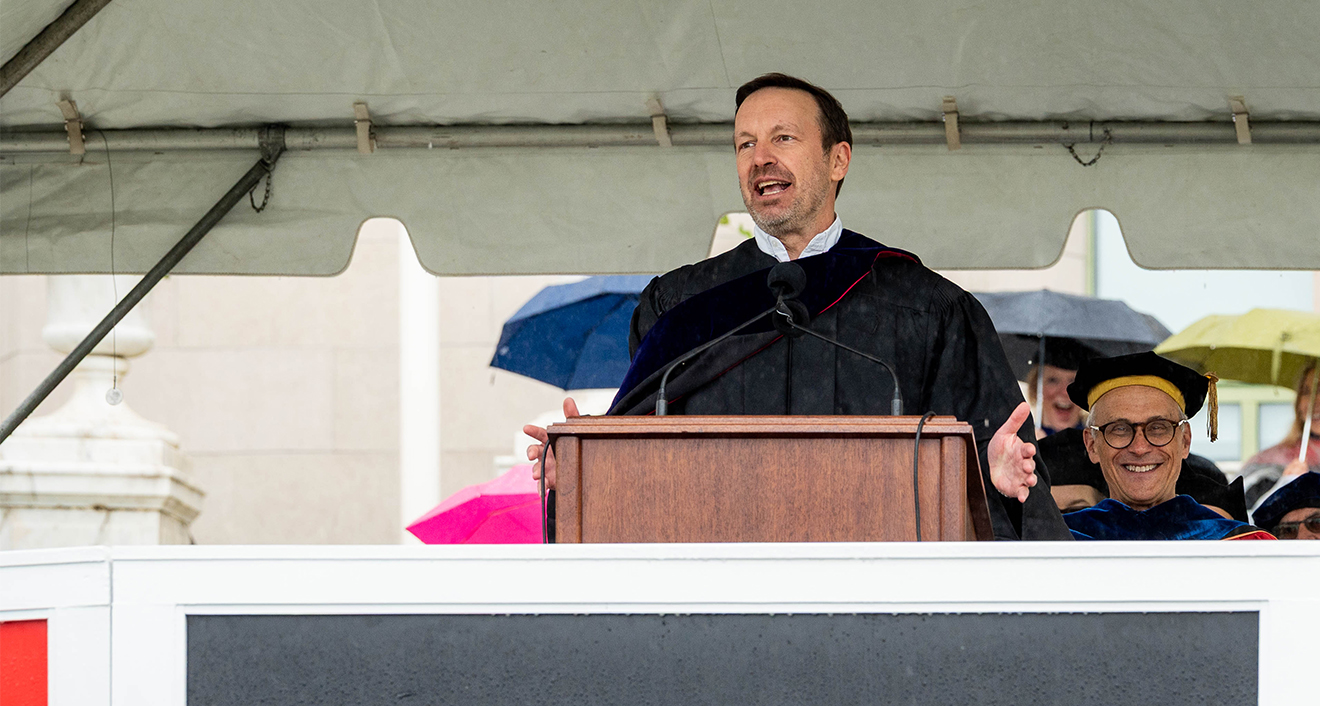
Chris Murphy Hon. ’26: “Don’t Just Take the Slow Road; Design It”
In his Commencement address at Wesleyan’s 194th Commencement Ceremony, Senator Chris Murphy Hon. ’26 urged members of the Class of 2026—who enter a world awash in algorithms and artificial intelligence—to prize humanity over the unquestioned pursuit of efficiency.
“Soon enough, with the world-class degree that you are getting today, you are going to be in positions of power, in government, in tech, in business, in entertainment,” said Murphy, who was named an Honorary Doctor of Laws. “You will get to make policy choices and design systems that either feed this efficiency beast—or tame it. And so I do hope you rise to that challenge.”
Serving as Connecticut’s junior Senator since 2013, Murphy has been a leading voice in the United States Senate, fighting for affordable health care, sensible gun laws, a forward-looking foreign policy, and a democracy and economy that serves working people. He was the driving force behind the Bipartisan Safer Communities Act, the first federal anti-gun violence bill in 30 years. Since the bill’s passage in 2022, he has championed legislation aimed at tackling corporate and political corruption and safeguarding Americans’ constitutional rights. Prior to his election to the US Senate, Murphy served Connecticut’s Fifth Congressional District for three terms in the US House of Representatives, as well as eight years in the Connecticut General Assembly. Murphy grew up in Wethersfield, Connecticut, and attended Williams College before earning a law degree from the University of Connecticut.
Senator Murphy made the following remarks during Wesleyan’s 194th Commencement Ceremony on May 24:
First, congratulations to the Class of 2026!
To President Roth, to the Wesleyan faculty, to the staff, to the trustees: Thank you so much for allowing me to be part of such a special day.
This is actually my second time on campus this spring. A few months ago, I came here with the older of my two sons. He’s a high school junior, and we were here touring the campus. A shout out to CJ Grant, our tour guide. You were awesome.
My son was struck, of course, by how the whole campus is really oriented off of the athletic fields. He even said to me: “Wow, Dad, this must be a really serious sports school.” To which I replied: “No, it’s really not.”
OK, OK, you saw in my bio I’m a Williams alum. I had to take one shot. I know. OK, I could spend my entire speech talking about the differences between Williams and Wesleyan, or we could just choose to focus on what unites us. Which is that Amherst sucks.
By the way, I’ve never been invited to give the commencement address at Williams. I checked: One of the Williams commencement speakers this year is a podcaster, which tells you the esteem that U.S. Senators are held in these days.
So I guess all I’m saying is that I’m really grateful for this invitation. Although, admittedly, my expectations are low that you’re going to remember anything that any of us said here. My graduation speaker was the first President Bush. President George Bush was my graduation speaker at Williams, and here’s what I remember from that speech...
So my expectations are really low that you’re going to remember anything. But let me say this: There was a reason that one of the first visits that I took with my son to a college was here. I grew up just a few towns away. I’ve represented Wes in the Senate for the last 14 years. I know what a truly special place this is.
And I thought about the ways to explain the magic of this campus and this community. But there’s really one aspect of the design that stands out to me, especially at this vexing economic and cultural moment. And it’s this: Wesleyan is a deeply inefficient place.
And I mean that as a compliment.
The purpose here is not to churn out the largest number of graduates in the shortest amount of time. It’s not to squeeze out every inch of wasted effort and to turn a profit.
No, Wesleyan takes its time. It lets you bake. Because intellectual growth doesn’t happen by sticking an academic IV into your veins. It happens in Fisk Hall, in the small seminar that, week after week, teaches you to think big. It’s that long, quiet walk from Olin to the CFA across a blanket of New England snow, where those ideas slowly start to take root. It’s the 2 a.m. conversations at Mezzo where you test out, where you refine, where you gain confidence in those new theories.
Wesleyan is inefficient. Because inefficiency is good, actually. And that’s what I want to talk to you about today. The beauty of drift, of friction, of a pause for a pause’s sake, of inefficiency.
You are about to step out into a world that prizes efficiency and the annihilation of drift and friction, above all else. Our entire economy is built on rewarding companies that are efficient at making a profit, not based upon how they treat their workers, the social value of their product, or the impact they have on the community.
Every day, technology companies are rolling out new products that cut the time it takes to do everything in your life, from eating to shopping, to dating, from getting one place to another. These aren’t products designed to make you happier. These are products designed to make you more efficient.
Now, you didn’t design this world. You didn’t choose it. But you will live with the consequences of this cult of efficiency. And you will have to choose which side you are on.
Now, you are probably sick of lectures from people double your age about the dangers of the algorithms of the apps in your pocket. You definitely don’t need another speech about AI. I’ve seen how those speeches are going.
But the cult of efficiency is really not just about what’s on your phone; it seeks to occupy every unoccupied space, every vacuum.
We don’t get to know the owners of local restaurants or run into our neighbors at the grocery store, because we get all of our food delivered by an app. When we leave the house to grab a sandwich, odds are you going to interact with an iPad instead of a person. When we click to summon a car to our front door, we don’t even have to speak to the driver. There’s a button for silence.
Fewer of us even have a primary care doctor. That’s because the hedge funds and private equity companies that buy up medical practices see those relationships as inefficiencies, and so they just schedule with whichever doctor is available soonest, or they push you to a cold, soulless urgent care clinic.
The cult of efficiency has also leached into the fun parts of our lives. Years-long friendships, they’re flattened into a feed. Movie-going shrunk to solo viewings on tiny screens. Romance reduced to half-hearted swipes.
Now, I’m not a Luddite. I know the value of efficiency. Those dating apps, they can produce lifelong friendships. Sometimes I don’t have the time to wait in line at Popeye’s.
But I guess what I’m asking you is this: What happens to us, on the inside, when every interaction, every aspect of our lives, gets optimized for efficiency? When the whole world is at our fingertips, yet we don’t actually experience the world.
Yes, we are optimizing our time. But we aren’t happier. In fact, I think all of these things make us feel the opposite.
I think that’s because the human brain wasn’t built to have conveyor belts feed it. It wants to do work. It grows by hitting dead ends, through trial and error. The song—it just sounds better if you had to search for it. The movie is always better with company. The meal tastes different at a table with friends.
Sam Altman was in my office about a year ago. And he knew that I was a critic of AI. He’d also heard me talk about what I see as a loneliness epidemic in this country. So he wanted to show me a new OpenAI project that he thought that I couldn’t critique.
His product was AI best friends. A new model that, he told me, after a handful of interactions could supposedly be a better friend to its user than a person’s lifelong best friend.
Needless to say: I had plenty to critique. But Altman had put his finger on one of life’s most important inefficiencies: friendship.
Sitting in this audience today is someone you didn’t know existed four years ago—who means the world to you today. And most likely, some of the friends you have made at Wes will be your friends until the end of your days, the most important friends you will have in your entire life.
But think about those friends that are sitting amongst you. Yes, they had your back, but I bet they’ve also confounded you, maybe even occasionally let you down. And that’s how it will be for the next 50 years of friendship with your Wes friends as well.
Friends are so inefficient. That’s why Altman thinks he can build a better product. And he’s betting that you’ll buy it.
But don’t. Because there’s nothing better than the inefficiency of friendship. The inefficiency of family. The ups and the downs of the real stuff.
I guess what I’m saying to you today is this: Choose inefficiency. Don’t let the cult of efficiency maximize everything—and minimize all the friction that makes life so bracing, so fulfilling, so rich with detours and possibilities.
Some of the best things in life are wonderful because they don't work quickly, because they aren't always reliable. Friendship is one of those things. But so is democracy, right? One ruler with total power—that's more efficient, but there is a miracle in the inefficiency of the people, the messy American people, ruling themselves. Sometimes designed inefficiency, from friendship to American democracy, is worth protecting.
Now, I'm going to do everything I can to protect those wonderfully inefficient things, but I can't guarantee you that Congress is going to save you. Maybe I'm wrong. I'll try to be wrong, but I'm sorry if I'm right.
And so here's my final message: Soon, you are going to be replacing us. Soon enough, with the world-class degree that you are getting today, you are going be in positions of power, in government, in tech, in business, in entertainment. You'll probably have lots of Amherst graduates working for you—I really hope that my son doesn't want to go to Amherst. I’m ruining his chances. But I promise you, for all the mistakes we are making, it won't be too late. You will get to make policy choices and design systems that either feed this inefficiency beast—or tame it. And so I do hope you rise to that challenge.
But in the meantime, in your everyday lives, you can try, as hard as chronically overachieving 22-year-olds can, to be purposely inefficient. You can place your coffee order in person. I mean, online ordering is faster, but wait in line. You never know who you'll meet. Ask the human behind the counter how their day is going. Slow down. Take the extra five minutes. When you get in the Uber or the Lyft, don't use the time to catch up on texts and emails. Ask the driver a question: How does she like her job? What's his favorite restaurant in town? Waste some time with conversation and just see where it goes. Ask actual human beings questions. Don't rely on the machine for all your advice. Call your parents if you have a problem. Ask your handy friend how to fix the leaky sink. Invite your neighbor to come over to show you how to cook that dish that you just can't get right.
There's a word for what happens when you embrace inefficiency and toss aside the perfectly optimized roadmap. That word is exploration. Exploration takes time. It does not come with certainty, but it can take you to some pretty incredible—and often unexpected—places. The cult will take you to the place that you want to get faster. But your destiny is more often a spot off the road, not at the end of it. And you can view this moment in time, when everything from traditional friendship to the very idea of democracy is being tested, and wake up with anxiety and angst about the moment you live in. Or you can choose to see your moment in time, at this fulcrum of American culture and American democracy, as the greatest gift ever given to you. That you will get to decide, in your early life, whether the cult of efficiency wins or whether exploration still has a role in American lives. You will get to decide whether we preserve the inefficiency of democracy, the messiness of free speech for a generation to come. You may be filled with worry, a little bit of dread, as you leave this safe place, but you are entering this American world, at a time where the decisions you make will likely be more important and more impactful than any generation before you. So when you're in charge—and you'll be in charge soon—don't just take that slow road, design it.
But that all starts tomorrow. For now, you should just go celebrate. And so I'm simply here to give you a little bit of a mission, a little bit of advice, but to really say, to the Class of 2026, to your friends, to your parents, to your family, who are so proud of you: Good luck. Congratulations.