
In Celebration: Commencement 2026
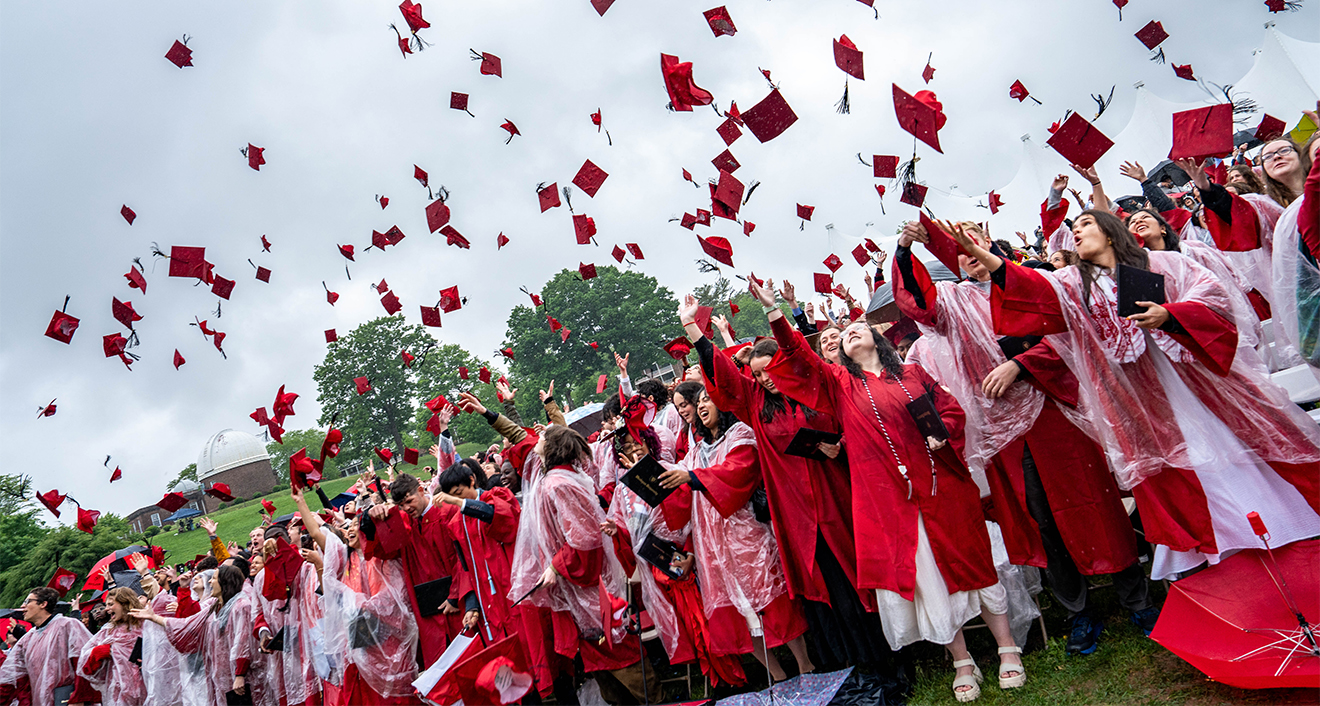
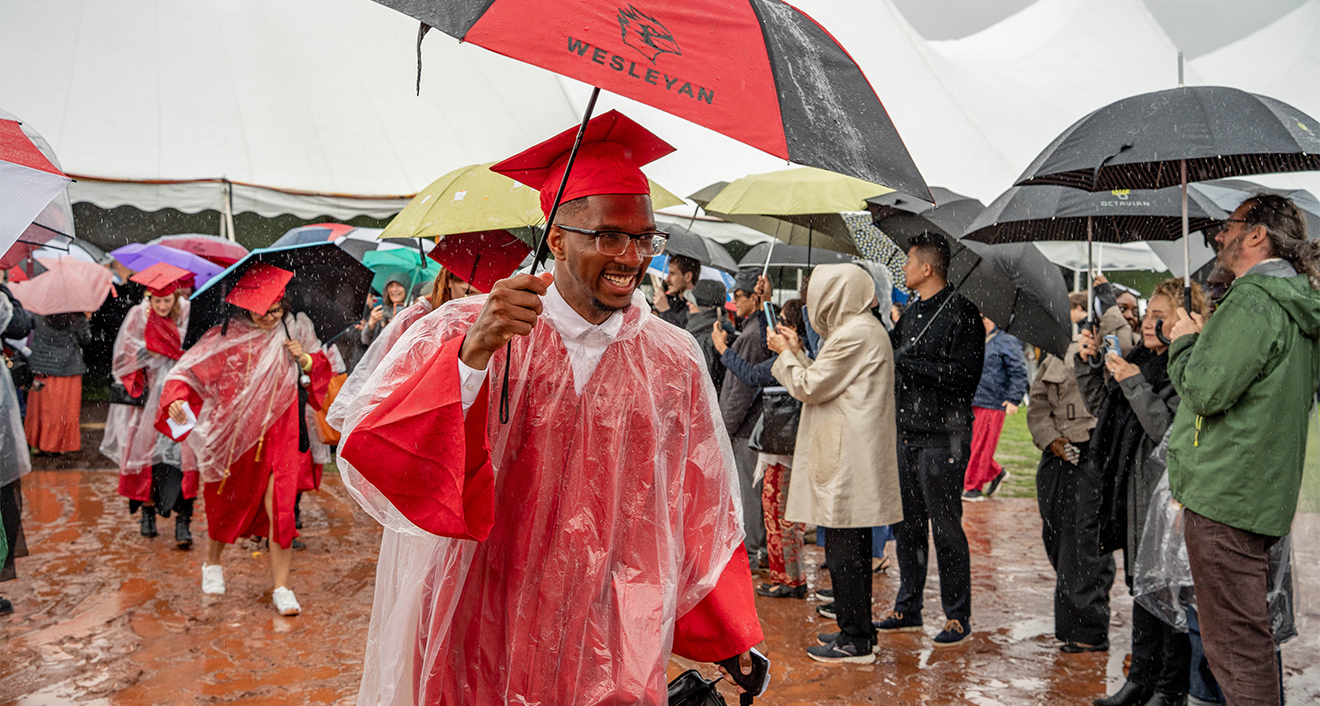
Neither clouds nor rain nor fog could keep the hundreds of eager graduates from realizing the culmination of years of study: Wesleyan University’s 194th Commencement on Sunday, May 24, 2026. Under umbrellas and ponchos, the exuberant scholars processed down Foss Hill to the sounds of drumming and took their seats to commemorate the close of one phase of their journeys together and the beginning of another.
At commencement, Wesleyan conferred 746 Bachelor of Arts degrees, eight Bachelors of Liberal Studies, 27 Masters of Arts, 19 Masters of Arts in Liberal Studies, one Master of Philosophy in Liberal Arts, and 12 Doctor of Philosophy degrees.
Graduating seniors like Alexus Martin ’26 felt a bit emotional about reaching this milestone. “When I first picked up my diploma and I finally looked and I saw my name in the Wesleyan University Bachelor of Arts, I almost started tearing up and crying,” said the double psychology and education studies major. “I'm the first in my family to go to college so this is really special to me.”
Mathis Blanc ’26 of Los Altos, California was feeling a bit nostalgic about the people and the campus he would be leaving behind. “People make the place and no matter where they are, that's going to be Wesleyan for me,” he said. Yet he was looking forward to the world beyond Wes. “We'll be all going our different directions, but we'll always be united by the experiences we went through here. It's going to be a great journey and I'm excited for the future.”
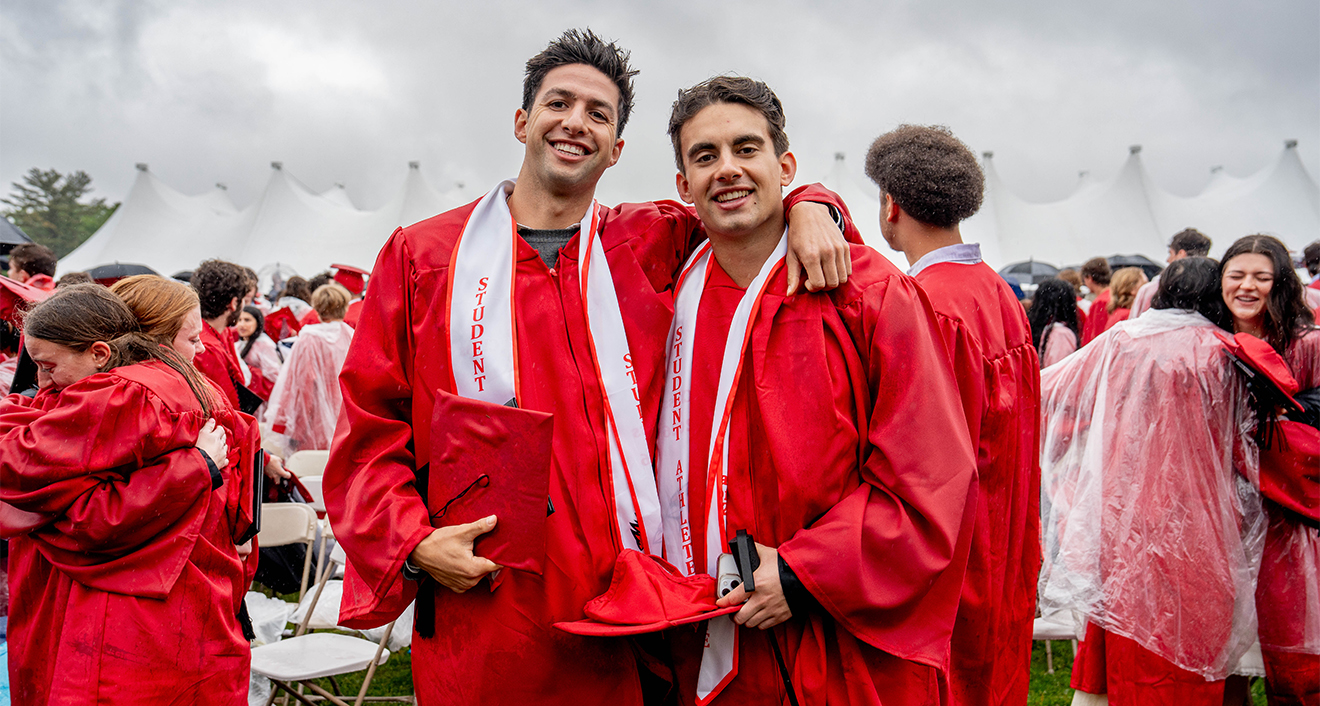
Like many of her peers, Kavya Panjwani ’26, is going to miss her friends but is excited about the next chapter. After finishing up her honors thesis studying how iron influences triple-negative breast cancer, she’s filled with pride and gratitude for what’s she learned. “Wesleyan really taught me how to work hard,” she said. “I think the classes here really taught me how to study and how to push through during difficult situations. And I also think I learned how to grow and learn from other people, making a lot of different friends and collaborating with them in different ways.”
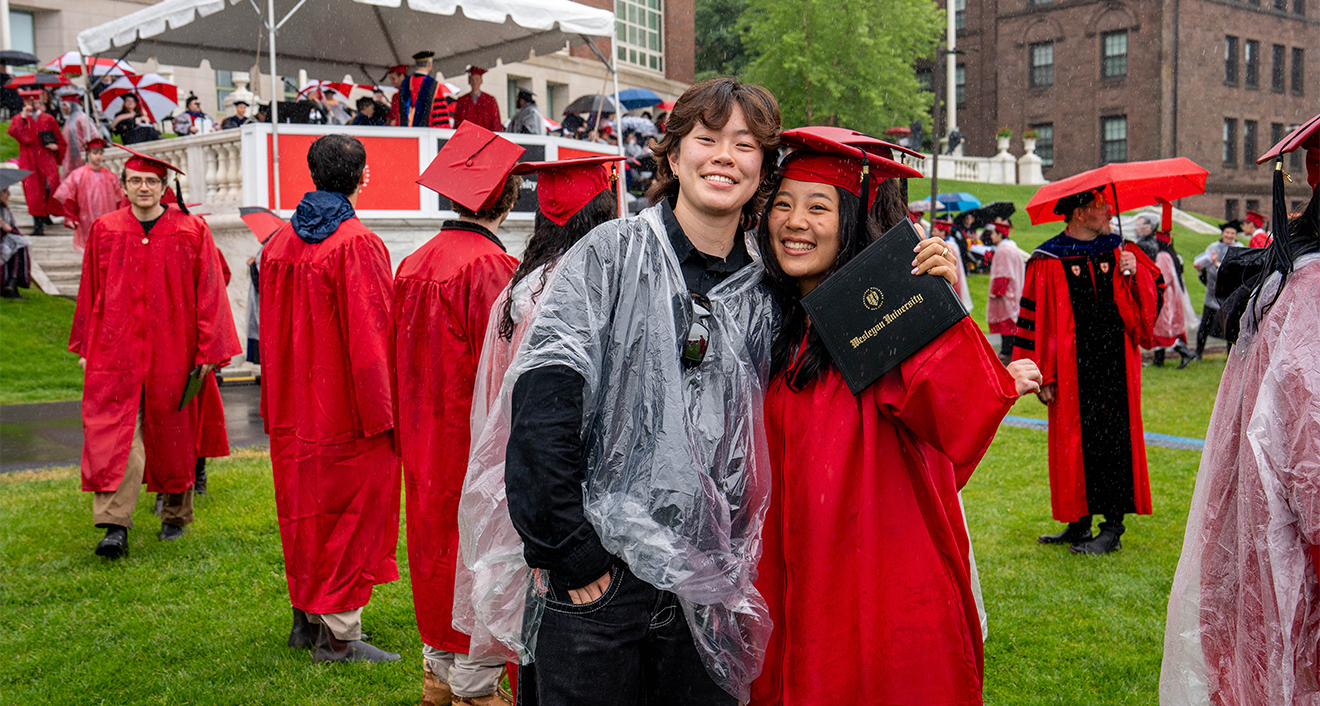
During his four years at Wesleyan, student commencement speaker Thomas Lyons ’26 discovered that learning doesn’t stop at the end of a class or upon earning a degree. In his message to fellow graduates, Lyons encouraged them to continue to pursue their interests and passions deeply. “Whatever it is we choose, class of ‘26—whatever job or not job, whatever adventure or misadventure—let’s believe it’s the real thing,” he said. “After all, there’s nothing left to do but go experience it.”
The University also awarded honorary degrees to three exceptional individuals with a commitment to practical idealism: Chris Murphy Hon.‘26, the junior United States senator for Connecticut, who delivered the commencement address; Dr. David M. Carlisle ’76, Hon.’26, president and chief executive officer of Charles R. Drew University of Medicine and Science in Los Angeles, and Karen Freedman ’75, P’05, Hon.’26, founder and president of Lawyers For Children in New York City and Wesleyan University trustee emerita.
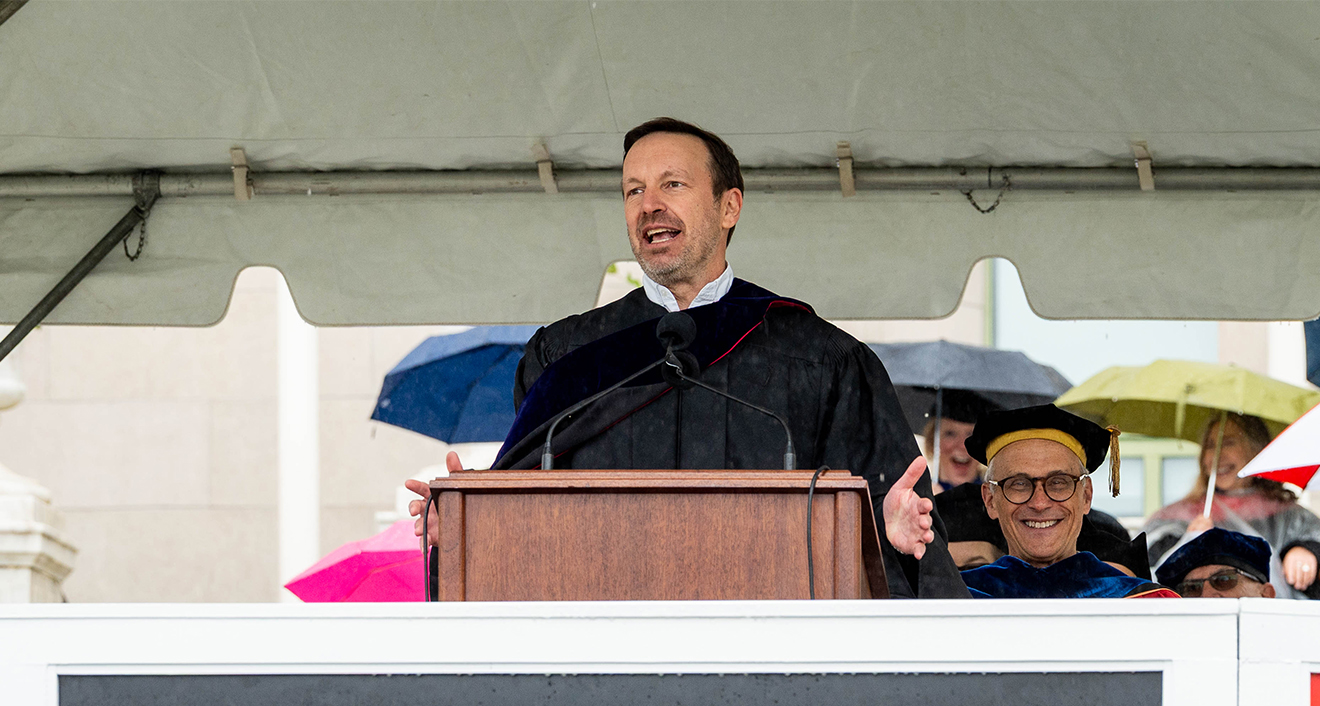
Remarks by Honorary Degree Recipient Murphy focused on the unlikely topic of efficiency. He complimented Wesleyan on being inefficient in the sense that the University aims to foster the intellectual growth of students, which takes time and effort. He contrasted that ethos with the prevailing trend to accelerate efficiency in all areas of life through technologies like artificial intelligence, smartphones, and apps.
“You are about to step out into a world that prizes efficiency, and the annihilation of drift and friction, above all else,” he said. “Our entire economy is built on rewarding companies that are efficient at making a profit, not based on how they treat their workers, the social value of their product, or the impact they have on their community.”
Instead, Murphy encouraged graduates to slow down and truly embrace the rewards of experiencing the world first-hand. “Choose inefficiency. Don’t let the cult of efficiency maximize everything—and minimize all the friction that makes life so bracing, so fulfilling, so rich with detours and possibilities,” he said. “There's a word for what happens when you embrace inefficiency and toss aside the perfectly optimized roadmap. That word is exploration. Exploration takes time. It does not come with certainty, but it can take you to some pretty incredible—and often unexpected—places.’”
In his remarks, President Michael S. Roth ’78 touched on the significance of our nation’s upcoming anniversary. “As we approach the celebration of the 250th anniversary of the Declaration of Independence, I trust you will continue to learn how to protect your freedoms and ours by continuing to experiment with what it means to be free,” he said. “What better way to acknowledge this anniversary while keeping your education alive than by participating in communities in which people can pursue happiness, without prejudice, without bigotry, without hatred—communities in which they can together thrive.”
He continued, drawing a line between learning and freedom. “Practicing education, I believe, is like practicing democracy: Both are collaborative, experimental paths of improvement. Both depend on inclusion rather segregation. Both are very much now endangered. If we don’t defend education and protect democracy, we will lose them. Stand up against those who fear fluidity, who ban books, who are frightened by diversity, free expression, and creative transformation,” he said.
Carlisle highlighted a commonality between the namesake of his institution, Charles R. Drew, and Wesleyan. He said that Drew, who invented the process of preserving and storing blood plasma, was a change agent. “Wesleyan is a change agent too. Wesleyan has a special commitment to bringing a truly liberal education to students from all walks of life,” he said. “…it created a special place where students felt truly free to explore and learn from each other, not just the faculty.”
He encouraged the class of 2026 to remember that legacy and to commit to being change agents, too.
In her remarks, Freedman shared a story about volunteering at the now defunct Long Lane School as a student and witnessing abuse and mistreatment of youth. Her determination to give young people a voice led her to found Lawyers for Children, which represents vulnerable children and young adults. “I honestly do not think my work would have been possible without the education I received at Wesleyan,” she said. “Wesleyan creates spaces where ideas can be explored, assumptions challenged, risks taken, and voices—especially dissenting or marginalized ones—are heard. These are educational values that are deeply embedded in Wesleyan’s culture.”
The close of commencement was bittersweet, as Isaac Ostrow ’26 described. “I'm really excited for what's next for me after Wesleyan, but I know I'm going to miss all of my really close friends and the experiences I've had here,” he said. Like his peers, he pointed to the community he built on campus through activities, including Club Rugby and The Green Fund, as sources of pride. He looks forward to a job with a solar development company. “That's really exciting. But I'm also looking forward to keeping in touch with my Wesleyan friends as we go on to bigger and better things.”