
Karen Freedman ’75, P’05, Hon. ’26: “Use Your Voice Not Only When It Is Easy”
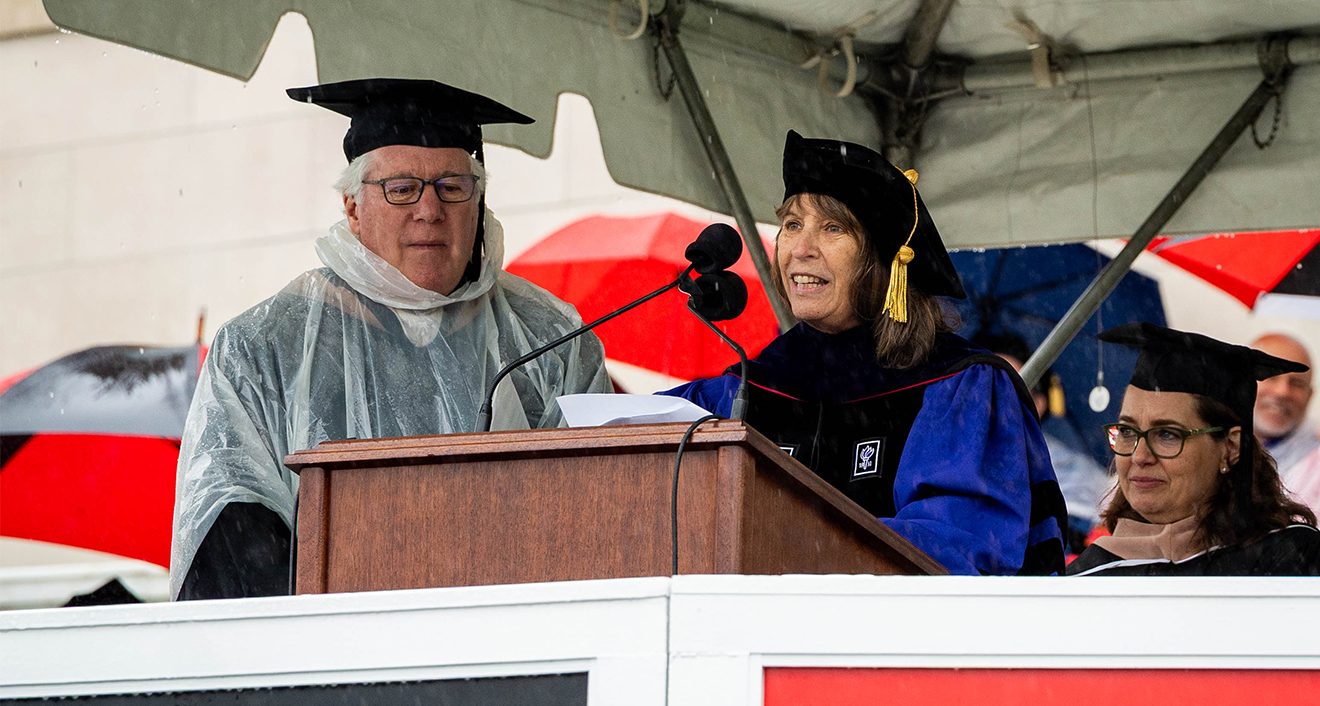
Karen Freedman ’75, P’05, Hon.’26, founder and president of Lawyers For Children, was named an Honorary Doctor of Laws at Wesleyan’s 194th Commencement Ceremony. In her speech to the Class of 2026, Freedman recalled how volunteering at a notorious juvenile detention center became a crucial part of her undergraduate education—and galvanized an enduring advocacy for young people in dire circumstances.
“Wesleyan creates spaces where ideas can be explored, assumptions challenged, risks taken, and voices—especially dissenting or marginalized ones—are heard,” said Freedman, who is also a Wesleyan University trustee emerita. “These educational values are deeply embedded in Wesleyan’s culture. And this is why I know that you will use your Wesleyan education not only to advocate for your own careers, but to advance justice in the world around you.”
Freedman has devoted her legal career to serving children and young adults. More than 40 years ago she founded Lawyers For Children, a legal services organization that has represented more than 100,000 children and young adults. She has created several projects at the organization to serve particularly vulnerable young people in the foster care system, including initiatives on behalf of LGBTQ+ youth and unaccompanied minors seeking asylum and safety in the United States. After receiving her BA from Wesleyan University and her JD from New York University School of Law, Freedman served as staff attorney with the Juvenile Rights Division of the Legal Aid Society and a law clerk in the US Court of Appeals for the Second Circuit.
Freedman made the following remarks during Wesleyan’s 194th Commencement Ceremony on May 24:
Thank you, thank you, thank you, thank you!
Returning to Wesleyan to receive this degree is deeply meaningful—not only because it is the honor of a lifetime to accept this recognition from an institution I so deeply respect, but because Wesleyan has already given me so much.
People like John and his wife, Shonni, who have been the closest of Wesleyan friends for the past 50 years; my husband and life partner, Roger, who graduated with me in the class of ’75; and a treasured education inside and outside of the classroom.
Looking back on my final semester at Wesleyan, I’m haunted by the work I did as a volunteer at the nearby Long Lane School. Despite its name, Long Lane was anything but a school—it was a juvenile detention center, run like a prison.
There, I met young people who had come to expect very little from the world—or from themselves.
But I also witnessed the power of a young person finding their voice and learning to speak out to protect their rights. I saw hope and determination that came from something as simple as having a meaningful stake in one’s own future.
The Long Lane School had a shameful history of abuse and mistreatment. And, tragically, it took a young girl’s attempt to take her own life to force the state to pay attention. And when Connecticut finally heard the voices of these young people, Long Lane was closed forever.
Today, most Wesleyan students hear “Long Lane” and think of Wesleyan’s thriving student-run organic farm. Long Lane’s transformation is a prime example of what Wesleyan calls practical idealism. And although the dark legacy of the Long Lane School may have faded, my experience there stayed with me.
Years after graduation, as a young legal services attorney, I wandered into a courtroom where children in foster care faced life-altering decisions without legal representation.
I was shocked. No child should stand alone in a courtroom at their most vulnerable moment without anyone to amplify their voice or protect their rights. I immediately went to my boss to ask why we weren’t representing these children. When she turned to me and said, “Karen, that’s never going to happen,” it lit my Wesleyan fire.
It may have started as impractical idealism, but a year later, Lawyers For Children was born—and over the past 40 years, our legal and social work teams have represented more than 100,000 young people and secured every foster child’s right —yeah, that’s my family—and secured every foster child’s right to legal representation in New York State.
But our most important work always begins with a commitment to listen closely to the young people we serve. It is their lived experience that informs both our daily courtroom advocacy and our fight for systemic change.
But I honestly do not think my work would have been possible without the education I received at Wesleyan.
Wesleyan creates spaces where ideas can be explored, assumptions challenged, risks taken, and voices—especially dissenting or marginalized ones—are heard. These educational values are deeply embedded in Wesleyan’s culture.
And this is why I know that you will use your Wesleyan education not only to advocate for your own careers, but to advance justice in the world around you. That you will use your voice not only when it is easy, but when it is hard. That you will stand up—not just for yourselves, but alongside those who cannot stand alone.
So go forth, Class of 2026, and give this world what it needs—more Wesleyan! Congratulations!