
Building Civic Trust on a Congressional Campaign
The following story is a first-person account of a student's experience.
As an intern with Luke Bronin’s congressional campaign for Connecticut’s First Congressional District, I often meet residents who are undecided, which gives me an opportunity to talk through their policy concerns and Bronin’s ideas. In one case, I met a voter who said he hadn’t voted in an election in years due to his disillusionment with both parties. We had a 15-minute conversation, which was refreshing considering that most voters are only interested in talking for a few minutes. I explained Bronin’s qualifications and mentioned that this district has the first competitive Democratic primary in nearly three decades, meaning that voters now have a rare opportunity to vote for change.
Afterwards, although the resident remained on the fence, he became receptive to the idea of a change in leadership in Congress and the perspective that Bronin offered. Through this, I have found that campaigning revolves around building trust one interaction at a time. Above all, voters want a candidate who listens to their concerns and has a plan to act once elected.
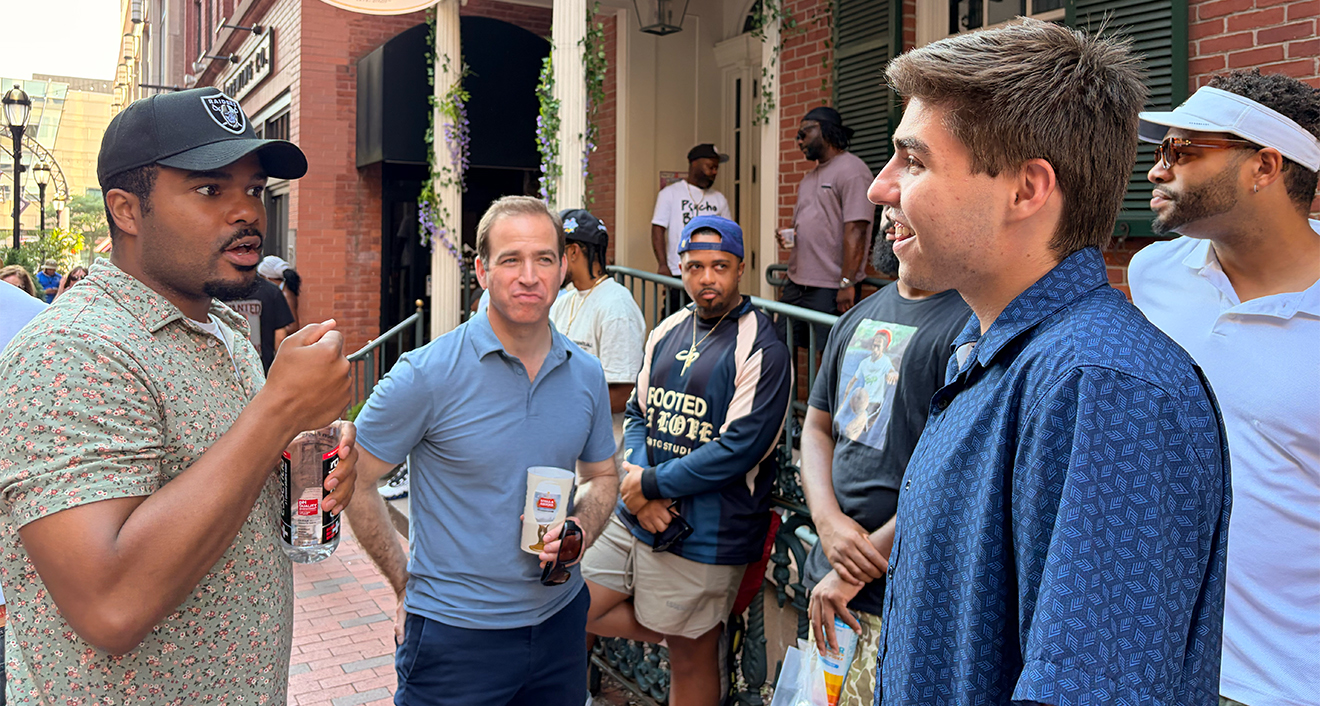
Bronin talks a lot about generational change in politics and working with him has allowed me to play a role in shaping this district’s future. Throughout my three-month internship with the campaign, I have typically divided my time between field and office work. Being on the “frontlines” with Bronin while staffing events he attends has proven to be among the most memorable and rewarding experiences. The first events I helped plan and staff—Memorial Day parades in the towns of Wethersfield and Newington—provided me with insight into how campaigns execute their participation in public events.
Preparations started a few days before, when two other interns and I researched the parades and planned parking locations, arrival and departure times, and important elected officials that Bronin should expect to see. On the morning of the day of the parades, we arrived early to provide updates on crowd sizes, identify press, and connect Bronin with the local mayor. As Bronin waved his mini American flag and greeted onlookers, I took photos and videos for social media content. For the first time, I was no longer an observer of a campaign, but rather directly supporting the efforts of a candidate.
In the office, I helped lead a project to draft letters asking local newspaper editors to endorse Bronin, based on testimonials from volunteers. Overall, in the letters I highlighted Bronin’s achievements as mayor of Hartford, his progressive platform, and the district’s need for new energy and perspectives. I also helped draft responses to the League of Women Voters’ candidate guide questionnaire, an email release announcing the endorsement by the Connecticut Hispanic Democratic Caucus, and an op-ed in support of Bronin. Working on these tasks makes me grateful for the opportunities Wesleyan has offered to engage with politics, from Government coursework to the Wesleyan Institute for Policy. Both allowed me to refine writing skills applicable to this internship and consider more about how politics affects my life and the community. This internship has given me a better understanding and interest in our political system, so I hope to become more involved this upcoming year by joining the Wesleyan Democrats.
In the field, canvassing takes up roughly two hours of my time each day. Although it is difficult to predict how voters will respond to you at their doorsteps, I find that going door-to-door canvassing is essential for increasing voter support. Some voters have limited interest in politics, while others are happy to discuss their opinions. I hope that my interactions with residents on this campaign encourage more people to go to the polls.
Everyone’s voice deserves to be heard, and we need higher voter turnout in our elections, from local to federal. It’s important that people do research on the candidates so that they can decide who best deserves their vote. Participation in public life crucially reinforces community trust. I've met supporters of Bronin’s opponent and Republicans, and despite our political disagreements we can agree on the importance of discourse. As freedom of speech and the right to vote are core tenets of democracy, we should encourage dialogue and connection.
Trevor Mangus '28 is a junior at Wesleyan. The candidate he interned for, Luke Bronin, won his primary race.