The Long Run
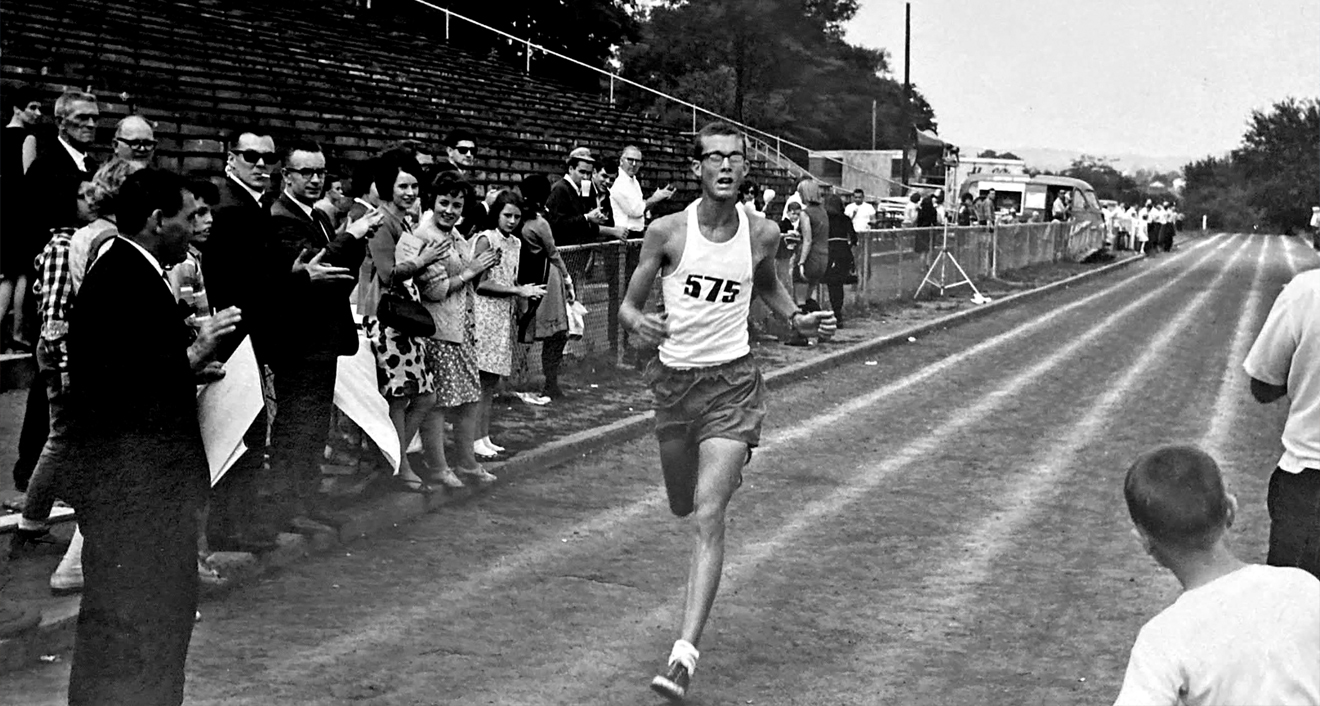
On April 19, 1968, while Wesleyan’s track team convened for a meet at the University of Connecticut, its star senior was chasing down a dream in Boston.
The Boston Marathon had long consumed Amby Burfoot ’68, then a 21-year-old psychology major. For years he routinely ran more than 100 miles a week, sandwiching track practice between supplemental morning and afternoon runs. Over spring break in March, he logged 25 miles—nearly the full distance of a marathon—every day for two weeks. “I just figured, if I run more miles and more hours, I’m going to beat everybody else,” says Burfoot, who’d finished 25th during his first Boston attempt in 1965. Coach Elmer Swanson had few reasons to question Burfoot’s high-mileage habit—after all, he’d gone undefeated through four years of dual races, and twice earned All-American honors. When Burfoot skipped the meet, coach quietly offered his blessing.
Burfoot showed up at the starting line in Boston in his Wesleyan racing singlet and in the shape of his life. After 2 hours, 22 minutes, and 17 seconds, he became the first active college undergraduate to win the world’s oldest annual marathon. Almost 60 years later, Burfoot downplays that feat with characteristic modesty. The best American runners had skipped Boston to focus on that year’s Olympic trials, he says. And anyway, consider what his roommates did later.
For one fleeting academic year at Wesleyan, three of the most important runners in the history of the sport were all on the same Division III team. There was the late Jeff Galloway ’67, an Olympian who established the first retail stores geared toward runners and created training methods employed by millions. There was Burfoot, who segued from competing to chronicling the growth of the sport as an author and an editor at Runner’s World magazine for more than 30 years. And there was Bill Rodgers ’70, whose competition record, punctuated by a five-year stretch where he won four Boston and four New York City Marathons, ranks among the greatest of all time.
Others clearly played crucial roles in turning distance running from a fringe subculture into an activity practiced by 50 million Americans and an industry worth tens of billions of dollars. But it’s difficult to overstate the collective impact of Rodgers, Burfoot, and Galloway. They were competitors who emerged outside of elite track and cross-country programs, entrepreneurs who made their passion into their work, lifelong running ambassadors shepherding the sport well into the 21st century. It’s also difficult to overstate the influence Wesleyan had on their journeys.
“For those three in particular—and me and maybe others—Wesleyan taught us a way of looking at the world: How can we take our skills and apply them to solve problems that we care about?” says Randy Accetta ’85, a track and cross-country standout and director of coaching education for the Roadrunners Club of America, an umbrella organization for roughly 1,000 running clubs. “And for those guys, of course, it was, how fast can I go? Then, how can I make a living? And then, how can I impact people?”
Amby Burfoot
1968 Boston Marathon Champion | Manchester Road Race: 62X Finisher (9X Champion) | Runner's World Editor-in-Chief (1985–2003)
Jeff Galloway
1972 US Olympic Team Competitor (10,000-Meter Run) | American 10-Mile Road Race Record (1973) | Galloway Run-Walk Method Creator
Bill Rodgers
4X Boston Marathon Champion | 4X New York City Marathon Champion | 1976 US Olympic Team Competitor (Marathon)
Running might seem like it’s always been a piece of the athletics landscape. After all, track and field has been a recognized collegiate sport since the 1800s and a staple of the Olympics since Ancient Greece. “We have a huge heart for our measly body size; we hunted down our prey 200,000 years ago,” Rodgers says. “We’re made to move. We’re made to run.” But in the mid-20th century, runners were on the margins of sport as well as the road, routinely drawing puzzled looks and even contempt. “Cars would go by, windows would roll down, and either taunts or empty beer cans would come flying out,” Burfoot once told The New York Times.
Becoming a runner back then involved some amount of random chance. After doing well during a three-mile run his basketball coach intended as punishment, Burfoot migrated to the cross-country team at his Groton, Connecticut, high school, where coach John J. Kelley—Olympian, renaissance man, and 1957 Boston Marathon champion—profoundly shaped Burfoot’s running aspirations. Five years after taking up running as an overweight 13-year-old in Georgia, Galloway finished in first place in what would become the Atlanta Marathon. Rodgers joined his Newington high school’s first cross-country team and became a racing rival of Burfoot’s younger brother. Burfoot eventually approached Rodgers and encouraged him to matriculate into the small liberal arts school where he and Galloway were already enrolled.
“I never would have been a success in a Division I school, that type of environment,” says Rodgers. “I needed a place like Wesleyan, which was a bit more relaxed, and you could find what you wanted in school, and maybe in life.”
At Wesleyan, they found an academics-first institution with a track team led by a coach unlike any other. Coach Elmer Swanson, a tobacco-chewing former first baseman in the Detroit Tigers farm system who coached at the University of Michigan before coming to Wesleyan in 1963, was “omnipresent” at practices and meets, Burfoot says. But he also gave his athletes wide latitude instead of enforcing rigid regimens, benefiting runners whose aspirations went beyond track and cross-country events. (“I undercoach,” Swanson told Accetta for a 1985 story published in this magazine.)
“A smart coach, I think, has to be flexible,” Rodgers says. “The hardcore ones that push their athletes wrong, I just don’t think they’re as good. Elmer was a smart guy . . . He watched us and made sure we were on the track, too, but he knew we were ambitious and trying hard, and he gave us a lot of freedom.”
-
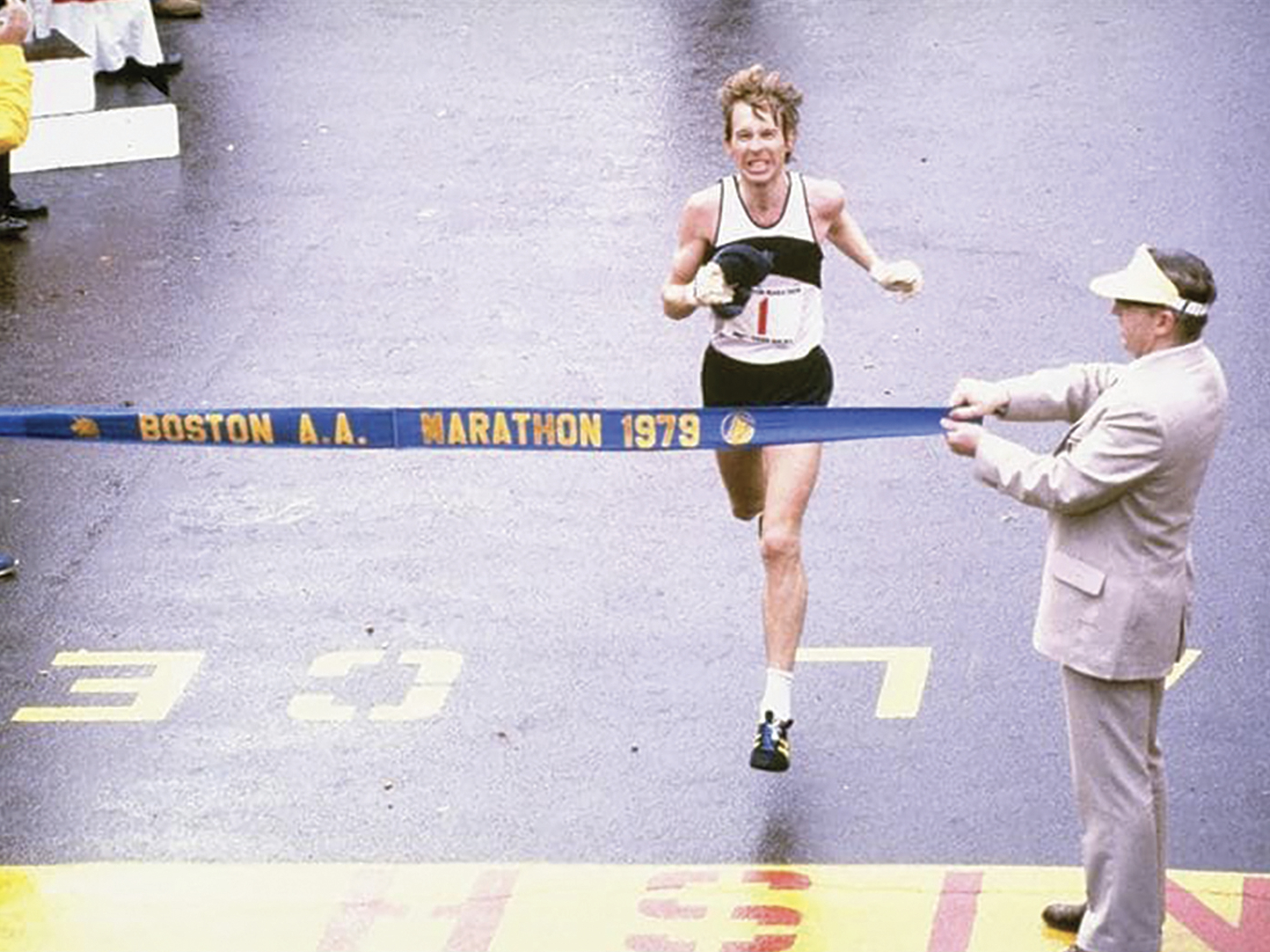
When running was still considered a niche sport, Rodgers—pictured here just before one of four first-place finishes at the Boston Marathon—Burfoot, and Galloway found kinship at Wesleyan. Photo: AP
-
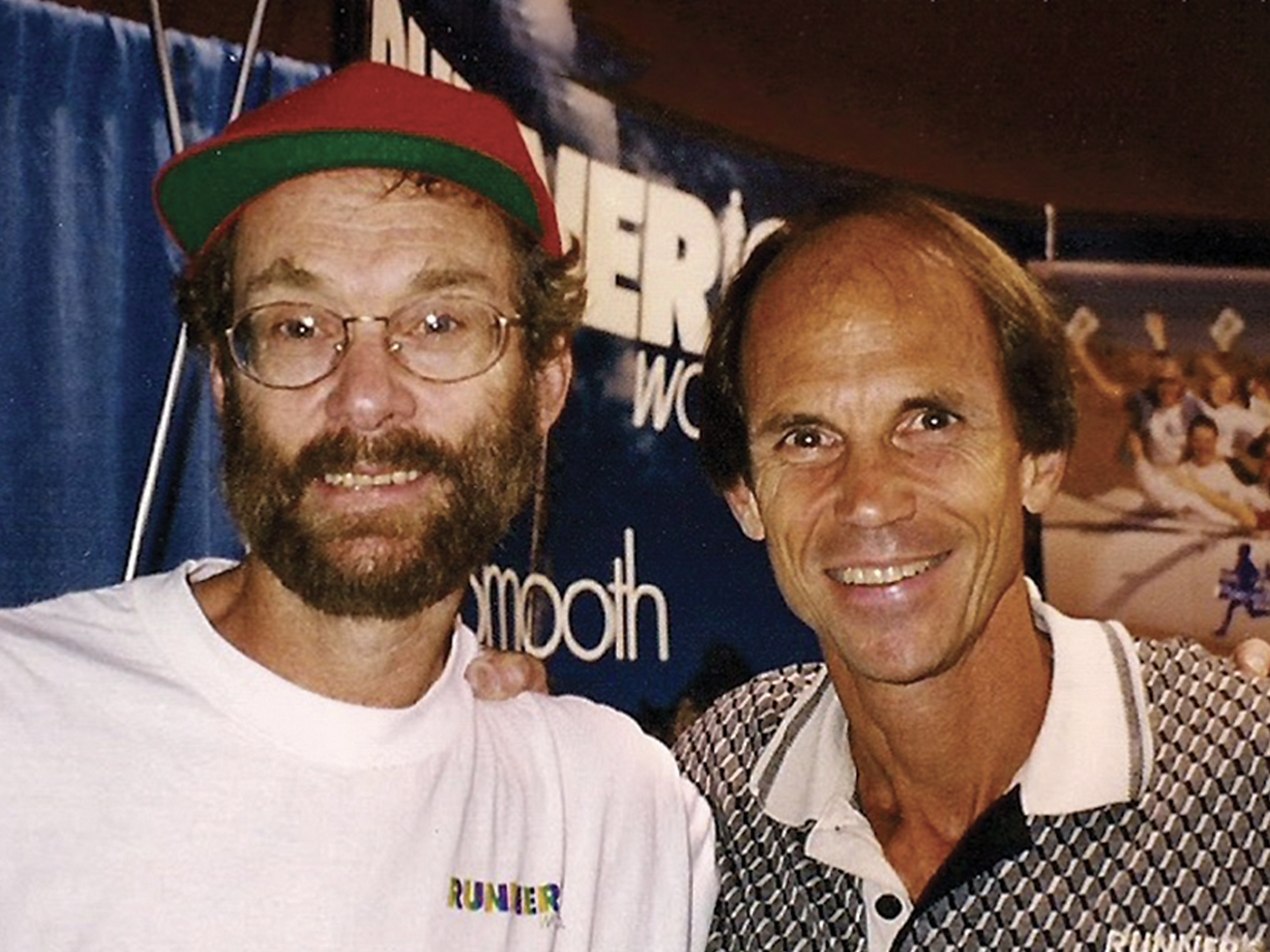
Burfoot (left) was undefeated in four years of cross-country dual meets, while Galloway was an All-American in both cross-country and track. Photo courtesy of Amby Burfoot
-
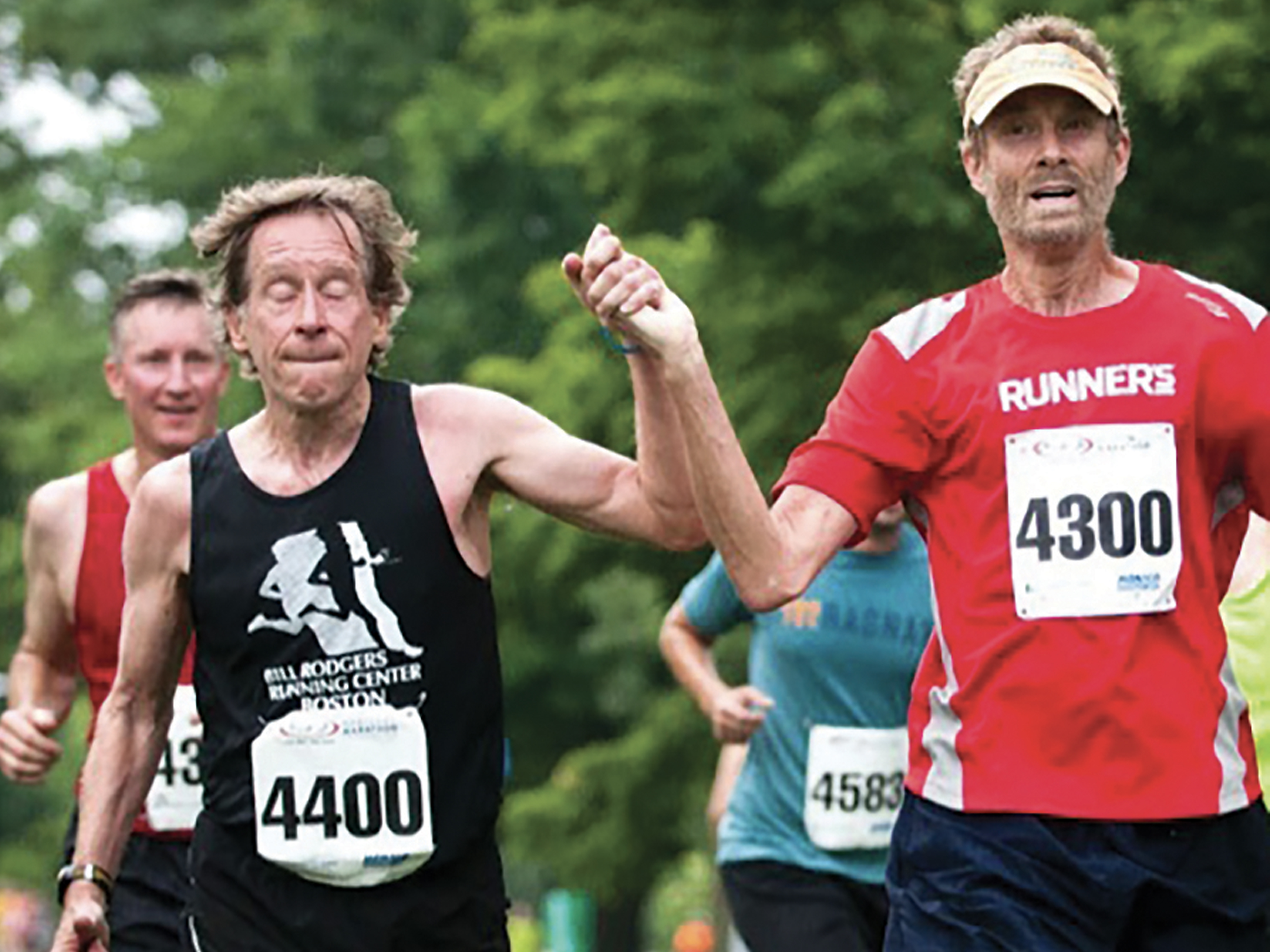
After graduating Wesleyan, the three runners had an enduring influence on the trajectory of American running. Photo courtesy of Amby Burfoot
Burfoot spent four years splitting his time between studying in the library and a monkish pursuit of greater distances. He found a kindred spirit in Galloway, the quiet, methodical marathoner and history major one class above him. Soon, they were roommates logging extracurricular mileage together every day along Route 66, up hills, and through the woods. And while college athletes are notorious for turning training into pitched battles, Burfoot says he and Galloway never raced each other: they both understood that only steady, consistent effort would take them where they wanted to go. “I don’t use the word ‘perfect’ often, but it was a near-perfect partnership,” Burfoot says.
When Galloway graduated, Burfoot became a mentor to Rodgers, a sociology major: the latter credits the former with inspiring him to run longer distances, even when Rodgers’s natural talent fell short. When Burfoot ran grind-it-out 25-milers to prep for Boston, Rodgers would meet up with him for the final 15. Once Rodgers thought that he, the fresher runner, was actually pushing Burfoot. But as the last few miles approached, Rodgers recalls, “He turned to me and said, ‘Bill, I gotta go now.’ He took off like a lightning bolt and just disappeared.”
When Burfoot returned to campus as the Boston Marathon champion, his track teammates applauded the major achievement he’d accomplished. Otherwise, the reception was muted. Asked what Coach Swanson said to him upon his return, Burfoot draws a blank. “We would have had much sharper memories of everything that happened in those years at Wesleyan if we knew that they were important, almost historical-era days,” he says with a chuckle. “But we were just three skinny guys who were running at a college that was not a running college. We didn’t think there was anything remarkable in our futures ahead of us.”
“I never would have been a success in a Division I school, that type of environment,” says Rodgers. “I needed a place like Wesleyan, which was a bit more relaxed, and you could find what you wanted in school, and maybe in life.”
In graduating at the height of the Vietnam War, the trio took detours. Galloway enlisted in the Navy before moving to Florida to teach, while Burfoot taught elementary school and served in the Peace Corps. But they both kept training and competing: Burfoot came within a second of the American record at the Fukuoka Marathon, while Galloway represented the United States in the 10k at the watershed 1972 Olympics.
In 1973—the same year he registered a national 10-miler racing record—Galloway and his wife, Barb, opened the country’s first specialty running store in Atlanta: Phidippides, named for the courier in the original Greek marathon myth. The franchise eventually encompassed 60 locations across the country, becoming a hub for a growing running culture. “[Running stores are] the vehicle of connection,” says Westin Galloway, Jeff’s son and a former collegiate runner. “They serve as great community builders, places where you know you’ll have camaraderie with like-minded people who are doing something good for you.”
Meanwhile, Rodgers stopped running altogether. After Wesleyan, Rodgers moved to Boston to work as a hospital orderly, a condition of his conscientious objector status. He saw no viable way to keep on running, so he took to smoking Winstons and riding a motorcycle instead. After a few years’ hiatus, however, his listlessness became restlessness. He’d see old teammates and old rivals at the finish line in Boston, right around when Galloway’s training partner Frank Shorter took marathon gold at the ’72 Olympics and running started seizing America’s imagination. Rodgers joined up with the Greater Boston Track Club and entertained 26.2-mile dreams of his own.
“After a while I said, ‘You know, I don’t need these cigarettes so much,’ and I started running a little bit,” says Rodgers. “As soon as you do that, you change your life.”
By compiling a racing résumé with few equals, Rodgers became the face of elite American running in the latter half of the 1970s. After a few stops to drink water and tie his Nikes, he set an American record with his first Boston Marathon victory in 1975. He won the race three more times by 1980, breaking the record again in 1979. Dubbed “Boston Billy” by the sports media, Rodgers’s rivalry with Shorter helped define the decade. After stumbling through an injury at the 1976 Olympics and finishing 39 spots behind Shorter, the silver medalist, Rodgers finished first at the landmark New York City Marathon that same year, just over three minutes ahead of his then-more-famous rival. He won that race three consecutive years after that too.
But Rodgers’ 60-marathon racing career represents a fraction of his impact. The sport’s amateur status meant top athletes scraped by on day jobs, appearance fees, and under-the-table payments. But Rodgers, who first made ends meet as a schoolteacher, demonstrated how elite runners might earn an income solely from sport, becoming one of the first runners to sell branded apparel and following Galloway’s footsteps in opening the Bill Rodgers Running Center retail chain in Greater Boston. “This way, you could make a living, and you’d be free to do the summer road races,” he says. More critically, Rodgers helped professionalize the sport: he and Shorter were driving forces behind the Association of Road Racing Athletes, a group of elite runners whose efforts through the early 1980s compelled major marathons to offer truly substantial prize money.
And as road races cropped up from Cape Cod to Davenport, Iowa, organizers sought him out to compete and stay for the after-race festivities, further boosting interest and participation. Back then, Burfoot says, “Bill was the everyman of running. He was the guy who could win the races, then be your best friend the next moment. He created this camaraderie, which is the word runners always use to describe the feelings of closeness they have with all the other runners out there. Bill lived the role, and he didn’t live it as a marketing strategy.”
Amidst a fitness boom encompassing everything from weightlifting to Jazzercise, an estimated 25 million people took up running in the 1970s. Events like the Peachtree Road Race in Atlanta, a 10k that Galloway helped organize, swelled from 1,200 runners in 1975 to 12,000 in 1978. Nike, the market leader in running shoes, saw annual sales grow from $2 million in the early 1970s to $694 million in 1982. Along with the passage of Title IX, women runners became elite competitors accepted into places where they’d previously been barred, like the Olympics and the Boston Marathon. The Complete Book of Running by Jim Fixx, father of Wesleyan track standout John Fixx ’83, deserves special credit for igniting the running boom when it was released in 1978, Burfoot says.
That’s also the year Burfoot became a writer and editor at the leading magazine Runner’s World. Originally hired to lend a hardcore racer’s perspective to a publication with “a little too much of a granola and transcendental meditation” reputation, he eventually became editor-in-chief for nearly 20 years. “It was as close to a dream job as you can get, and I don’t have rose-colored glasses,” says Burfoot, who also authored five books on running. Along with chronicling the ascent of stars like Joan Benoit Samuelson and paradigm shifts at the sport’s elite levels, Burfoot observed in real time as running shed its self-imposed limits to welcome runners of all ages, genders, and ethnicities.
“The sport is open, it’s everywhere, it’s inclusive,” Burfoot says. “We just need more people like Jeff Galloway to say, ‘There is a way for you to become part of this sport. It’s not as impossible as it appears from the outside.’”
While Galloway remained a high-level competitor well into his 30s, his gentle charisma and authentic desire to help others made him an apostle of running, sharing with others the life-changing potential of a once-inscrutable sport. “He was able to pivot early enough, and he became determined to change the lives of other people for the better,” Barb Galloway adds.
Beyond his retail enterprises, Galloway’s signature contribution is the racing and training protocol that bears his name. “Gallowalking” or “Jeffing” is a method centered around intervals of running and walking—say, two minutes of running and 30 seconds of walking, repeated over 20 minutes—to build endurance and improve performance. He shared its nuances in running retreats and clinics, in more than 20 tomes like Galloway’s Book on Running, and in the beginner-friendly workouts he crafted as a longtime training consultant for Disney’s wildly popular road racing series. It’s difficult to ballpark the number of lives Galloway touched; depending on one’s definition of “coaching,” Barb says, a million people would be a low-end estimate.
“I only mean this positively: Jeff was like a southern preacher,” Rodgers says. “He was someone from this unique world, he loved what he was doing, and he knew how to help people. Not many can really say that.”
Burfoot counts Galloway among the single most important figures in the sport’s history. “He really democratized running,” he says. “He took it to people who didn’t understand that they could call themselves runners, that it was okay to finish a marathon in six or seven or eight hours if that’s what you took—because to you, the meaning of that finish is just as important as a Bill Rodgers Boston Marathon victory or Frank Shorter Olympic victory.”
After Galloway passed away from complications of a stroke earlier this year, tributes poured in. His pupils talked about how his methods helped them run their first half marathon, lose weight and stabilize their blood pressure, and find community around a healthy hobby. “The tributes that hit me the hardest were the ones that said, ‘I never met him, but he changed my life,’” Westin says.
-
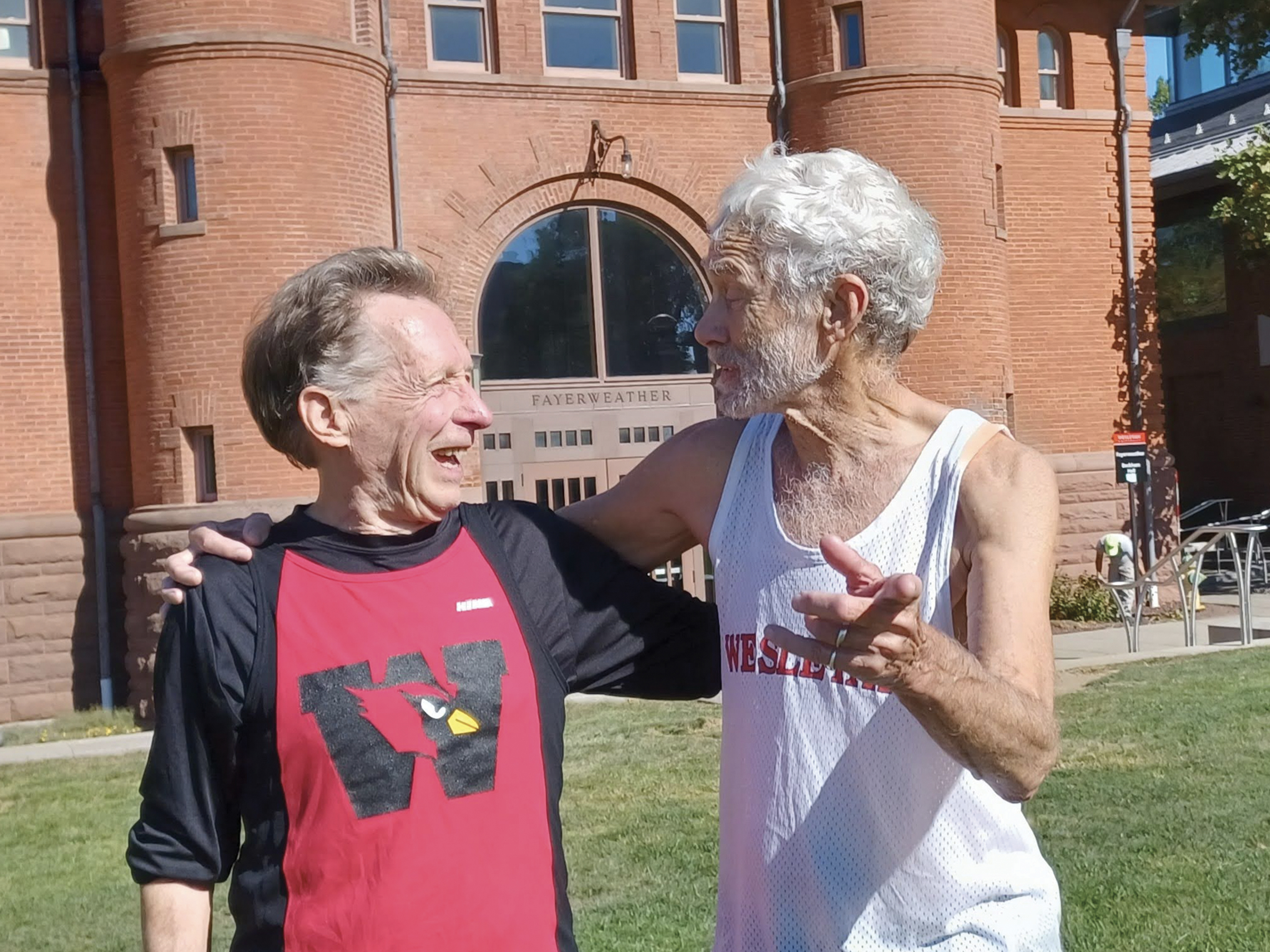
Each impacted the sport in different ways. Rodgers (left) won four Boston and four New York City Marathons. As an editor at Runner's World, Burfoot became a chief chronicler of an ascendant sport.
-
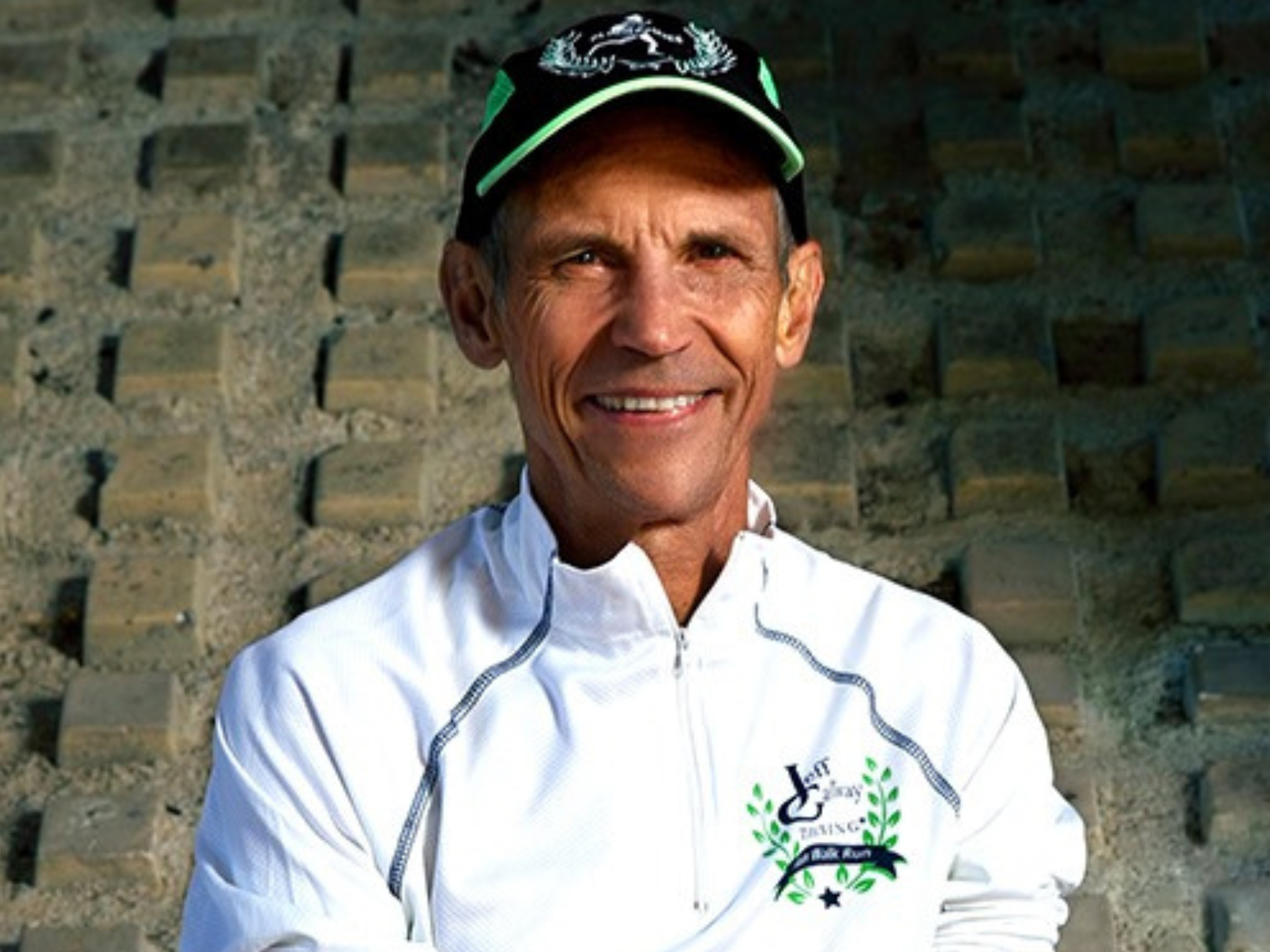
After competing in the 1972 Olympics, Galloway developed his run-walk training method and opened the first running retail stores.
-
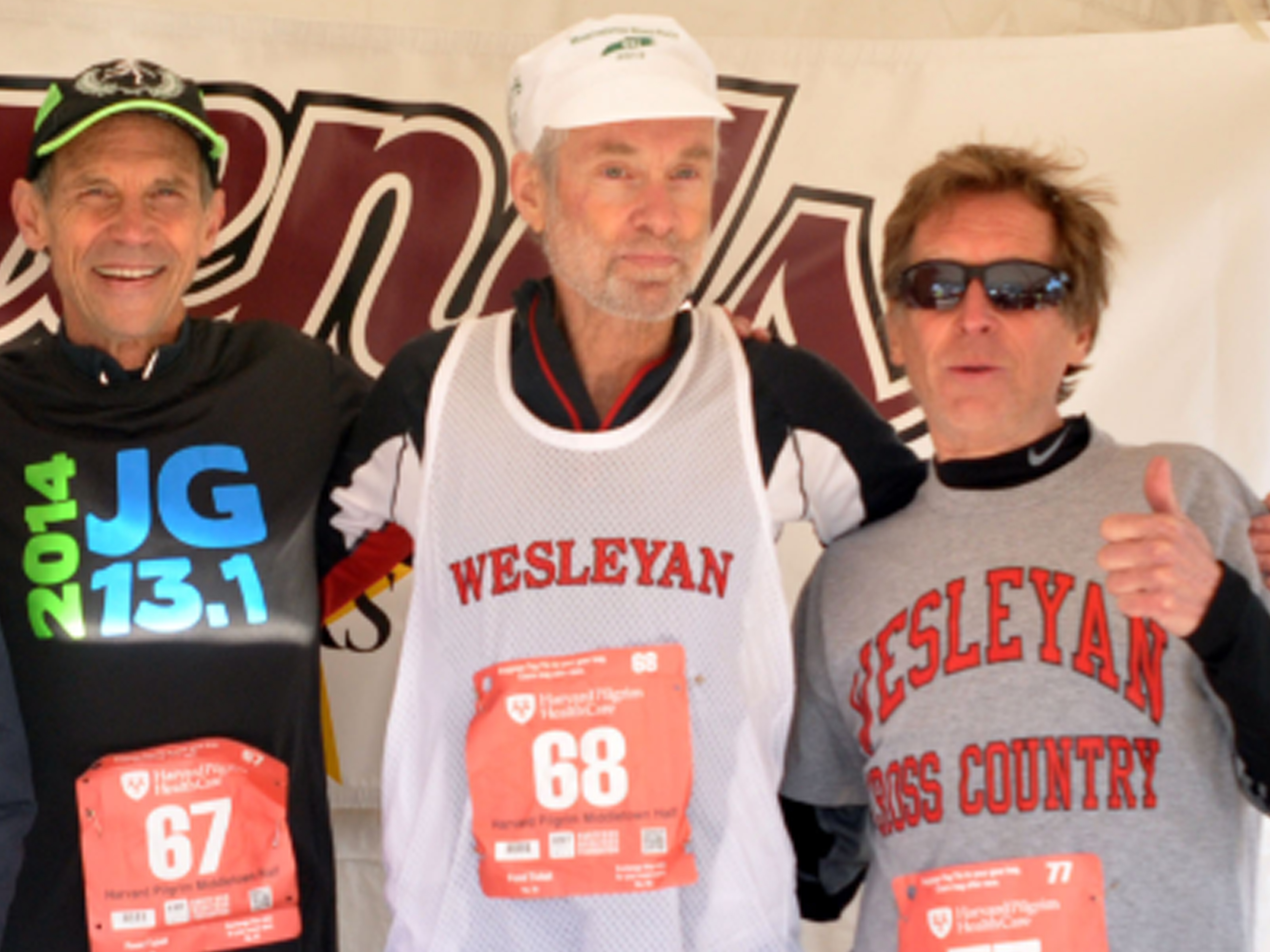
The trio (from left: Galloway, Burfoot, and Rodgers) remained closely connected to an ever-growing running culture decades after their competitive peaks, helping others discover the sport they loved so deeply.
Today, running is as big as it’s ever been. The global market for running shoes alone is projected to reach $77 billion by 2032. A single race—the 2024 New York City Marathon—infused almost $700 million into the city’s economy. It’d be foolish to credit the economics of modern-day running to a trio of Division III runners, but it’d be misguided to ignore their pioneering impact. “Phidippides, Bill’s running stores, [Amby’s] writing—all of them were early entrepreneurs in this space, which created an industry where I’ve been able to make a living,” says Accetta, who founded a running event and coaching business 20 years ago, called Run Tucson.
And these days, Rodgers and Burfoot are testaments to the relationship between running and lifelong fitness. Though long retired from marathoning, the 78-year-old Rodgers runs (or Gallowalks) about 25 miles a week and still enters the occasional 10k or half marathon. “I have, like, 185,000 miles on my body,” he says. “I’m like an old car.”
Now 80 years old, Burfoot co-hosts the Running: State of the Sport podcast and remains a steady presence at the Manchester Road Race, a 4.7-ish-mile race he’s run every year since 1963. Even in retrospect, the idea that he and his Wesleyan teammates would come to have a profound influence on the sport they love so much seems beyond belief.
“We were just guys running cross-country and track, among millions in the country,” he says. “In hindsight, the fact that three of us came together at this small, wonderful little university that encouraged individual exploration, and that we would have rather outsized influences on the development of running—I mean, the chances of that are one in a million, one in a billion.”
Lead image: Amby Burfoot. Image courtesy of Wesleyan Special Collections and Archives