

Study: Can Plants Anticipate Help?
While studying caterpillars that live on white oak trees in Connecticut forests a couple of years ago, Professor of Biology and of Environmental Studies Michael Singer stumbled upon a mystery. As Singer and colleagues reported in a prior study, parasitic wasps that would typically infect caterpillars in the oak trees were absent. For some reason, the presence of sap-eating insects on the same tree branches was disrupting the wasps, which form part of the plant’s defense against caterpillars.
Scientists have long known that plants have different ways of defending themselves, including using chemical signals to “cry for help” from predators like parasitic wasps that eat caterpillars. “When a plant is getting attacked by an herbivore, like a caterpillar, for example, the plant can emit signals,” Singer said. These signals come in the form of volatile organic compounds, or chemicals that produce an odor that influences the behavior of animals in the environment. “Predators of the herbivore attacking the plant can smell those compounds and basically orient toward the herbivore to attack and consume it, thereby saving the plant.”
That decades-old cry-for-help theory has been tested and proven in laboratory settings. Knowing that, Singer wondered why parasitic wasps were not helping the tree with its caterpillar problem when sap-eating herbivores were also present. A follow-up experiment showed that birds were coming to the rescue instead. Birds took twice as many caterpillars as usual when sap-eating insects were present. That finding prompted Singer to speculate that plants might have evolved the ability to shut down one form of defense against herbivores while mounting another in anticipation of “help” from a third party.
To explore the “anticipating help” hypothesis, Singer and his team of Wesleyan student researchers combed the scientific literature on plant defense theory. They examined published studies of plant defense against caterpillars after sap-eating insects, such as aphids, had fed on the same plant. Some aphids recruit ants, which often attack caterpillars on the same plant. When the researchers compared plant defenses against caterpillars, they found that plants dampened their anti-caterpillar defenses only after experiencing feeding from aphids known to recruit ants. While the plants couldn't detect ants directly (because no ants were present in the published studies), plants appear to detect cues that predict their presence and protection.
“That was the exciting thing about [the research],” he said, “it seemed to show a level of anticipation from the plant that was surprising.” While it may seem counterintuitive that a plant would benefit from the presence of some herbivores and not others, it’s not. “You'd think this is definitely bad for the plant, but the benefit comes from the ants being around and kind of aggressively eating other kinds of herbivores that are often more damaging to the plant, like caterpillars,” said Singer.
Co-author and post-doctoral student Tamara Kancoglu added, “We predicted that plants may have more agency in perceiving and responding to cues from herbivores than previously understood.”
By outsourcing their defense to ants and other predators, plants also save energy that can be redirected toward plant growth or reproduction.
In addition to providing an answer to a mystery about plant defense, Singer’s research finding has implications for agriculture. Farmers already use biological enemies of crop pests to control those pests and reduce pesticide use. That practice is known as biological control. But if farmers knew which predators a plant is anticipating help from, they could focus biological control and conservation efforts on those predators in agricultural settings. This would enable the plant to accurately “anticipate help” and reap the benefits.
“Then the plant can reallocate those cost savings toward growth and reproduction, and ultimately, more of the crop you're trying to grow,” Singer said. “So, it could be economically advantageous to do that.”
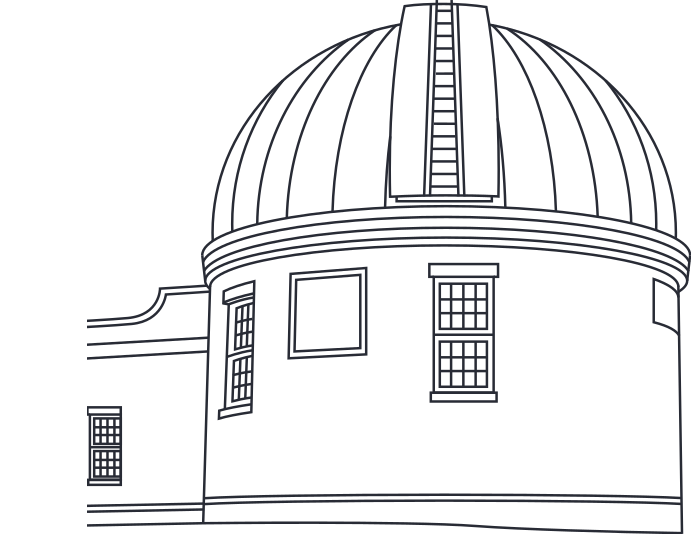
Illustrations by Hartmut Doerwaldt ’25, co-author and current BA/MA student, enlivened the pages of the article, which is published in Ecology Letters.