
2026 Binswanger Prizes for Excellence in Teaching
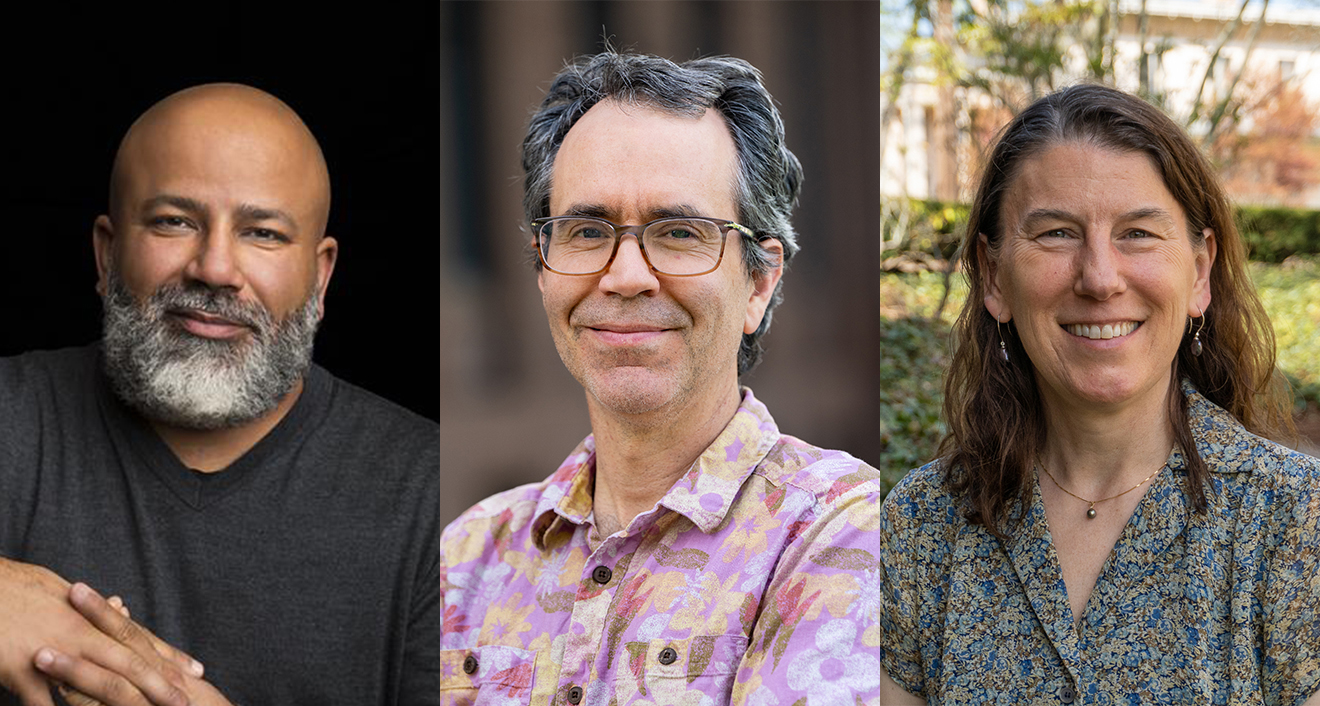
Each year at Commencement, Wesleyan University recognizes three outstanding faculty members with the awarding of the Binswanger Prizes for Excellence in Teaching. The University is delighted to announce that this year’s recipients are Anthony Ryan Hatch, professor of science and technology studies; Dana Royer, professor of earth and environmental sciences; and Stephanie Kuduk Weiner, professor of English.
Underscoring Wesleyan’s commitment to its scholar-teachers, these annual prizes are made possible by gifts from the family of the late Frank G. Binswanger Sr., Hon. ’85. Recipients are chosen each spring by a committee composed of faculty and members of the Alumni Association Executive Committee, based upon strong recommendations from alumni of the last 10 graduating classes, as well as current juniors, seniors, and graduate students. This year’s winners were lauded especially for their outstanding support and encouragement, holding students to the highest standards while giving generously of their time and knowledge both in and out of the classroom.
The nominating committee highlighted the significant impact these three faculty members have had on their students. A nominator stated, “[Professor Weiner] has changed my outlook on poetry and its role in my life.” Regarding Professor Hatch, one student noted that he encouraged them “to become the thinker, scholar, and writer I am today through honest, intensive, and involved guidance.” About Professor Royer, another student commented that he is “the true embodiment of a professor who goes above and beyond for his students.”
Please join us in congratulating these three remarkable teachers (bios below) as they join the distinguished group of previous Binswanger recipients.
2026 Binswanger Prizes for Excellence in Teaching Recipients
Anthony Ryan Hatch, Professor of Science and Technology Studies
Anthony Ryan Hatch is a professor of science and technology studies whose research examines how social structures shape biomedicine, the development and use of medical technologies, and patterns of health inequality. Along with affiliations in the departments of African American studies and sociology and the Bailey College of the Environment, Hatch is the director of the Center for the Humanities and co-director of Black Box Labs, a laboratory offering undergraduate students qualitative research training in science and technology studies.
Hatch earned an AB in philosophy from Dartmouth College, and an MA and PhD in sociology from the University of Maryland, College Park. Since joining Wesleyan’s faculty in 2015, he has served as faculty coordinator for the Sustainability & Environmental Justice Pedagogical Initiative and as faculty advisor to the College of Design and Engineering Studies, Center for Prison Education, Creative Campus Initiative, and the Embodying Antiracism Initiative. Hatch has served on a range of national and international scientific advisory boards—most recently a National Academy of Medicine committee—and is the author of publications including Silent Cells: The Secret Drugging of Captive America and Blood Sugar: Racial Pharmacology and Food Justice in Black America, as well as a co-author of The Racial Cage.
Dana Royer, George I. Seney Professor of Geology and Professor of Earth and Environmental Sciences
Dana Royer is the George I. Seney Professor of Geology and a professor of earth and environmental sciences. His research focuses on how fossil plants can be used to reconstruct ancient environments, as well as the physiological underpinnings behind plant-environment relationships. Royer’s work includes the reconstruction of atmospheric carbon dioxide levels from stomatal distributions in fossil leaves, and the development of climate and leaf ecology proxies based on leaf size and shape. He also compiles carbon dioxide records over Earth’s history and investigates the strength of carbon dioxide-temperature coupling over multimillion-year timescales.
After receiving a BA from the University of Pennsylvania, a PhD from Yale University, and completing a post-doctoral fellowship at Pennsylvania State University, Royer joined Wesleyan in 2005. He regularly teaches courses on soils and Earth history and rotates through multiple introductory courses and the department capstone senior seminar. While at Wesleyan, Royer has served as department chair and as a board of control member at the Connecticut Agricultural Experiment Station. Additionally, he has helped lead a multi-institution, National Science Foundation–funded project for standardizing and improving the deep-time paleo-carbon dioxide record.
Stephanie Kuduk Weiner, Professor of English
Stephanie Kuduk Weiner is a professor of English. Her courses examine 19th-century British literature and culture, literary representations of London, the comedic novel, and stories of action and adventure. Her current research projects investigate poetry and music, including the practices of writing and singing hymns and psalms; secular and sacred time; and literary experiments with the historicity and multiplicity of the English language.
Weiner earned a BA in English and women’s studies from the University of Minnesota and a PhD in modern thought and literature from Stanford University. She has published widely on 19th-century British poetry, including articles about political expression, print and oral cultures, and poetic representations of sensory experience. She is the author of two scholarly books: Clare’s Lyric: John Clare and Three Modern Poets, about strategies of poetic realism in the work of English poet John Clare as well as poets he inspired, and Republican Politics and English Poetry, 1789–1874, about poets who were activists against the British monarchy in the 19th century. A member of Wesleyan’s faculty since 1999, Weiner previously received the Binswanger Prize for Excellence in Teaching in 2010.