
2026 BINSWANGER PRIZES FOR EXCELLENCE IN TEACHING
Each year, Wesleyan University recognizes three outstanding faculty members with the awarding of the Binswanger Prizes for Excellence in Teaching. Underscoring Wesleyan’s commitment to its scholar-teachers, these annual prizes are made possible by gifts from the family of the late Frank G. Binswanger Sr., Hon’85. Recipients are chosen each spring by a committee composed of faculty and alumni based upon recommendations from alumni of the last 10 graduating classes, as well as current juniors, seniors, and graduate students.
-
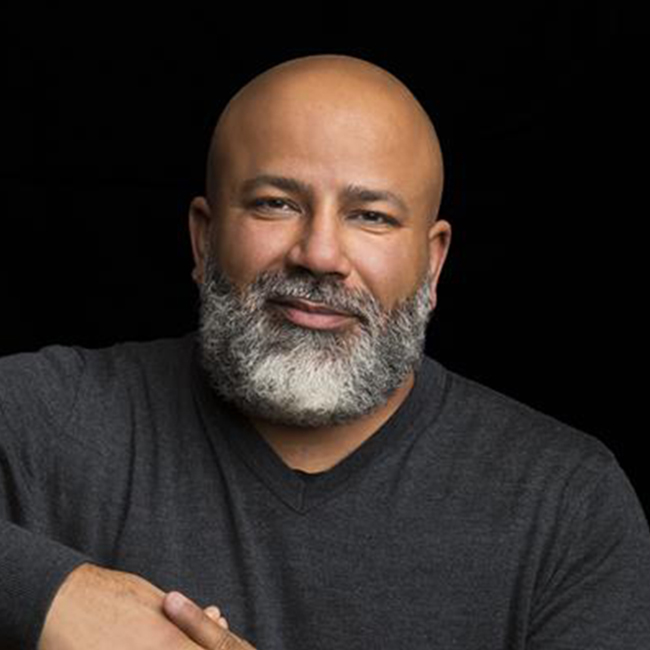
Anthony Ryan Hatch
Professor of Science and Technology Studies
Anthony Ryan Hatch is a professor of science and technology studies whose research examines how social structures shape biomedicine, the development and use of medical technologies, and patterns of health inequality. Along with affiliations in the departments of African American studies and sociology and the Bailey College of the Environment, Hatch is the director of the Center for the Humanities and co-director of Black Box Labs, a laboratory offering undergraduate students qualitative research training in science and technology studies.
Hatch earned an AB in philosophy from Dartmouth College, and an MA and PhD in sociology from the University of Maryland, College Park. Since joining Wesleyan’s faculty in 2015, he has served as faculty coordinator for the Sustainability & Environmental Justice Pedagogical Initiative and as faculty advisor to the College of Design and Engineering Studies, Center for Prison Education, Creative Campus Initiative, and the Embodying Antiracism Initiative. Hatch has served on a range of national and international scientific advisory boards—most recently a National Academy of Medicine committee—and is the author of publications including Silent Cells: The Secret Drugging of Captive America and Blood Sugar: Racial Pharmacology and Food Justice in Black America, as well as a co-author of The Racial Cage. -
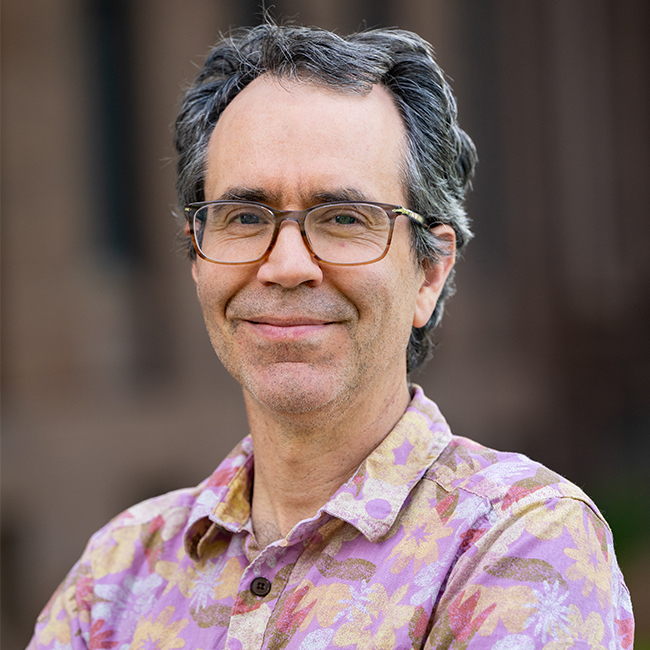
Dana Royer
George I. Seney Professor of Geology and Professor of Earth and Environmental Sciences
Dana Royer is the George I. Seney Professor of Geology and a professor of earth and environmental sciences. His research focuses on how fossil plants can be used to reconstruct ancient environments, as well as the physiological underpinnings behind plant-environment relationships. Royer’s work includes the reconstruction of atmospheric carbon dioxide levels from stomatal distributions in fossil leaves, and the development of climate and leaf ecology proxies based on leaf size and shape. He also compiles carbon dioxide records over Earth’s history and investigates the strength of carbon dioxide-temperature coupling over multimillion-year timescales.
After receiving a BA from the University of Pennsylvania, a PhD from Yale University, and completing a post-doctoral fellowship at Pennsylvania State University, Royer joined Wesleyan in 2005. He regularly teaches courses on soils and Earth history and rotates through multiple introductory courses and the department capstone senior seminar. While at Wesleyan, Royer has served as department chair and as a board of control member at the Connecticut Agricultural Experiment Station. Additionally, he has helped lead a multi-institution, National Science Foundation–funded project for standardizing and improving the deep-time paleo-carbon dioxide record. -
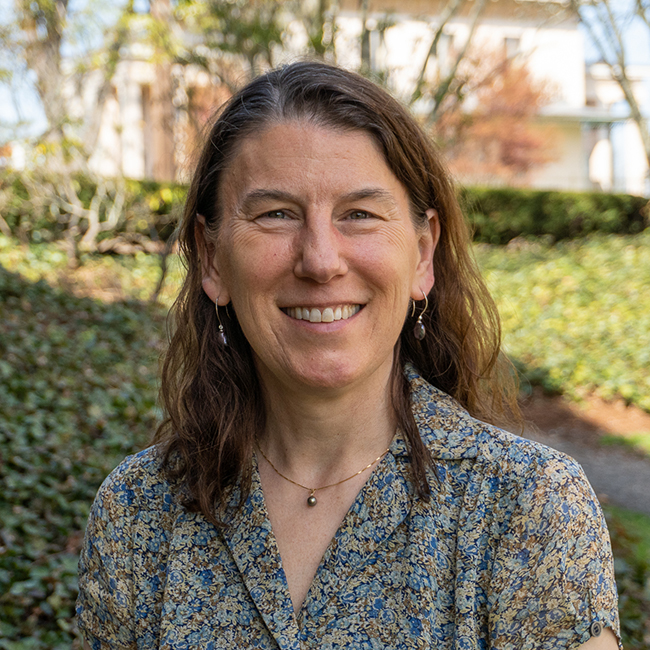
Stephanie Kuduk Weiner
Professor of English
Stephanie Kuduk Weiner is a professor of English. Her courses examine 19th-century British literature and culture, literary representations of London, the comedic novel, and stories of action and adventure. Her current research projects investigate poetry and music, including the practices of writing and singing hymns and psalms; secular and sacred time; and literary experiments with the historicity and multiplicity of the English language.
Weiner earned a BA in English and women’s studies from the University of Minnesota and a PhD in modern thought and literature from Stanford University. She has published widely on 19th-century British poetry, including articles about political expression, print and oral cultures, and poetic representations of sensory experience. She is the author of two scholarly books: Clare’s Lyric: John Clare and Three Modern Poets, about strategies of poetic realism in the work of English poet John Clare as well as poets he inspired, and Republican Politics and English Poetry, 1789–1874, about poets who were activists against the British monarchy in the 19th century. A member of Wesleyan’s faculty since 1999, Weiner previously received the Binswanger Prize for Excellence in Teaching in 2010.
Previous Binswanger Recipients
Recipients of the Binswanger Prize for Excellence in Teaching 1993-present.-
Recipients
- 2026: Anthony Ryan Hatch, Dana Royer, Stephanie Kuduk Weiner
- 2025: David Constantine, Logan Dancey, Camilla Zamboni
- 2024: Abigail S. Hornstein, Michelle Aaron Murolo, Rashida Z. Shaw McMahon
- 2023: Matthew Garrett, A. Meredith Hughes, Tushar Irani
- 2022: Frederick M. Cohan, Maria Ospina, Victoria Smolkin
- 2021: Sonali Chakravarti, Douglas A. Martin, Anna Shusterman
- 2020: Gloster Aaron, Robyn Autry, Keiji Shinohara
- 2019: Erika Franklin Fowler, Brian Northrop, Joseph Siry
- 2018: Lisa Dombrowski ’92, Iddrisu Saaka, Erika A. Taylor
- 2017: John E. Finn, Andrea Roberts, Mary-Jane Rubenstein
- 2016: Sally Bachner, Demetrius Eudell, James Lipton
- 2015: Michael Calter, David Schorr, Gina Ulysse
- 2014: Petra Bonfert-Taylor, Robert Steele, Xiaomiao Zhu
- 2013: Phillip Wagoner, Erik Grimmer-Solem, Jeanine Basinger
- 2012: Richard Adelstein, Nathanael Greene, Tula Telfair
- 2011: Wai Kiu Chan, Scott Higgins, Scott Plous
- 2010: Peter Rutland, Stephanie Kuduk Weiner, Jeremy Zwelling
- 2009: Douglas C. Foyle, Irina Russu, John G. Seamon
- 2008: Elizabeth McAlister, Howard I. Needler, Renee Christine Romano
- 2007: Joyce Jacobsen, Richard Slotkin, T. David Westmoreland
- 2006: Stephen Angle, Anthony Braxton, Anne Greene
- 2005: Jonathan Cutler, Jelle De Boer, Karl Scheibe
- 2004: Allan Berlind, Sean McCann, James McGuire
- 2003: William Herbst, Joseph Rouse, Janice Willis
- 2002: Susan Lourie, Cecilia Miller, Franklin Reeve
- 2001: Richard Elphick, Gayle Pemberton, Gilbert Skillman
- 2000: Jon Barlow, Ronald Cameron, Rob Rosenthal
- 1999: Donald Moon, Khachig Tölölyan, Hope Weissman
- 1998: Indira Karamcheti, Scott Plous, Ashraf Rushdy
- 1997: John Paoletti, Claire Potter, Richard Slotkin
- 1996: Jeanine Basinger, Andrew Szegedy-Maszak, Ann Wightman
- 1995: Henry Abelove, Ralph Baierlein, Martha Crenshaw
- 1994: Christina Crosby, John E. Finn, Joseph Siry
- 1993: Richard Adelstein, George Creeger, Cheryl Cutler
Binswanger Prize Criteria and Regulations
The standards and criteria for the annual prizes shall be excellence in teaching, as exemplified by commitment to the classroom and student accomplishment, intellectual demands placed on students, lucidity, and passion. Recommendations may be based on any of the types of teaching that are done at the University including, but not limited to, teaching in lecture courses, seminars, laboratories, creative and performance-based courses, research tutorials and other individual and group tutorials at the undergraduate and graduate level.
-
Section I: Eligibility Current faculty who have taught at Wesleyan for at least 10 years are eligible. Previous recipients are excluded for a period of 12 years after which they become eligible once again.
-
Section II: Selection Critieria The criteria for selecting the recipients shall be excellence in teaching, as exemplified by commitment to the classroom and student accomplishment, intellectual demands placed on students, lucidity and passion. Recommendations may be based on any of the types of teaching that are done at the University including, but not limited to, teaching in lecture courses, seminars, laboratories, creative and performance-based courses, research tutorials and other individual and group tutorials at the undergraduate and graduate level.
-
Section III: Granting of Prizes One to three recipients shall be chosen each year in accordance with these Regulations. The names of the recipients shall be communicated to the University by a designated committee member, and the Prizes shall be awarded at Commencement by the Chair of the Alumni Association.
-
Section IV: Understanding Between the Alumni Association and the University Sections I, II, III, and IV of these regulations reflect the current understanding between the Alumni Association and the University with respect to the Prize. The University reserves the right to make changes to the Prize, including but not limited to the Terms of Eligibility; Selection Criteria; number, dollar value, and timing of the Prize. The University also reserves the right to reassign responsibility for administering the selection process and to notify the Chair of the Alumni Association of any changes at least two weeks prior to the fall meeting of the Executive Committee, during the school year for which such changes are to be applicable. The Alumni Association reserves the right not to maintain responsibility for administering the selection process. The Chair of the Association will notify the University of any change no later than one week following the fall meeting of the Executive Committee during the school year for which that decision is applicable.
-
Section V: Selection Committee There shall be a Selection Committee, consisting of 5-7 members (one of whom shall be its Chair), whose duty it shall be, among other duties, to canvass students and alumni for recommendations and to convene in the spring to consider these recommendations and choose the recipients of the Binswanger Prize for Excellence in Teaching.
The Selection Committee will consist of the vice chair of the Alumni Association, three faculty members representing each of the three academic divisions, and up to three members at large, all to be selected by the Chair of the Alumni Association. Members of the Selection Committee shall serve a maximum of four years in any seven-year period. The Chair will appoint members of the Selection Committee such that, in any year, at least one faculty member and one other member of the Selection Committee shall have served on the Selection Committee the previous year. The chair of the Alumni Association will designate one member of the Selection Committee to serve as Chair of the Selection Committee.
-
Section VI: Selection Procedure Alumni eligible to submit recommendations shall consist of the members of each of the last ten graduating classes, (BA and graduate alumni), and current juniors, seniors, and graduate students. Alumni shall be contacted solely by email.
At least ten weeks prior to the scheduled meeting of the Selection Committee, the Committee shall send to alumni with known email addresses in the appropriate classes, and current juniors, seniors, and graduate students an email requesting up to three recommendations, ranked in order of preference, with written comments optional. An alphabetical list of eligible faculty with departmental affiliations will be included. The Selection Committee shall contact the three academic deans requesting any information they consider relevant to awarding the Prize. Two weeks after the initial mailing a second email will be sent to eligible alumni with known email addresses, and current juniors, seniors, and graduate students. All recommendations received up to two weeks prior to the scheduled meeting of the Selection Committee will be accepted.
The recommended faculty members will be ranked as follows: Three points are given for a first place showing, two points for a second place showing, and one point for a third place showing. Based upon these rankings, the Selection Committee will request from the Office of Academic Affairs the teaching evaluations of a group of faculty for review by the Committee.
The Selection Committee shall make its determinations in accordance with the Selection Criteria. In making its determinations, the Committee may consider the number of recommendations and point total received by faculty members, the quality of their teaching evaluations, the quality of comments included with recommendations, whether a candidate has been recommended in previous years, whether a candidate has been awarded the Prize in previous years, and such other factors as the Selection Committee may deem relevant.
The Chair of the Selection Committee shall notify the Chair of the Alumni Association of the Selection Committee's determinations.
-
Section VII: Amendments Any amendment to these Regulations shall be approved by the Executive Committee of the Alumni Association.
As adopted by the Alumni Association Executive Committee on March 4, 2000 and amended on October 21, 2000, March 4, 2001, November 2, 2001, September 21, 2003, September 24, 2005, and November 1, 2008.