
Belzberg World Music Hall Anchors a Global Legacy
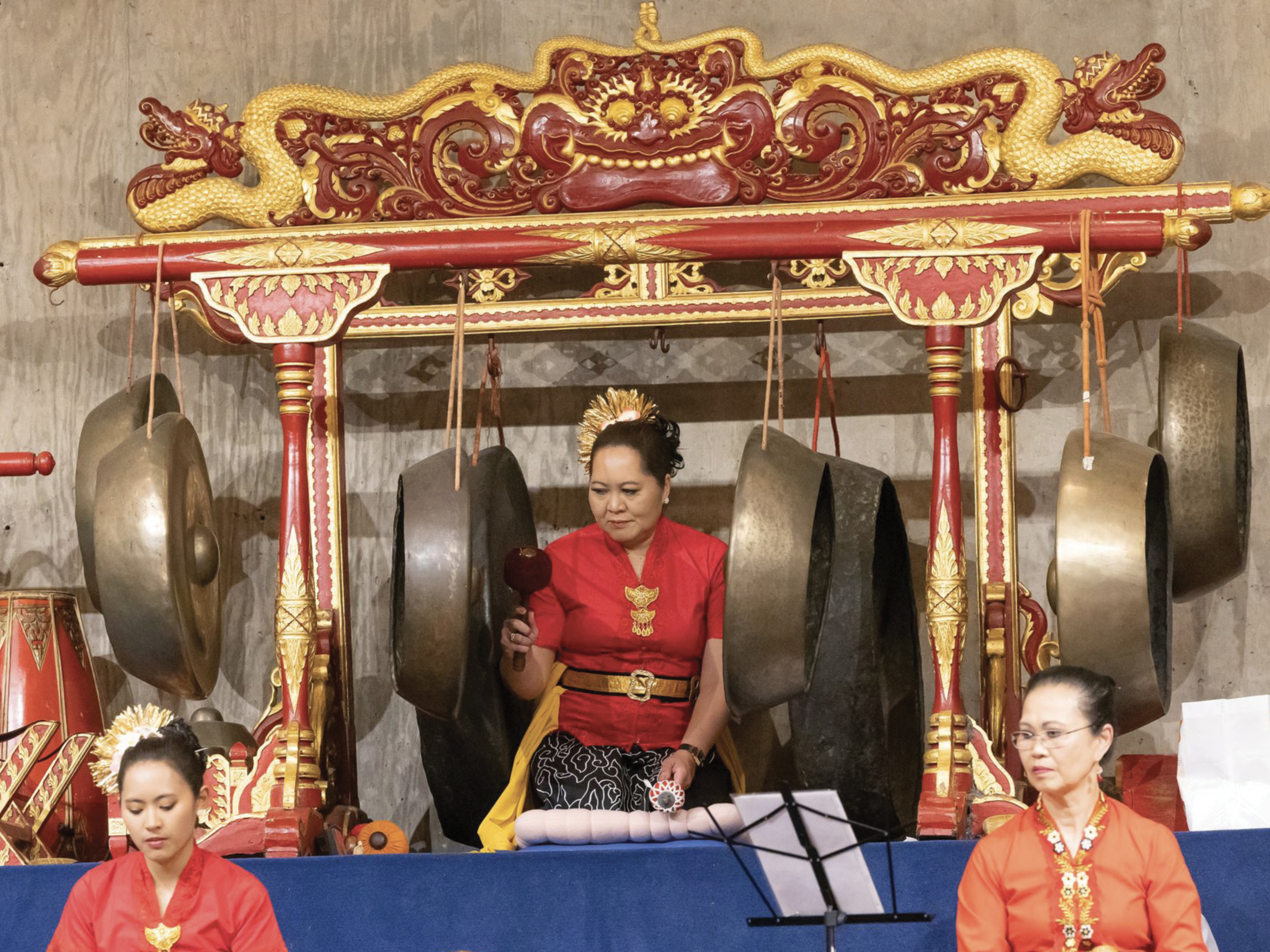
The sounds are minimalist—short, repetitive melodic fragments that weave together and evolve slowly into hypnotic, trance-like soundscapes. The instruments from which they emanate crowd a full stage, a crimson-and-gold orchestra of bronze gongs and metallophones, wooden xylophones, drums, bowed- and plucked-string instruments, flutes, and vocalists. And for more than 50 years, generations of Wesleyan students and Middletown residents have ambled through the Center for the Arts campus to experience a performance of this traditional Central Javanese gamelan, an experience resonant with meaning.
“The gamelan provides an anchor for Wesleyan’s long-standing commitment to the teaching and practice of world music,” said Joshua Lubin-Levy ’06, director and chief curator of the Center for the Arts. “Students come into Belzberg World Music Hall, and they get to see art that they would never have encountered in their lives, or art that speaks to their family and their ancestry in a way that makes them feel a sense of belonging.”
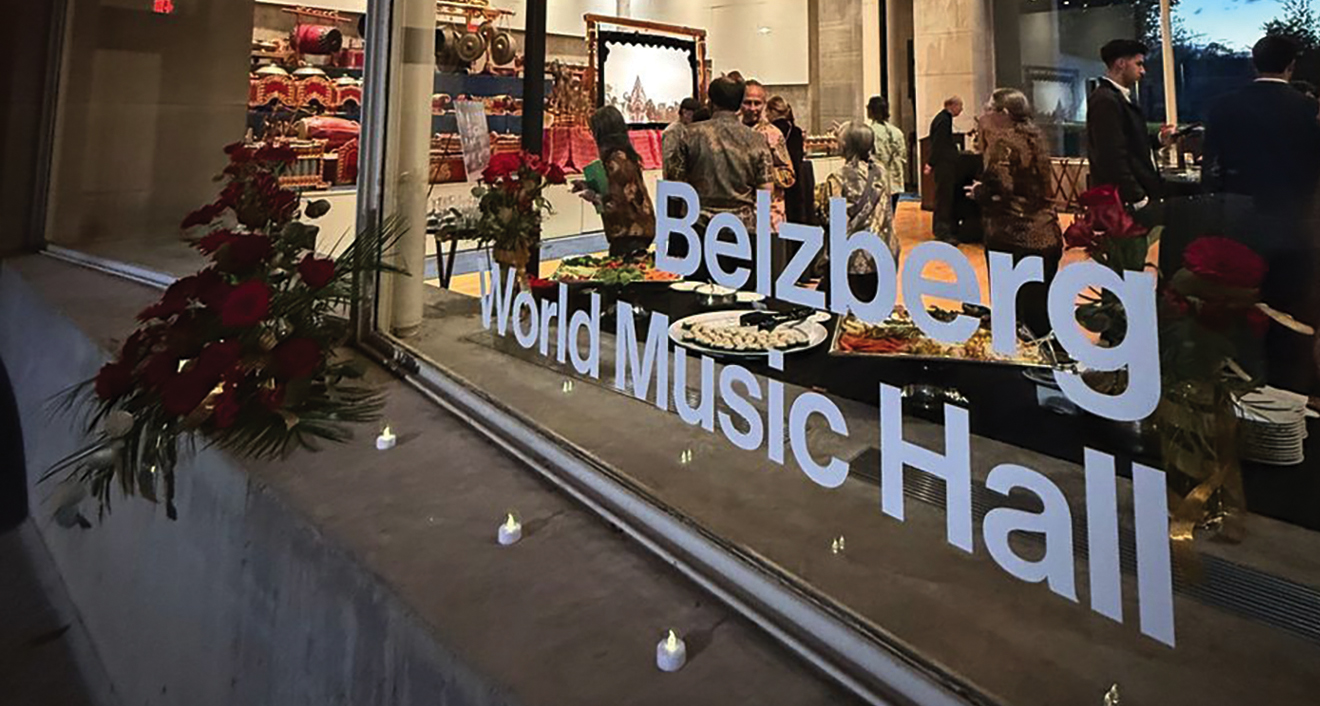
A singular, purpose-built facility for non-Western music ensembles, the Belzberg World Music Hall embodies the promise of Wesleyan’s global contemporary vision—grounded in a revitalized space that allows for immersion in international musical traditions. Students learn to use complex rhythms, structures, and philosophies not just as artifacts, but as the vocabulary to generate new, experimental work. The recent rededication of the building in honor of Strauss Zelnick ’79 and Wendy J. Belzberg highlights the University’s continued commitment to the arts as a central component of a Wesleyan education.
“Wesleyan believed in me when I didn’t believe in myself,” Zelnick said. “I attribute anything that I’ve been able to achieve professionally to both the education that I received here, but also the message that I learned here, which is that anything’s possible. And I think that remains true today.”
Wesleyan was among the earliest US higher education institutions to embrace the study of world music—and the first liberal arts school to build a substantive world music presence into its department’s curriculum and performance ecosystem in an integrated and sustained way, including offering a PhD in ethnomusicology. Belzberg World Music Hall, Lubin-Levy noted, was the first building on an American campus designed specifically for the performance of global traditions of music and dance. Its arrangement was based on the Indonesian Pavilion at the 1964 World’s Fair. That’s where John Spencer Camp Professor of Music Emeritus Richard K. Winslow ’40, Hon. ’10, P’71, GP’23 and Professor of Anthropology and Music David P. McAllester Hon. ’57 acquired Wesleyan’s first gamelan, an instrument whose origins trace to the 12th century and has long accompanied Indonesian feasts, ceremonies, and dances. (The current gamelan was donated to Wesleyan by Louise Ansberry in 1983, a set from the royal court in Yogyakarta, Indonesia.)
“What I love about this building—and it seemed to me to epitomize Wesleyan—is you would have an experience you never expected to have,” said President Michael Roth ’78, recalling his own undergraduate years during the Belzberg World Music Hall renaming ceremony at Homecoming + Family Weekend. “I never expected to be interested in hearing things that would just upend the way you think about aesthetic pleasure, about culture, about movement, about what’s possible.”
“Students come into Belzberg World Music Hall, and they get to see art that they would never have encountered in their lives, or art that speaks to their family and their ancestry in a way that makes them feel a sense of belonging.”
— Joshua Lubin-Levy ’06, director and chief curator of the Center for the Arts
Zelnick and Belzberg’s support allowed for numerous improvements to the space in recent years: a new roof, acoustic panels and roller shades, lighting, handrails, and storage for the Korean and Taiko drums that are also rehearsed and performed in the building. In October, the Gamelan Ensemble inaugurated the renamed space with a performance under the direction of Winslow-Kaplan Professor of Music Sumarsam MA ’76. Lubin-Levy noted that Sumarsam has been recognized by the Sultan of Yogyakarta for his sustained work in preserving Javanese tradition and cultural heritage at Wesleyan since 1972. As a scholar-teacher, Sumarsam invites students to inhabit this heritage, bridging the gap between historical preservation and live performance.
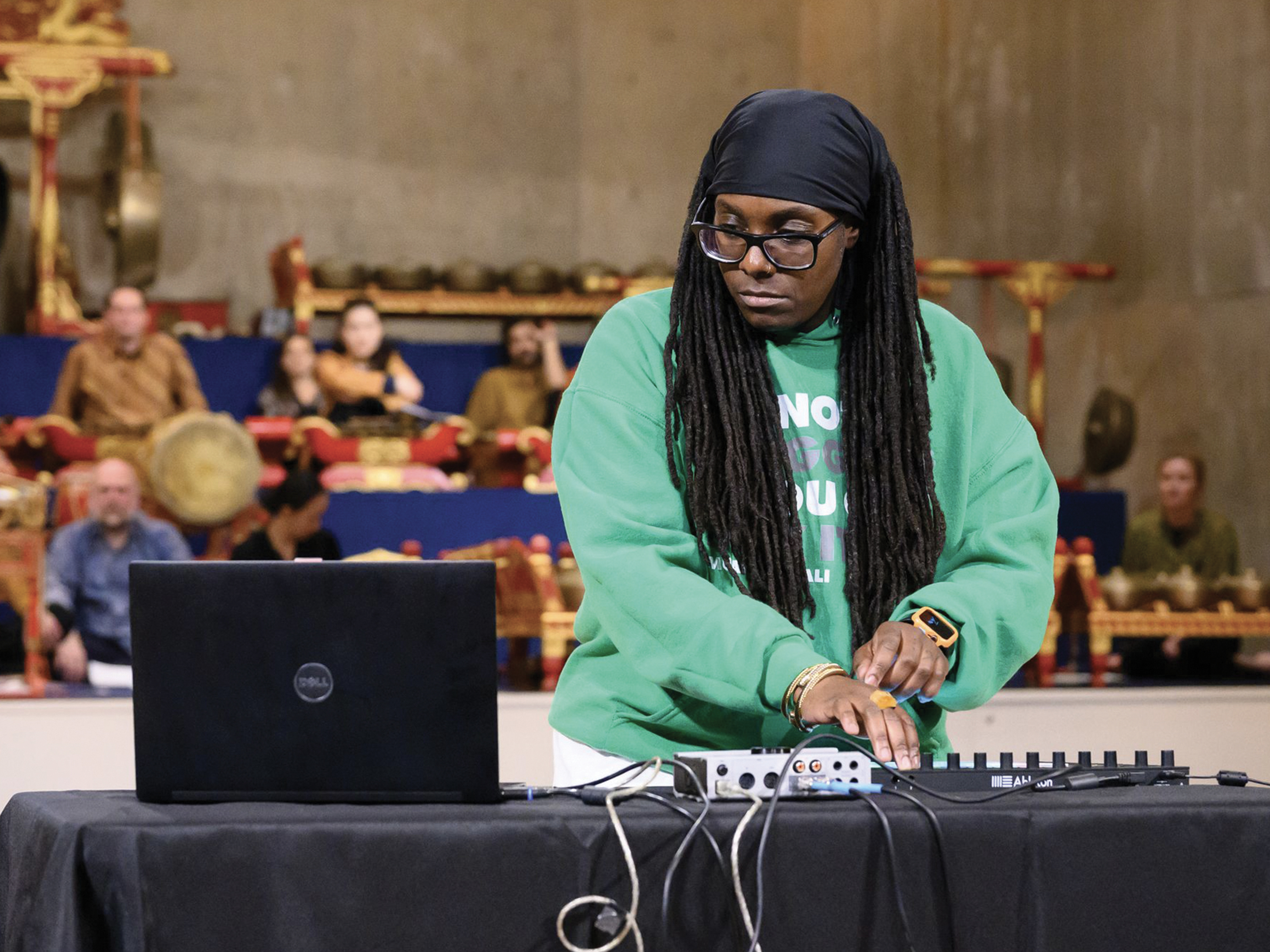
Today, the reinvigorated Belzberg World Music Hall remains a sanctuary for exploring other cultures through music and dance traditions, Lubin-Levy said. “For me, it really feels like there are increasingly fewer spaces where we can encounter difference in a space of curiosity and generosity and learning. [Here] they get to do that together and have conversations. It’s no wonder that this hall is one that we easily fill with students who are excited to see something that they’ve never seen before.”