
Senior Thesis: Filming a Period Piece on 16mm
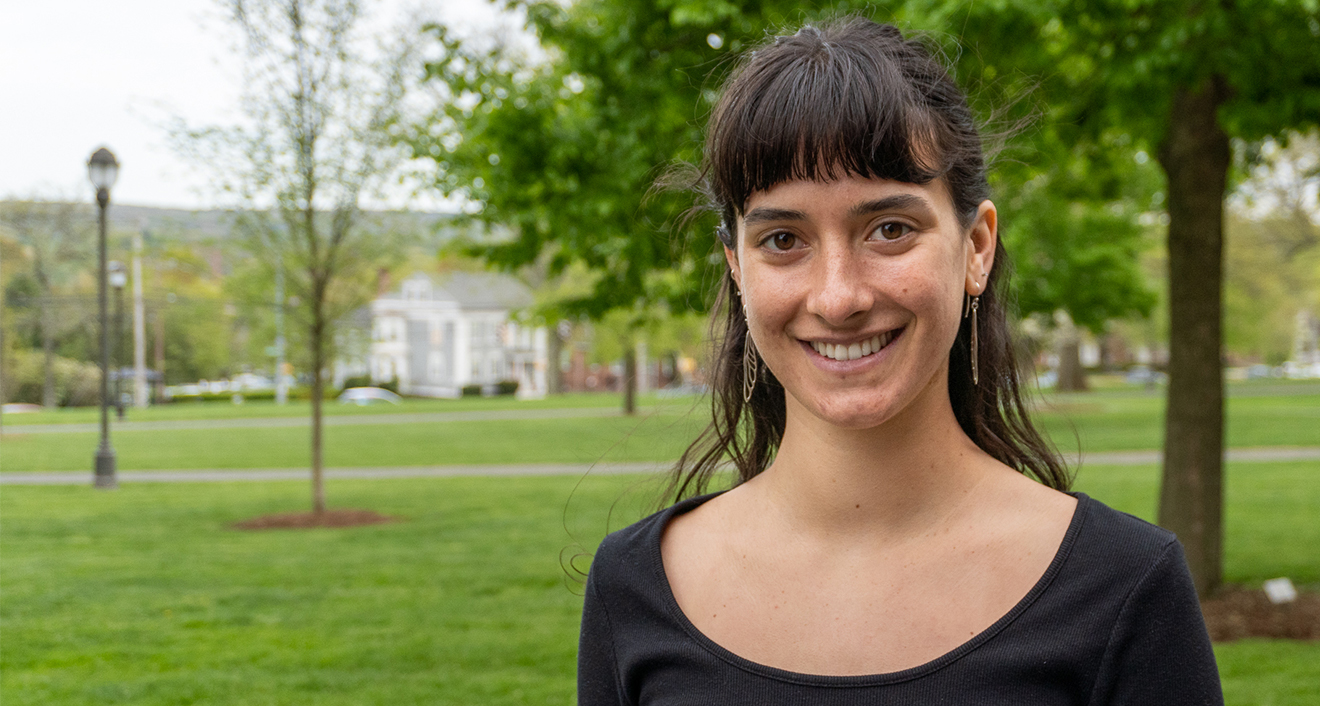
After taking a gap year prior to college, Maggie Leeming ’26 wanted to write a story exploring the relationship complexities between a teacher and a student who are close in age. She also wanted to create a film that considered how we say goodbye to those we are close to.
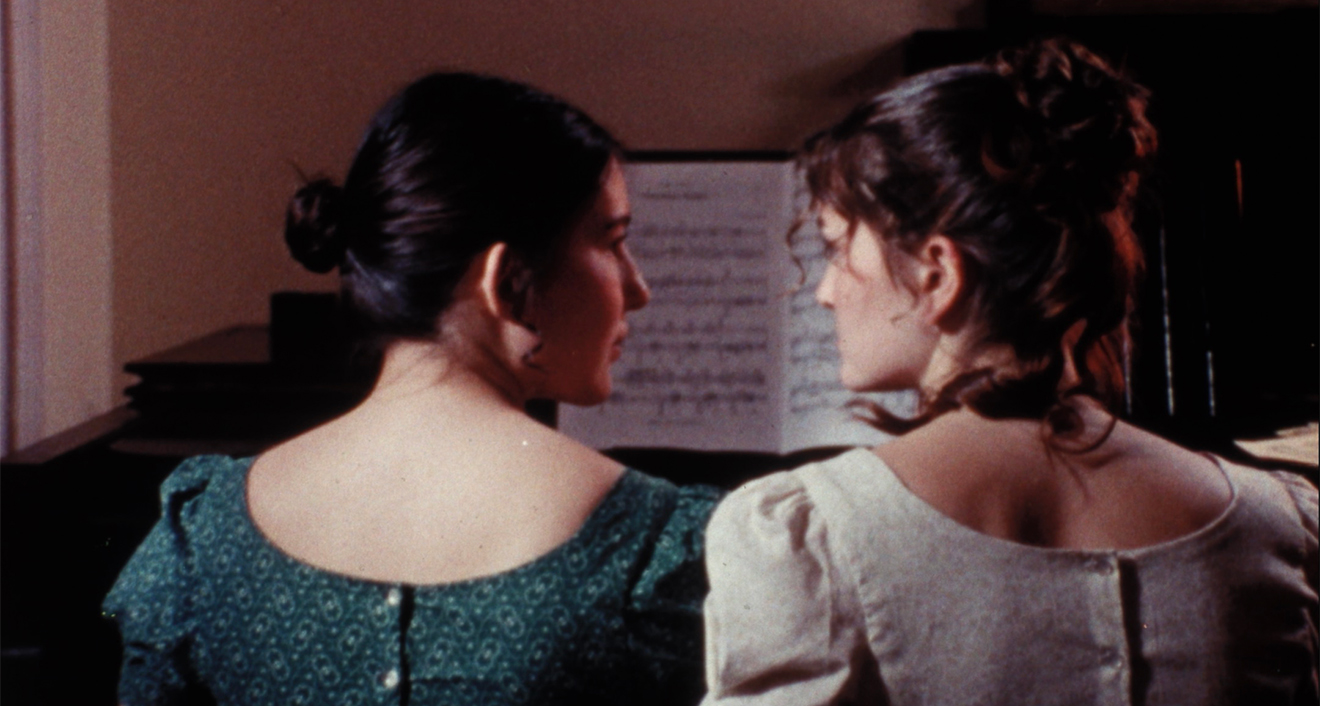
This year, Leeming was one of 21 film studies students to write, direct, and edit a senior thesis film. Her film, All That She Would Have Said, is a 12-minute, 19th century period piece depicting the relationship between a live-in governess, Fern, and the daughter of an upper-class family, Lydia, who views Fern as a companion. After years working with Lydia’s family, Fern is dismissed from her position one day before Lydia’s debutante ball, where she will be shown off to potential marriage prospects. Fern must leave Lydia behind.
“I'm really drawn to this very interesting dynamic of a live-in governess because she's meant to be a teacher figure or a role model, but they're very close in age,” Leeming said. “I think that Lydia sees Fern as a companion, whereas Fern has to be reserved all of the time. She feels a closeness to her, but is also employed by her family.”
Her work was inspired in part by the feminist subjunctive, a form of storytelling that rewrites the past to tell feminist versions of history to highlight stories that have been hidden. The feminist subjunctive is derived in part from cultural historian Saidiya Hartman’s writings on critical fabulation—a research methodology that retells historical events from perspectives that the archival record has left out, particularly when it comes to the voices of enslaved women.
“I see the film itself as an expression in the subjunctive mood,” Leeming said. “These two women didn't exist, they're a fabulation, they're a fabrication of my own mind. But, if they did exist, what might they have said? Or what might they have done? How might they have felt? How might they have expressed their love?”
To allude to this inspiration, Lydia and Fern practice subjunctive-tense Spanish in the middle of the film. Leeming also chose to work with an all-non-cis male cast and crew to help center the voices and work of women and genderqueer people.
Filming on 16-millimeter and production
Wesleyan’s College of Film and the Moving Image is the one of the last remaining schools in the United States to have students to shoot, edit, and project their senior thesis films on analog. The department has grants for students who want to shoot on film, funded by the Andrew W. Mellon Foundation.
Students can choose between shooting on modern, digital cameras, or on 16-millimeter film cameras. If they choose to work on film, they can achieve a distinct, older style feel within their films, but they must also deal with challenges that the medium presents. Film can be expensive to work with and develop, for example. Also, with digital filmmaking, it’s easier to manipulate the scenes in editing since it’s largely done with computer software. Footage on 16-millimeter is edited and processed by cutting and arranging film strips by hand, Leeming explained.
“I'm really glad that I chose 16-millimeter because I had to be so intentional with every decision,” Leeming said.
The decision to shoot in 16-millimeter affected every decision Leeming made throughout the production process, she said. Films shot on digital cameras also have their limitations, but using 16-millimeter forced her to meticulously plan each take carefully. Since they only had eight rolls of film to use, they had to reduce the number of takes they could record. Typically, filmmakers can get full coverage of scenes—footage of every speaker and angle they may need while editing—but shooting with just one film camera often restricted the crew to focus on one speaker in each scene.
Midway through the film, Fern and Lydia practice the piano in a small room as part of Lydia’s debut performances. Leeming said this scene was particularly challenging to shoot and required extra planning to account for how to fit the large camera in a tight space. She said, “with the piano scene, for every beat, every line, every moment, I had to ask myself or my [director of photography], ‘Who should we be looking at?” What should we be focusing on? Do we want to be close? Do we want to be far away? Why? What is the feeling that I want from this shot?’”
Alongside the on-camera planning, Leeming underwent an extensive planning process to get the logistical elements of the film in order. Ahead of production, she needed to book shooting locations, find period-accurate dresses for the actresses, and hire a full cast and crew of film students to help produce the project. She said this work taught her to follow through and keep herself accountable.
While her path after graduation is still uncertain, she wants to be a writer in the future. She said many of the skills she learned during this process will transfer to the next phase of her life.
“I think I've learned how to collaborate with other people in order to execute a vision,” Leeming said.