
From the Collections: Teaching and Learning with the Davison Art Collection
Among the many roles that art plays within the life of a community, it is a vastly adaptable learning resource because art is seldom only about art. In the words of American painter Jack Whitten (1939–2018), “The purpose of art is to expand consciousness.” Not just consciousness about art, but also about history, ethics, nature, politics. Because art is fundamentally interdisciplinary and pushes spectators to perceive the world anew, a strong university art collection enriches and expands the intellectual life of a liberal arts campus.
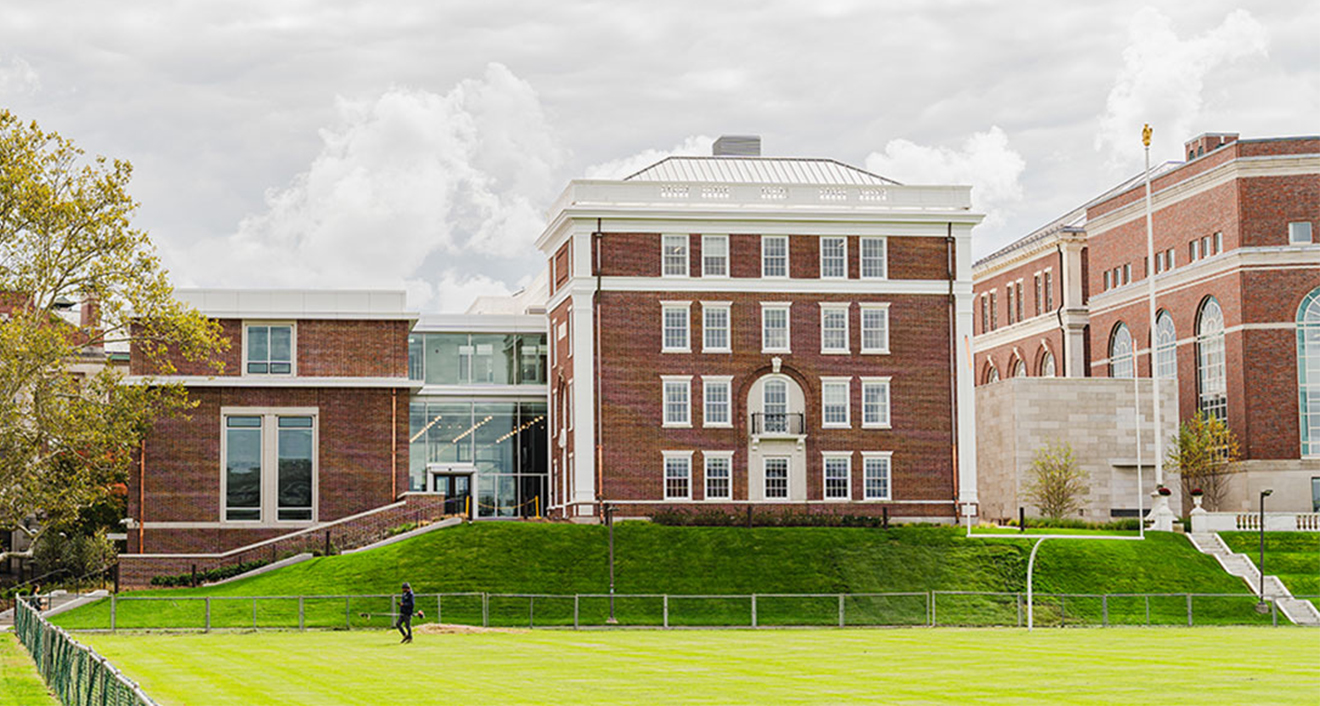
Every semester, students and faculty members from across Wesleyan’s curriculum gather in the two spaces operated by the renowned Davison Art Collection (DAC): the DAC study room in Olin Library and the recently opened Pruzan Art Center, which houses the Goldrach Gallery. In the study room, we review factual material about artworks, but we always broaden our conversations beyond taxonomies of “artist, title, date, medium.” Recent study room conversations have covered: the uneasy ethics of observing human suffering in Francisco de Goya’s 1810–1820 Disasters of War etchings with a history class; the use of portraits as political propaganda with a class on Italian Renaissance art; and historically gendered labor in scientific cataloguing addressed in Erika Blumenfeld’s 2022 work, Tracing Luminaries, with a professor of astronomy.
In the words of American painter Jack Whitten (1939–2018), “The purpose of art is to expand consciousness.” Not just consciousness about art, but also about history, ethics, nature, politics.
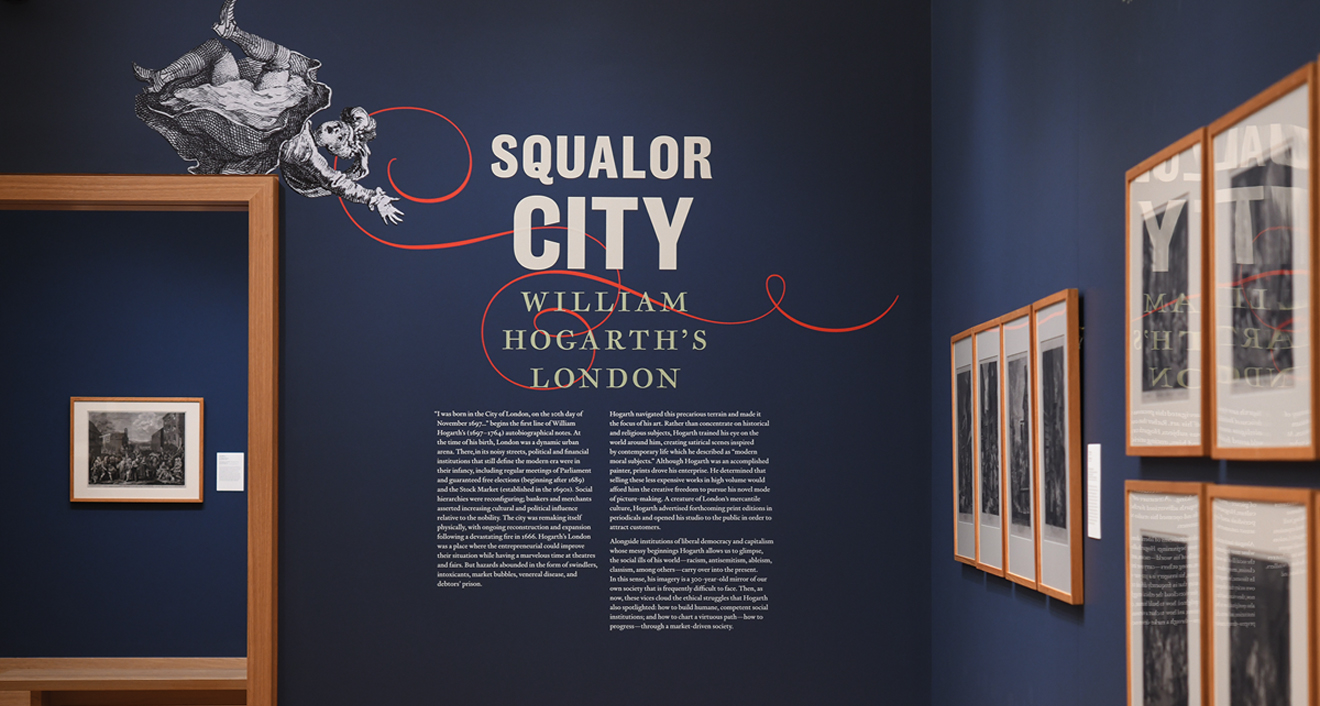
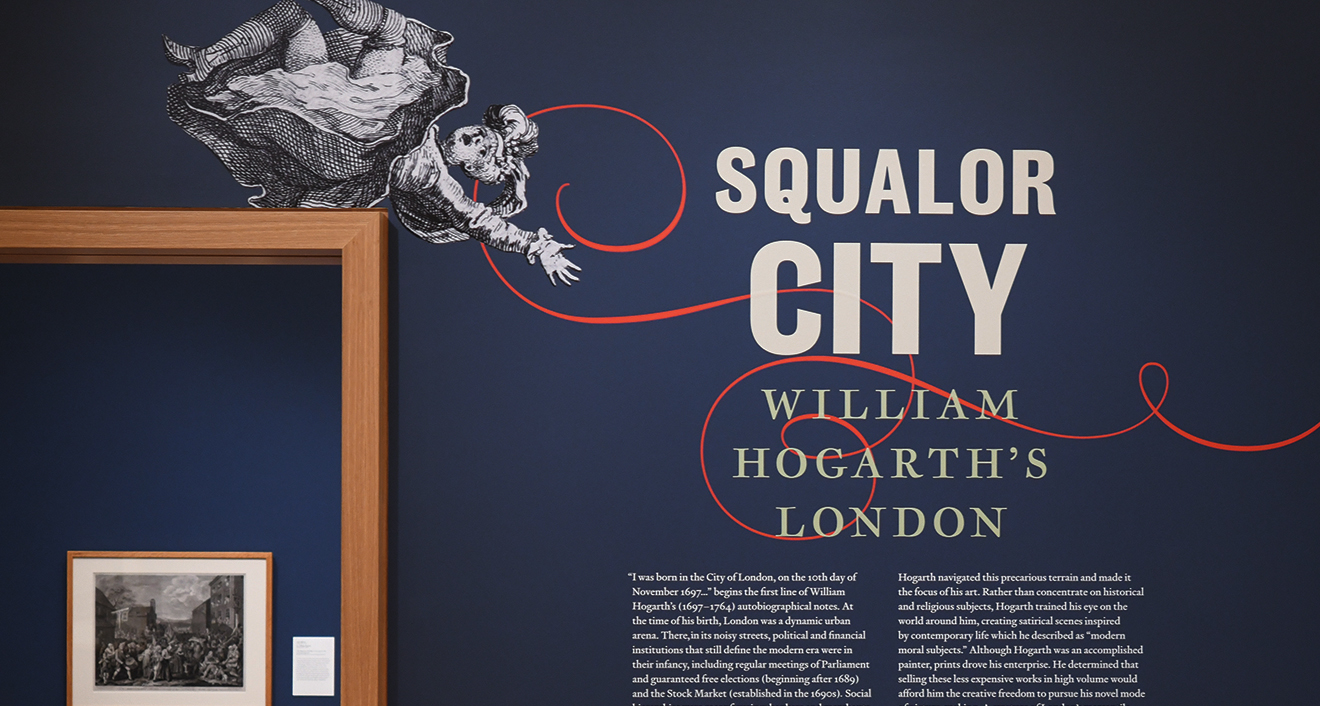
Entrepreneurship, mass media distribution, intellectual property—I have been discussing these topics with Wesleyan students throughout the Fall 2025 semester, not in the classroom of a communications or government course, but in the Goldrach Gallery. Together we have been considering the work of the British artist William Hogarth (1696–1764) featured in the DAC’s exhibition, Squalor City: William Hogarth’s London. In particular, we have been thinking through the ways Hogarth’s innovative approaches to print publishing bore upon the content of his pictures, typically satirical scenarios of daily life in Georgian-era London (roughly 1714 to 1837). Hogarth was an accomplished painter, and while he offered his paintings for sale, he also used them as compositional prototypes for planned print editions. He opened his studio to visitors from the public who could view the paintings, and if they were pleased, purchase a subscription to a printed set of the pictures. He also advertised forthcoming print editions in periodicals. Occasionally, he would print the same image on different papers, charging more for the impressions printed on finer stock. Hogarth also advocated for the protection of his intellectual property. Thanks to his efforts, Parliament passed England’s first copyright legislation, The Engraver’s Act, sometimes called Hogarth’s Act, in 1735. Hogarth’s art provides students in disciplines from English to Art Studio a tangible case study of how aesthetics and ideas manifest in the material world of commerce and political economy.
As part of the Squalor City programming, the DAC partnered with the English department to host Associate Professor of English Abigail Zitin from Rutgers University, a scholar of Hogarth’s aesthetic theory, for a special Hogarth study day with some of Wesleyan’s English majors. For me as an art curator, it was immensely rewarding to spend ample time with scholars and students who approach Hogarth’s work from the perspective of literary studies. In turn, I hope that some of the information I shared about Hogarth’s place in the art historical context of his time fleshed out their understanding of the artist, and indeed, the material culture of Georgian England.
The DAC’s rich Hogarth holdings are only a minuscule part of the collection, which encompasses over 25,000 artworks, mostly prints, drawings, and photographs. Representing the entire history of Western graphic art from the late Middle Ages to art of the present day, the collection includes some of the earliest woodcuts and engravings made in Europe as well as works by contemporary artists William Kentridge and Kara Walker—all of which support teaching, learning, and research at Wesleyan as well as the research of scholars, artists, and museum professionals who visit from around the world.