
Cynthia J. Tong '14 Is Making Room on Broadway
Broadway producing is a job built on uncertainty and a lot of determination. Shows take years to develop, and money is raised before anyone knows how audiences will respond. When the curtain finally goes up, nothing is guaranteed. It’s often not a predictable model. For Cynthia J. Tong ’14, that uncertainty has never been a deterrent.
“Our team at the office and people in the theater industry will probably say that I’m particularly interested in systems and how we do the work, not just about the work we put out,” said Tong, who majored in sociology. “That is something Wesleyan gave me the opportunity to find . . . seeking a vocabulary and framework with which to understand the world.”
Today, Tong is a Tony Award–nominated Broadway producer at Tom Kirdahy Productions whose work spans commercial theater and new work development—most recently being on the producing team of the new musical Just in Time starring Jonathan Groff as Bobby Darin. Producing at this level demands confidence in the unknown.
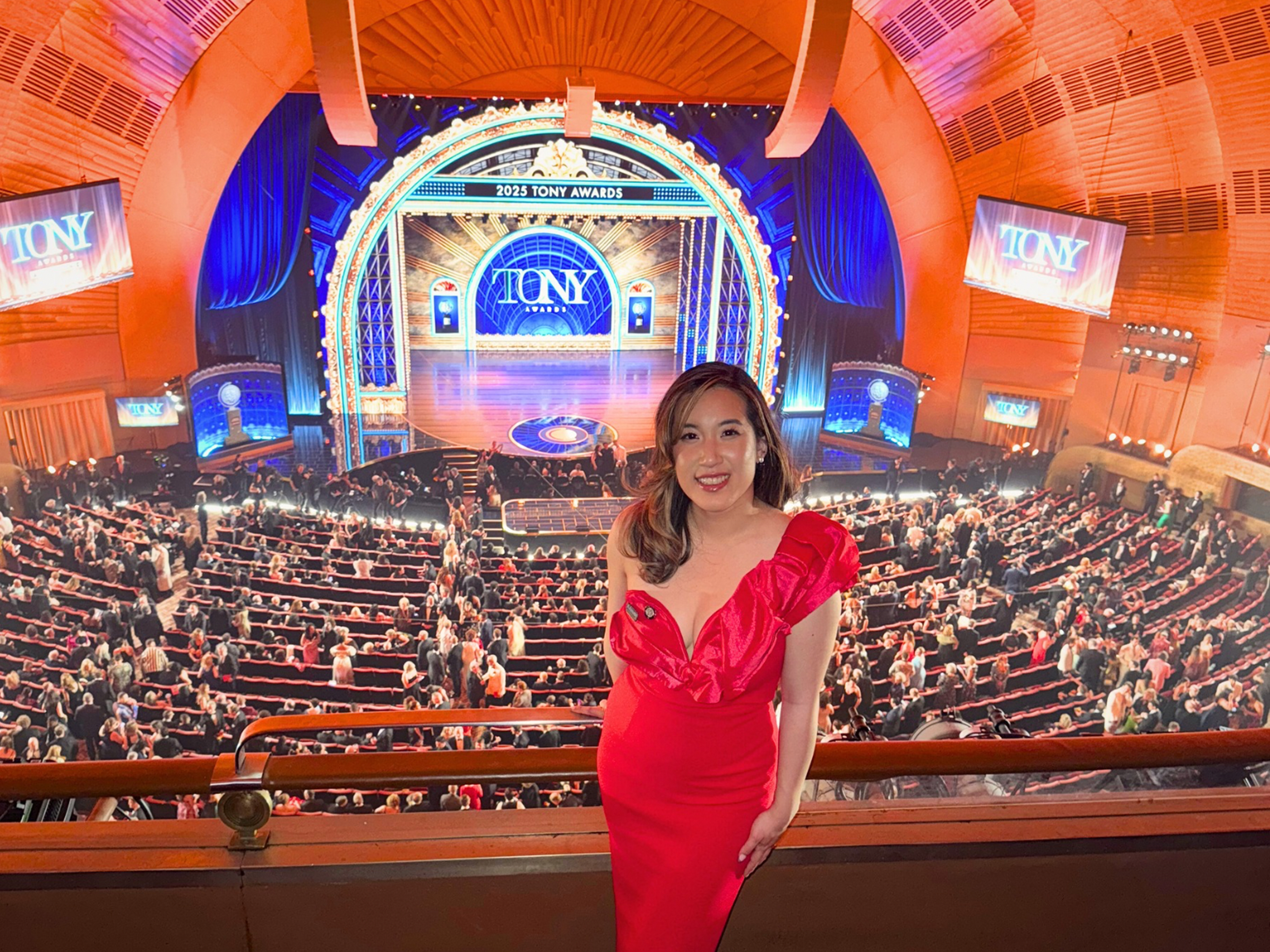
While at Wesleyan, Tong moved between creative spaces, learned by doing, and found herself drawn to work that required collaboration and care. All tools that would be critical to her success in the theater. “It felt okay not to have a clear answer right away. You’re encouraged to try things that don’t necessarily make sense on paper yet,” she says. And that idea of making something out of uncertainty is how she cut her teeth as a producer.
After graduating—and a few years working outside of the arts—Tong explored a career in theater, working in roles across development and production. Through “scrappy” efforts, she gained a broad understanding of putting a show up on its feet. Over the course of two years, she networked, served as a rehearsal assistant, and actively supported fellow Wesleyan alumni in producing innovative new works. Notably, she took on her first solo producing role with the New York Musical Festival, where she solo produced If Sand Were Stone, a new show created by Cassie Willson ’17 and Carly Feinman ’16, and choreographed by Nora Thompson ’15.
Over time, producing became less about a job title and more about a way of thinking: paying attention and helping new ideas survive, no matter the challenges. “The responsibility we have as producers is that you have to be there for the good and the bad and the crazy,” she said, noting that no matter the scale of a production, “it still feels incredibly scrappy.”
As Tong moved deeper into the field, she also noticed flaws in the system. Broadway has made uneven progress when it comes to representation. According to a recent report from the advocacy organization Asian American Performers Action Coalition, while there has been a significant increase in the number of Black actors appearing onstage, representation for other performers of color declined. Asian actors made up less than 4% of Broadway casts in the 2021–22 season and, of those surveyed, “less than 5.5% of those actors believed that theaters were creating an environment of inclusion for that ethnic group.”
“The responsibility we have as producers is that you have to be there for the good and the bad and the crazy.”
For Tong, those figures echo what she has experienced firsthand—and help explain why access matters as much as visibility. In the past few years, Tong has coproduced two celebrated Broadway productions that centered diverse voices, from a revival of August Wilson’s The Piano Lesson starring Samuel L. Jackson and Danielle Brooks to a revival of the musical Gypsy starring Audra McDonald in a role written and traditionally cast as a white character.
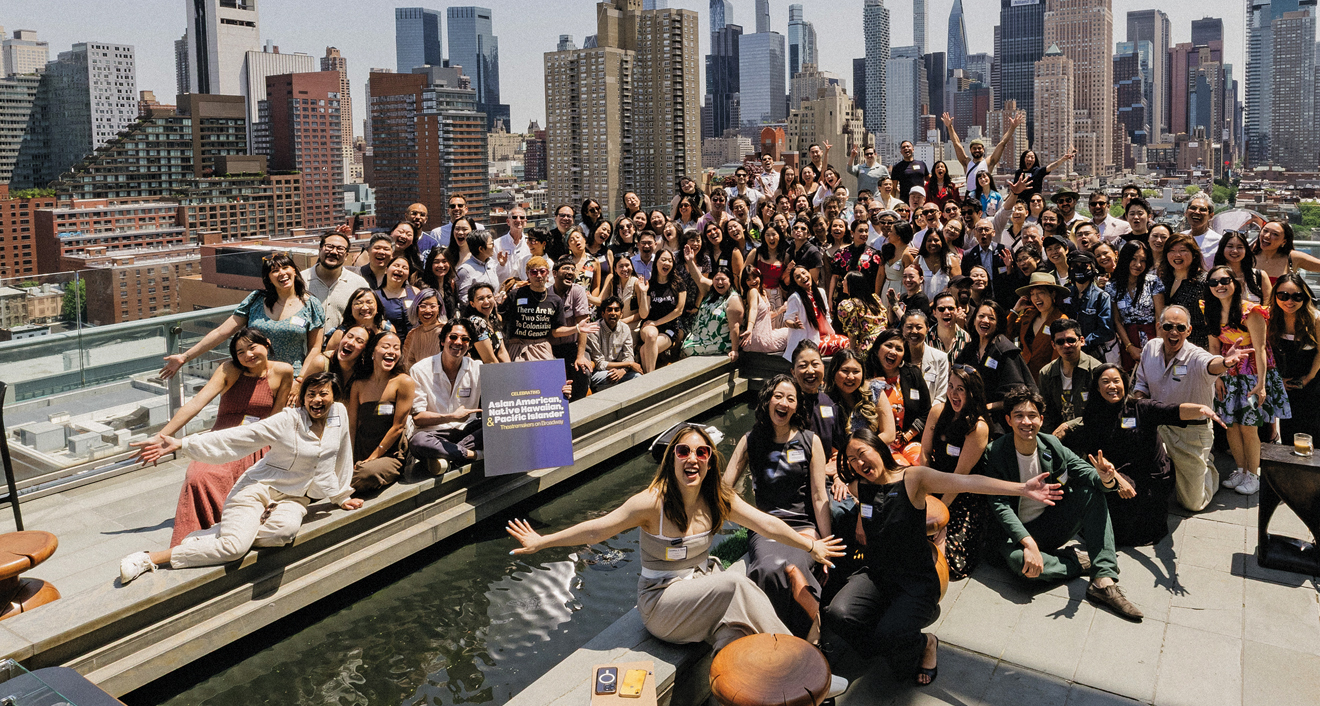
And last year, Tong organized an event alongside fellow alum and producer Miranda Gohh ’17 to celebrate Asian American, Native Hawaiian, and Pacific Islander theatermakers on Broadway. Over 130 people gathered to commemorate a season that marked the highest level of awards recognition for this community in American theater history. She has already made plans to celebrate for the second consecutive year later this year.
Tong began to think about producing to widen access—not only for artists, but for people who wanted to support theater and had never been invited into the process. “I came from a place of optimism,” Tong said of seeing opportunity to diversify the Broadway pipeline. “At the highest level, a producer is inviting investors to have a seat at the table,” she said, adding that when producers aren’t as diverse, their social sphere of influence lacks diversity, leading to less space for underrepresented investors to get that invite. “It means something when you can say that folks from the communities you are trying to reach are also literally invested in your shows.”
That thinking shapes her work with The Industry Standard Group, which she cofounded to lower the barrier to entry for Broadway investments and invite more people into the work of building and supporting shows. Tony Award–winning producer Sammy Lopez, a cofounder of the organization, explained that their goal is not just investment, but participation. “I think what we’re identifying on our side is, well, as a coproducer, we are bringing to you a diverse slate—a group that could possibly do some kind of brain-trust conversations around messaging, or trying to reach specific demographics for your show, or group sales and more advocates speaking about the show or championing the show,” he said.
For Tong, the work is grounded in intention rather than attempting to overhaul the industry. Through the organization, she and her cofounders focus on teaching diverse new groups how Broadway operates and gradually expanding participation in the field. Last year she also was selected for the Shubert Organization’s Artistic Circle—an initiative supporting theater producers of color. Such work is rooted in her instinct to better the world, which was foundational to her undergraduate experiences. “Wesleyan helped me trust my instincts,” she says. “I still draw on what I learned there all the time.”
That instinct toward inclusion shows up beyond the theater world for Tong. She currently co-chairs Wesleyan’s AAPI alumni network, helping build connections across graduates and creating space for mentorship and shared experience. It is a natural extension of her work as a producer: building relationships and making sure people feel welcome.
For all the responsibility that comes with producing on Broadway—musical theater is a notoriously risky business, with investments often nearing $20 million with no certainty of recouping—the excitement remains. Live theater, Tong says, is still an act of faith—one that depends on people choosing to show up, together. With Just in Time, the ways she learned to see the world while at Wesleyan continue to shape her approach to work. She is constantly trusting collaboration and committing to stories before their endings are known.
Today, Tong is not only helping bring new works and voices to Broadway, but she is also helping reshape who gets to be part of the process—onstage and in the rooms where decisions are made. It is patient work. It is intentional work. And it begins, as it did years ago for Tong at Wesleyan, with the belief that art is better when more people are invited into the story.
Top photo: In June 2025, Cynthia J. Tong ’14 and Miranda Gohh ’17 gathered more than 130 AANHPI Broadway theatermakers to celebrate their 2024–25 season successes in New York City. Photo by Laurel Hinton.