
Inspired: Science Visualization that Reveals Our World
You are on the water, somewhere in the middle of a shimmering San Diego Bay, with the sun setting on the horizon in front of you and a small sailboat floating behind you. Waves lap. Seagull cries fill the air. Whoosh! Suddenly, you are plunging down—fast—encircled by walls of water. You look around the darkness to discover you are now deep in the ocean, surrounded by glowing plankton and a host of palm-sized brightly colored krill that begin swarming toward the surface.
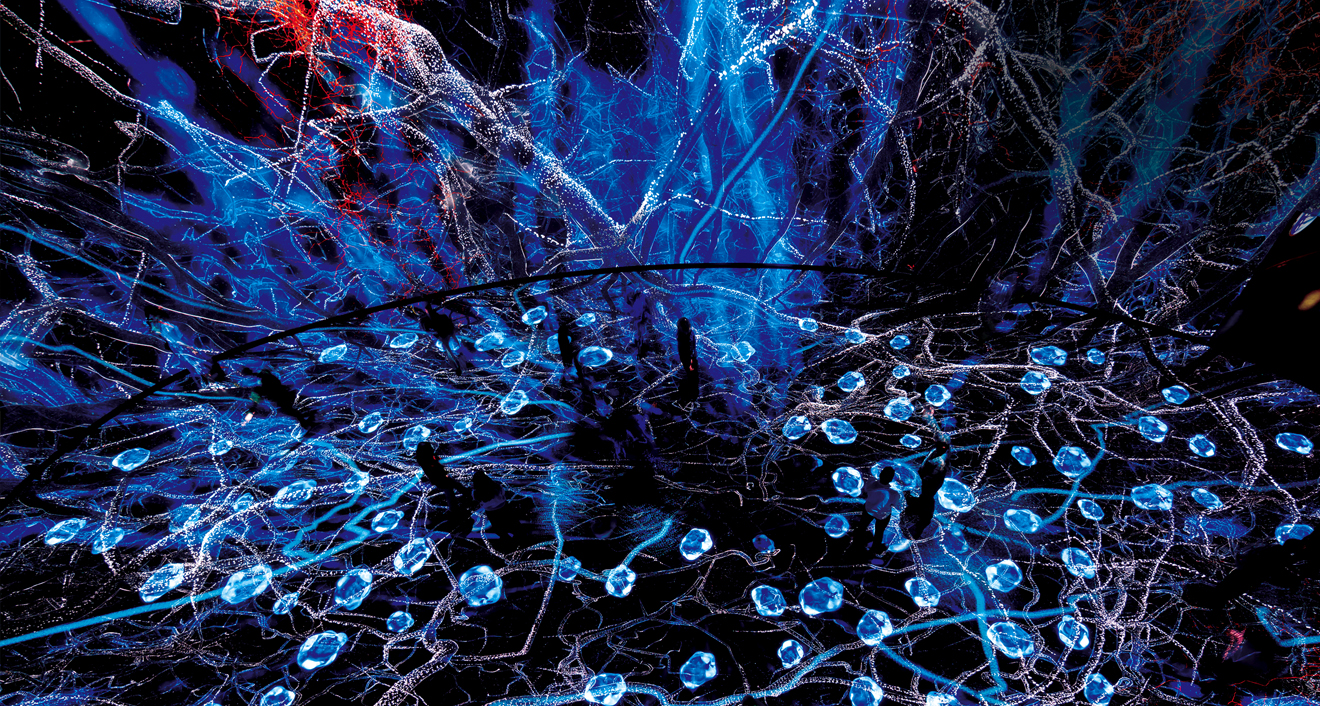
Welcome to Invisible Worlds, an American Museum of Natural History exhibit in which immersion—via a unique 360-degree theater—is the point. Like Alice in Wonderland, visitors moving about in the bowl-shaped, high-walled chamber experience vertiginous changes in perspective—including zooming in to the microcosmic ecology of the soil beneath Brazil’s Caxiuanã National Forest before zooming out above the treetops to arrive at a macrocosmic view of Earth from space. Kids delight in the numerous interactive elements of the show: During the underwater sequence they run in spurts or circles to create trails of luminescent plankton beneath their feet. Later, inside the human brain, they hop from one manhole-sized neuron to another to cause impulses—streaks of red, yellow, green, and blue—to shoot out between them.
An exploration of how all life on Earth is connected—by shared DNA, ecosystems, food webs, and forms of communication—Invisible Worlds is the result of seven years of development helmed by Vivian Trakinski ’87, AMNH’s director of science visualization. “This is designed to look at the world around us and to put us inside the story,” she says. “We are part of the nature that we are visualizing.”
While “science visualization” can be rendered in many forms, from a simple infographic to a detailed poster presentation to a complex computer simulation, Trakinski’s work takes science visualization to the level of an artform that few institutions can replicate. Her exhibits and planetarium shows draw upon the same highly precise datasets that are used by researchers on the cutting edge of scientific discovery—including readings from NASA spacecraft, geospatial data from satellites orbiting Earth, and imaging of cellular functions collected by the most sophisticated microscopes. As such, the programs are “authentic artifacts of science.” But they are also creatively conceived and designed to educate. (The immersive part of Invisible Worlds takes place after visitors have learned about nature’s hidden dimensions and unexpected connections in a display area with interactive kiosks.) For Trakinski, presenting complex scientific ideas in ways that are accessible and compelling to people of all ages is “the challenge that gives life to the work.”
Ultimately, she seeks to create “large transformative experiences that provide some joy and take people out of their normal day to day—and give them something new to experience and be inspired by.”
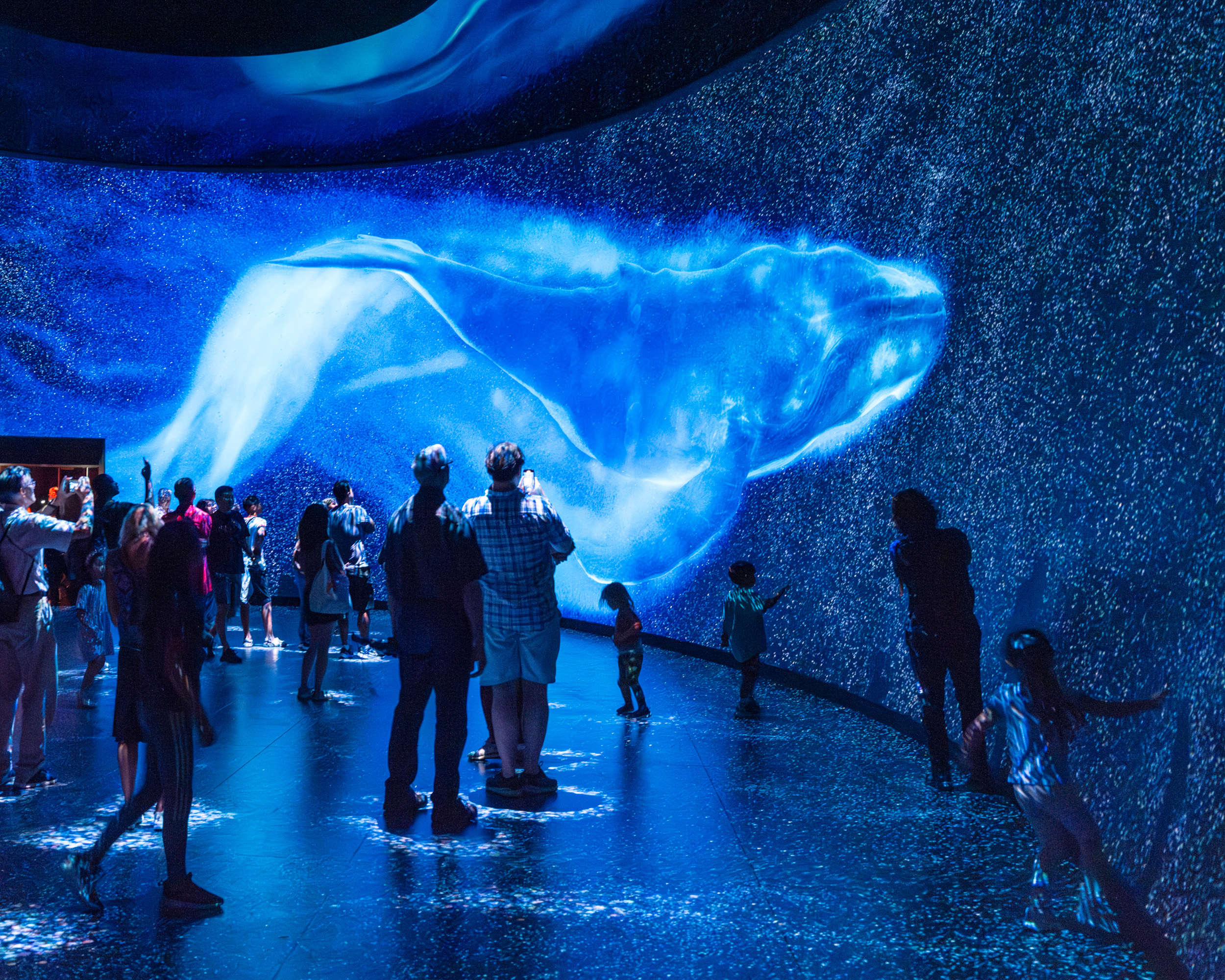
UNDERWATER: "Invisible Worlds" was conceived to immerse visitors in nature’s hidden realms—like the underwater ecosystem that is home to humpback whales and bioluminescent plankton. Photo by Alvaro Keding/©AMNH
Amplifying the Science
Martha Gilmore, Joshua Boger University Professor of the Sciences and Mathematics, is a planetary geologist and expert on Venus whose career was inspired by childhood visits to her local planetarium. Gilmore, who is also Wesleyan’s dean of the natural sciences and mathematics, worked with Trakinski and her team on a planetarium show called Worlds Beyond Earth, which debuted in 2020. While visiting the museum for preliminary meetings with other contributing scientists, Gilmore was stunned by a planetarium simulation that gave the perspective of standing on the surface of the moon. The stars above twinkled in the vast darkness of space, the moon’s Taurus mountains loomed nearby, and when she looked down she could see, right in front of her, the actual footprints of Apollo astronauts in the powdery soil. “I look at images from space all the time,” she says. “I’ve looked at the moon a million times. But to have that feeling like I was a geologist standing on the moon—I was just floored. Literally, my mouth was open.”
In her work, Gilmore seeks to understand and describe processes and planetary histories that unfold over billions of years—phenomena that are simply beyond human experience. But simulations can compress time and space and tell the story of eons in a visual and visceral way that mere numbers cannot convey. That’s why Gilmore believes Trakinski and her colleagues—by “amplifying” the data—are providing a service both to the public, which would not otherwise engage with this kind of hard science, and to the scientists who are trying to explain it.
“What they’re doing at the museum is giving everybody access to those data in such a profound way,” she says. “These visualizations provide a visceral connection between these phenomena and our humanity. They allow children to fly through the solar system. They allowed me to stand on the moon.”
Evolution and Innovation in the Field
Before Trakinski started taking people on wondrous simulated journeys, she was out experiencing real adventures in some of the most intriguing corners of the planet. She has hiked the Peruvian Andes, trekked across the Greenland ice sheet, and celebrated her 36th birthday at the South Pole, where the elevation (some 10,000 feet) gave her altitude sickness. She says, “I woke up the first morning with my face blown up so much my eyes were halfway closed.” Then there was the distressing moment in Mongolia, when her failure to plant the tent pegs deep enough resulted in her tent blowing away across the grassy steppe.
At the time—the early 2000s—she was producing short documentaries about scientists in the field for AMNH’s educational Science Bulletins series. (She’d been recruited by the museum after working as an independent filmmaker and writer and producer for broadcast TV—including a stint as an associate producer for a kids’ documentary science series called 3-2-1 CONTACT.) Whether she was covering gazelle migration patterns in East Asia from a rickety biplane or spelunking in Tennessee with scientists seeking to develop new drugs from compounds produced by cave-dwelling microorganisms, the work honed Trakinski’s expertise at science storytelling through the medium of videography. But, over time, she noticed something “starting to sneak into the stories”: The scientists wanted to share their visualizations. Trakinski says, “More and more, the visualizing of the evidence was a very important part of their research.”
Meanwhile, a shift was going on at the museum. Trakinski and her colleagues began to consider how they could innovate with evolving technology that went well beyond videos. She says, “Instead of narrative storytelling as a way to communicate ongoing scientific research, we adopted the idea of leveraging scientific data across many different types of technology platforms to engage visitors in modern science.”
In the early 2010s, Trakinski began producing the space shows presented in AMNH’s Hayden Planetarium. Far from providing a pedestrian view of the night sky from Earth, the programs in the dome are designed to bring people into specific locations of the known universe, where they can see spatial relationships, chronologies, and phenomena that have been directly “seen” or measured by NASA’s telescopes, spacecrafts, and rovers. (Not to mention that the projection technology renders solid objects so realistically that it’s hard not to instinctively duck when, for example, the Gaia space telescope passes overhead.)
Her first show, Dark Universe, which is narrated by the planetarium’s director, Neil deGrasse Tyson, is representative of the challenges of astrophysics visualization and storytelling for a lay audience. Imaging, such as that from the Hubble space telescope, enables us to see the Whirlpool Galaxy with our own eyes. But how to convey that which is invisible and detectable only indirectly with remote sensing or other technology? A particular brain-boggler for the production team was how to portray the poorly understood phenomenon of dark energy—the existence of which is inferred by the acceleration of the universe’s expansion—in a way that would be true to the science.
Such conundrums become opportunities for the creative thinking that excites Trakinski. “Everything requires interpretation,” she says. “Science is always evolving and always changing and new interpretations add to our understanding.”
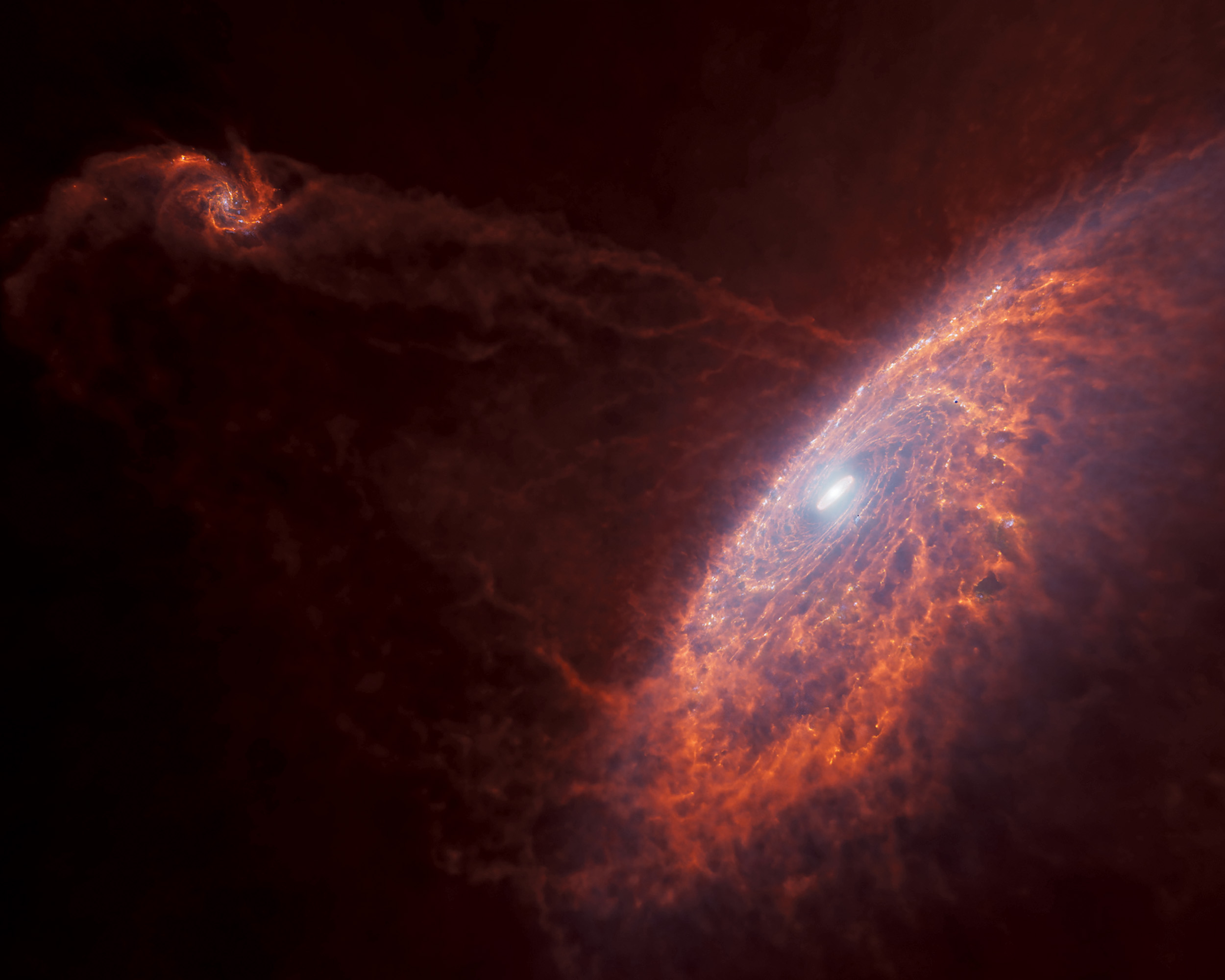
IN SPACE: This visualization of our galaxy’s ongoing collision with the Sagittarius dwarf galaxy is featured in "Encounters in the Milky Way," the latest space show produced by Vivian Trakinski. Photo by Jon Parker/©AMNH
Among the First of her Profession
Trakinski became science visualization director in 2016, a position she originated at the museum and that didn’t really exist anywhere else. She says, “I was probably one of the first to adopt that title.” Today she has a production team that develops a wide array of multimedia projects for various areas of the museum and planetarium. Whether she is acting as the creative director, producer, or executive producer, all of the work is highly collaborative, involving some combination of researchers, educators, and technical and creative talent, including writers, composers, and stars of the Hollywood variety. A favorite career moment involved directing narrator Liam Neeson in the sound studio as he performed the lines she’d scripted for the museum’s Big Bang Theater show.
For Invisible Worlds, Trakinski shepherded the project through a seven-year-long development process, from finding the right design partners to create the unique space to managing the editorial process, brokering a consensus among the team members about what elements the immersive journey should include, collaborating on scripting, and providing feedback on all aspects of the production.
Trakinski notes, “I like to think of my role as an advocate for the visitor because I’m not a trained scientist.”
Aside from rewarding collaborations, the joy for Trakinski comes from experimenting with new forms of storytelling and new forms of art made possible by evolving technology. Her objective is always “to create something that has many, many doors in, and can be interpreted in many ways.” She says, “I like my work to be sort of an exploration, the start of a conversation, rather than the end of a conversation.”
Approaching Science from a Humanities Background
What has become clear to Trakinski in recent years is that her work—at an institution dedicated to science in a professional field that didn’t exist when she was in college—is actually “a natural evolution” of her pursuits as a College of Letters major. At Wesleyan, Trakinski relished the interdisciplinary study of history, philosophy, and literature, which afforded opportunities for “understanding nature, exploring what it means to be human, [and] trying to interpret reality.” Her thesis posited that the Book of Job can be interpreted as a metaphor for the god-like creative powers of the human imagination.
As an expert in science visualization today, Trakinski doesn’t think re-creating worlds using data as the raw material is all that different from the way that art, literature, and philosophy have been re-creating nature and interpreting human experience throughout the ages. She says, “This is just another branch of that attempt to explore the world around us and to understand our place in it.”
Opening Photo: A symbiotic network of mycorrhizal fungi and tree roots in the soil of a Brazilian rainforest is depicted with drops of water that visitors to Invisible Worlds can interact with to “feed” the trees. Photo by Iwan Baan