
Jesse Wegman ’96 on the Founding Father America Forgot
This July Fourth, the United States will mark the 250th anniversary of the Declaration of Independence. For journalist and author Jesse Wegman ’96, the milestone arrives at a moment when the country’s founding arguments for democracy, equality, majority rule, and self-government feel anything but settled.
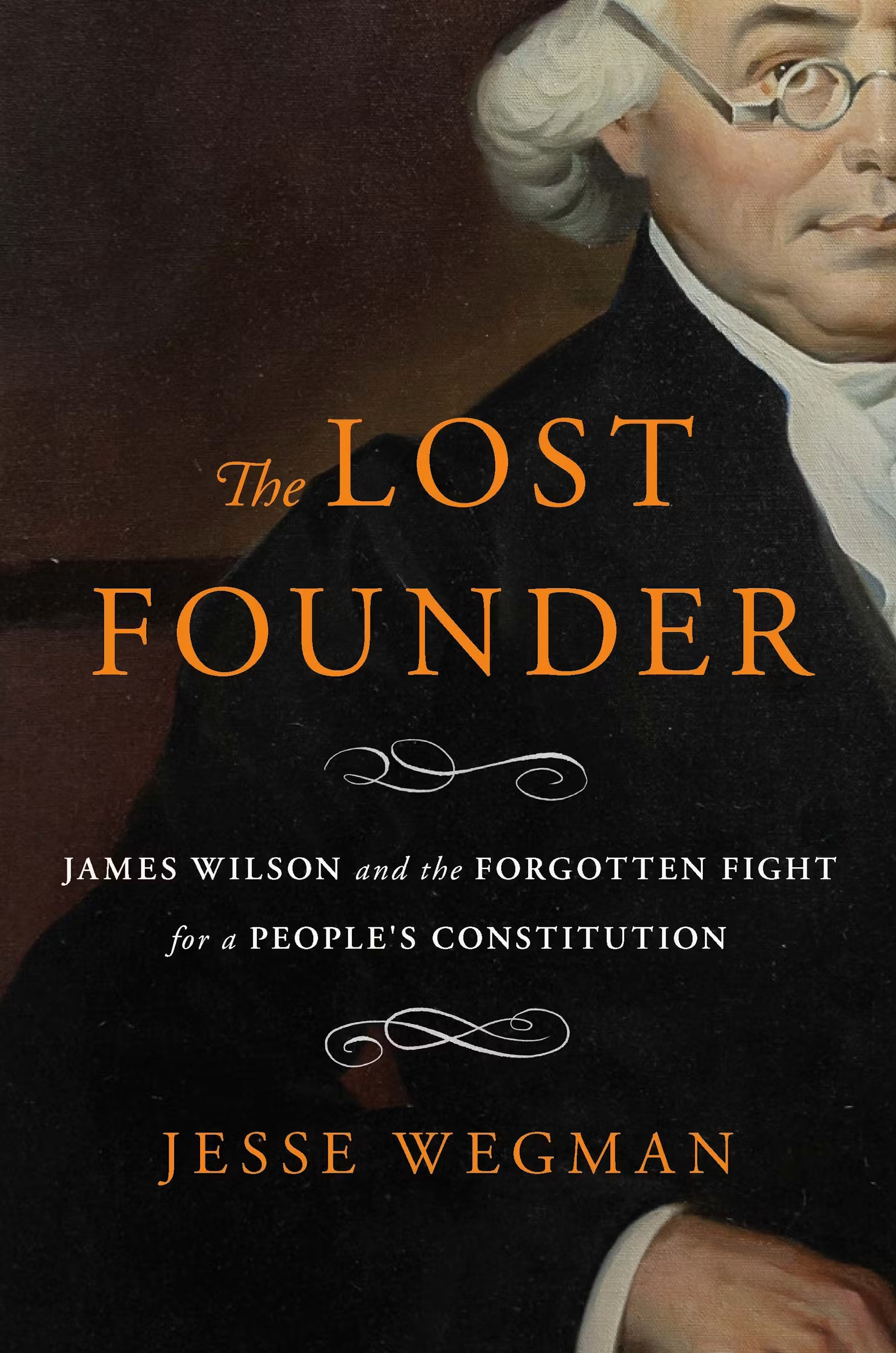
In his new book, The Lost Founder: James Wilson and the Forgotten Fight for a People’s Constitution (Celadon Books), Wegman turns the spotlight on one of the nation’s most overlooked founding fathers: James Wilson, a Scottish-born lawyer, signer of the Declaration of Independence, principal framer of the Constitution, and one of the first Supreme Court justices. Wilson was among the most brilliant political thinkers of his time—his bold assertion that the people are the ultimate source of all power inspired the famed lines “We hold these truths to be self-evident, that all men are created equal”—before financial ruin reduced his legacy to a scandalous minor note beside more celebrated luminaries like Thomas Jefferson and Alexander Hamilton.
In a conversation with Wesleyan University Magazine, Wegman discusses how he discovered Wilson while researching the Electoral College; why the story of a complicated, flawed founder matters during the semiquincentennial; and how his Wesleyan education helped kick off a career translating the complexities of law and politics for the average citizen.
You have spent more than a decade writing about the Constitution, the Supreme Court, and the rule of law. And yet you’d never heard of James Wilson. What first brought him to your attention?
I was working on my previous book on the history of the Electoral College, and I wanted to know exactly when the College had been adopted. I wanted to see the moment at the Constitutional Convention where they agreed on this way to elect the president. And as I’m reading through James Madison’s notes of the convention, I come across this long-winded Scottish guy who keeps saying things that are pretty striking for the late 18th century about the importance of democracy, the importance of popular participation in government, the equality of people.... His name is James Wilson, and he’s one of the founders, one of the main authors of the Constitution, the best lawyer in the country at the time, and the most respected legal thinker. And I thought, How do I not know who this guy is? Not only was he missing from the story, but he seemed so vibrant and so modern in his way of thinking about democracy. The more I learned about him, the more I thought his story has to be told. We have to understand these democratic roots of the country if we’re going to figure out how to move forward in this moment.
Other founding fathers have been much more celebrated, including Alexander Hamilton, who got a boost into mainstream consciousness thanks to fellow Wes alum Lin-Manuel Miranda ’02, Hon. ’15. Why is Wilson so overlooked and what made him such a fascinating figure to examine?
Hamilton, like a number of the other founders, was really prolific in his writings, his speeches, his personal correspondence, what other people said about him. Hamilton was a lover and a fighter; there’s a lot to work with there dramatically. Wilson was more of an awkward, aloof figure. He was clearly not someone who was beloved by anybody. Even his close friends were put off by his somewhat awkward style. He lived in his head and did not keep records the way the other founders did.
A central part of Wilson is that he’s torn between two apparently contradictory ways of living. One is very much about regular people, common people having equal say in government and being directly involved in their own government. And then this other where he likes to live the high life. He’s wealthy, he’s not shy about it. He has a nice house, he has nice clothes. He pals around with rich and powerful people. He is an elite. Those two things constantly had conflict in him and really contributed to the public perception of him as a not entirely trustworthy person. Certainly it made him a complicated advocate for the popular will: Here’s this elite who’s talking about the importance of regular people in government; and the regular people, when they get up close to him, don’t really like him. In fact, they try to kill him at least once. And so that to me was fascinating.
We have to understand these democratic roots of the country if we're going to figure out how to move forward in this moment.
And yet, the democratic principles he was championing have formed the bedrock of American democracy. Now 250 years later, America is celebrating its anniversary under immense national and institutional strain, what do you hope readers take away from Wilson’s story?
When I pitched [this book] to my agent, we were only a few weeks past January 6th. The country [was] still experiencing trauma from that day and the aftermath. And now here we are in a scenario that I don’t think I could have envisioned in 2020, early 2021, which is even more difficult and more troubling than where we were then....
When I think about the meaning of democracy, treating all people as equal members of the political society and treating the majority of what a majority wants as the decisive factor in setting policy and making laws is really the only way we can do this. Overall, our problem is not tyrannical majorities. As we’ve seen—especially in the last decade—our problem is tyrannical minorities. That’s how we ended up with an Electoral College twice in 20 years electing the candidate who won fewer votes. And I think that does an immense amount of harm to the country’s self-conception and to the people’s belief in how a republic is supposed to function. At the time of the founding, Wilson was out in front on this, but the other founders all came around to the idea that majority rule is the vital principle of republican government.
Through your work with the Brennan Center for Justice and your previous roles on The New York Times editorial board, Newsweek, Reuters, National Public Radio, etc., you often write about complex legal and constitutional ideas for a broad audience. How do you understand that role and the responsibilities that come with it?
I’ve always taken to writing. That’s always been my way of processing my own thinking.... I hope that in doing that for myself, I’m doing that for other people. I think most of us struggle to make sense of an enormously complicated world and an enormously contradictory world. I see myself as something of a translator between scholars and lawyers and legal thinkers and regular people, because I have a foot in both worlds. I get to be around [lawyers and experts] and ask them questions, and yet I can’t go as deep as they go. I have to figure out how do I make this accessible to my mother or my father or people who just are interested in life and interested in ideas but aren’t scholars at that level.
We’re living in a moment where discourse has become in many ways debased, and violence has become embraced by a lot of people as a way of solving problems. The whole point of representative democracy is to resolve disputes without violence. Writing is a way of trying to get there thoughtfully and safely.
Why is it still so important to do this work of understanding and participating in democracy?
The reason that [democracy and the rule of law] became the focus of my work even more than the Supreme Court is that Donald Trump’s candidacy and then presidency and now second presidency really brought to the fore a lot of issues that I think a lot of Americans had either just never thought of or gotten complacent about because they didn’t have to. And if I can say that anything good has come of these last 10 years it’s that we’re being forced to go back to first principles and to say, Why is the rule of law an important thing? Why is due process important? Why is presidential power something that should always be viewed with skepticism and kept under control?
That conversation feels like a natural one to me because it’s about how you live in a free and yet ordered society at the same time—a society that operates by rule of law, where people can feel free to live and be themselves and also be responsible to others and not just looking out for themselves. That’s the balance of democracy and it’s the balance of self-government.... It’s important to recognize the value in those things and to promote the parts of it that are worth preserving and rebuilding in this moment when I think they are at profound risk.
We’re living in a moment where discourse has become in many ways debased, and violence has become embraced by a lot of people as a way of solving problems. The whole point of representative democracy is to resolve disputes without violence.
Looking back at Wesleyan, how did your experience help shape who you are today?
I instantly felt at home, I instantly felt this [sense of] community. It was welcoming, it was warm, it was expansive, it had so much diversity to it in so many ways ... And that whole time I just felt extremely supported and excited by the community of people, both social and academic, that I was surrounded by at Wesleyan. It had this energy where I knew people at Harvard and Yale, too, and I thought, Harvard and Yale, those people are probably going to run the world, but we’re going to change the world. My Wesleyan peers were so smart and so creative and so engaged in life. I loved how much people were willing to think differently and be bold and brave about it.... That was a hugely important shift in my life into becoming an adult.
What advice would you give students who want their writing or scholarship to matter beyond campus?
Trust your instincts and trust that if something matters to you, it’s going to matter to a lot of other people. That has almost always worked for me.... Trusting that the things you’re experiencing are things that lots of other people experience, too, is an important part of writing for a broad public. It’s trusting that you are both special but also not. You’re one of many and you’re like a lot of other people. And if you have that desire and that skill, then writing in such a way that you connect to people is a really valuable thing to give the world.