
Leading with Values: President Roth and Tony Marx in Conversation
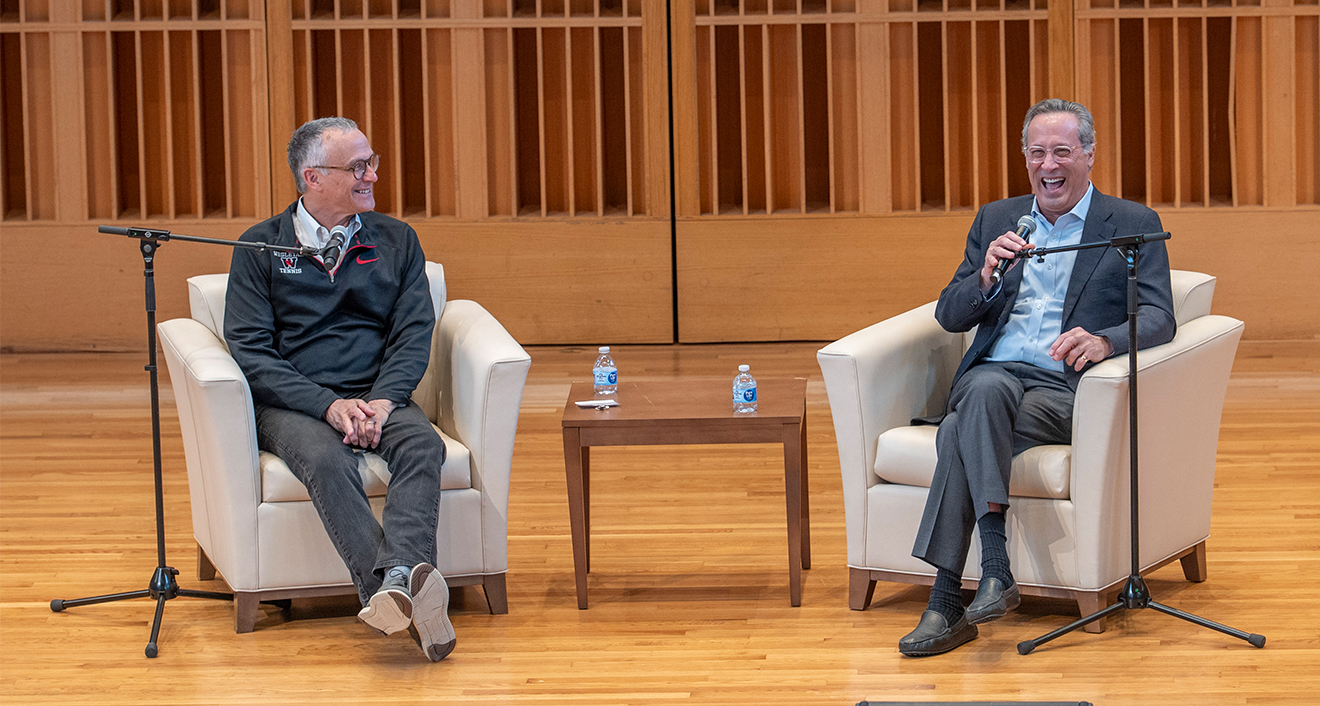
A common thread connects Wesleyan University President Michael S. Roth ’78 and Tony Marx: Both have built careers around leadership guided by values, often with a steadfast conviction required to turn institutional ideals into action.
Marx, who attended Wesleyan in the 1980s, is the former president of Amherst College, and is now president and CEO of the New York Public Library. He joined Roth during Wesleyan University’s 2026 Reunion & Commencement Weekend for a conversation that moved from Wesleyan’s activist history to the responsibilities of institutions facing political pressure today.
For Marx, Wesleyan provided the tools to think about the world and the push to participate in it. “[Wesleyan] taught me to think. That was useful. Thank you,” Marx said. “Also, when I was here, South Africa was the big topic of conversation—although not always conversations, some yelling and screaming as well.”
That campus engagement drew Marx into the anti-apartheid movement and helped shape his post-college trajectory. After graduating, Marx went to South Africa where he helped set up “a college that would give Black South Africans one year of quality residential education after 12 or more years of purposefully bad education under apartheid. And it worked. One year undid the damage of 12 years.”
Roth connected Marx’s student experience to Wesleyan’s current Democracy 250 work, which supports students working on campaigns, voter registration, and public issues across the political spectrum leading up to the midterm elections and beyond.
“We believe that participation in the public sphere is educational,” Roth said. “It’s not a distraction from what you’re learning. Learning how to think, learning how to reason, learning to appreciate other people—all those things that you want while you’re on campus, you also can get by engaging in the public sphere.”
Marx said the approach reflects a role higher education should not abandon, especially during moments when institutional caution can become its own form of retreat.
“At a moment when it’s really tempting to just duck and cover or put your head in the sand and hope, Oh maybe in two years this will go away—it’s not going to go away then,” Marx said. “You’ve been a very powerful voice, Michael, in saying that this is the role of higher education, that we are not just in the business of academics narrowly conceived though we are in that business. We are also in the business of inspiring and educating and enabling the future leadership of the country, and we need better leadership.”
At Amherst, Marx put that thinking into practice by expanding access while the college was already top ranked. He said a supportive board encouraged him to take risks while the institution was in a position of strength. He turned his attention to transforming what he saw as “the whitest, richest college” by increasing access for low-income students and changing the composition of the student body.
“We tripled low-income enrollment at a time when no one else was really in that business,” Marx said. “When I left Amherst, it was minority white American, which was very different. And the conversations on campus and in the classroom were transformed and enriched for everyone.”
The same values now guide Marx at the New York Public Library, where he leads the nation’s largest library system. He described the library as a deeply democratic institution, open to everyone, and grounded in the belief that access to knowledge is essential to public life.
“The library is democratic,” said Marx. “We serve everyone from the poorest to the Nobel Laureates. We offer education programs in every neighborhood for free. We care about digital access, which a million-and-a-half New Yorkers still don't have at home, which is mind-boggling.”
That work has placed the library in the middle of many of the same debates facing colleges and universities, including book banning, pressure to self-censor, and threats to immigrant communities.
“We're very mindful that we are the place that the immigrant community comes to first [and] feels that they can trust. They feel respected,” said Marx. “We live in dread of the day when ICE comes into the libraries, which they can do. We have the largest English-language instruction classes because we've turned the libraries from passive space to proactive education spaces in all these neighborhoods.”
Roth and Marx also discussed intellectual diversity, the rise of artificial intelligence, and the role of libraries and universities in helping people identify trustworthy information. At the library, Marx said, people are already arriving with AI-generated citations for sources that do not exist.
The conversation closed with a question from Sarah Guernsey ’92, a public-school teacher, who asked how to take lessons learned at Wesleyan beyond campus.
Roth said Wesleyan can model approaches that other institutions can adapt, including through partnerships with high schools and colleges that hold very different perspectives.
“What we really need to do is have a conversation about what an informed citizenry in this country might look like,” Roth said. “Libraries play a role. Colleges play a role. Obviously, the public school system is so important. What I hope we can model is the joy of learning in a way that conveys to people that learning shouldn’t be a privilege. It should be our birthright in this country.”