
New Book on Interstellar Medium Charts Cosmic Past and Future
The local interstellar medium, or the gas and material in between the nearest stars, has always surrounded the Sun, but humans have only been able to observe it within the last 30 years since the introduction of the Hubble Space Telescope.
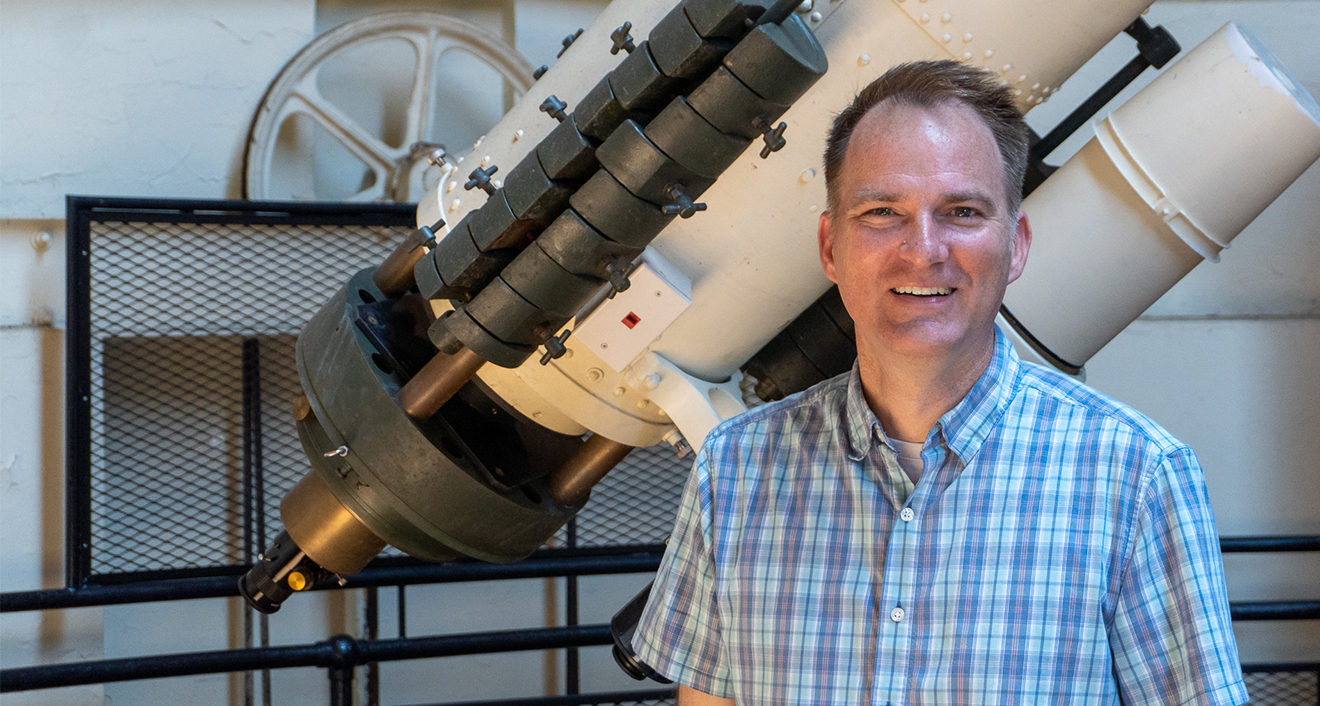
This subfield of astronomy is still in its early stages, which is partly why Fisk Professor of Natural Science and Chair of Astronomy Seth Redfield co-authored From the Heliosphere to the Local Bubble: The Local Interstellar Medium with astrophysicist Jeffrey Linsky. The book was published by Springer on Aug. 7.
“Most of this field grew up when Hubble started observing and it's because it could see in the ultraviolet and get high-resolution spectra,” Redfield said. “It had the capabilities and could see at wavelengths that were important for this work. Over the last couple decades, we've had this new view of the local interstellar medium.”
Alongside our new view through Hubble, astronomers also have emerging data from the Voyager and New Horizons spacecrafts. Voyager 1 will reach one light-day away from Earth—the time it takes light to travel in 24 hours and the furthest distance a man-made spacecraft has reached—later this year. This distance is crucial, Redfield explained, since it’s easier to observe the local interstellar medium from further away.
The book summarizes the present knowledge of the local interstellar medium (LISM) within the heliosphere, the space in proximity to the Sun, and the Local Bubble, which stretches about 300 light years from the Sun on all sides. Redfield and Linsky also identify the complex characteristics—like mineral composition and density—of the materials and structures within the local interstellar medium that astronomers theorize also exist in other galaxies.
“This book tries to present the new findings that have come about from these new views of this space over the last 20 years,” Redfield said. “It also tries to connect it up with the bigger effort to contextualize the Earth and life in the universe.”
Learning from the Interstellar Medium
By researching and understanding the interstellar medium, astronomers will have a more complete picture of faraway Earth-like planets, Redfield said. Exoplanet science—the study of planets outside our solar system—has boomed over the last few decades. For a long time, astronomers were limited to a simple conception of what could lead to life on a planet. The main factor they considered was how far a planet was from its star, or whether it was within the habitable zone, like Earth. “It's a lot more complicated than that,” Redfield said. “The observations we take to study these planets has also grown more complicated.”
Currently, NASA is working on building the Habitable Worlds Observatory, and other telescopes around the world that will be used to try to measure the atmospheres of Earth-like planets. Redfield said this is one way we may discover life elsewhere, because life has significantly altered Earth’s atmosphere. Similar changes on Earth-like planets could signal life elsewhere.
“This Habitable Worlds Observatory is motivating this topic, where in order to successfully make that measurement, we may need to know the interstellar medium in extreme detail in that direction,” Redfield said.
Since the interstellar medium and the Sun are traveling through space in different directions, our heliosphere will change as the Sun traverses different interstellar environments. Astronomers theorize this will lead to changes to Earth’s atmosphere in the future, since the heliosphere offers a protective layer from some interstellar medium gases and material. For instance, researchers are studying what would happen if the local interstellar medium made direct contact with the atmosphere of Earth in the future, if it has not already. Further study is needed, but researchers have proposed that global climate changes could occur from direct contact due to factors like increases in the amount of hydrogen and dust in the atmosphere and in galactic cosmic rays as the Sun travels outside the heliosphere. “These and future studies highlight the importance of changes in the interstellar density on the Earth and its biohistory,” the book said. “Since this broad topic has immense public interest, look forward to major studies in the very near future.”
In the final chapters, the book looks at our interstellar future, or what sort of environment the Sun will enter over the next several thousand to million years. The co-authors then explore several unanswered questions researchers are studying, like what roles magnetic fields play or when does the Cluster of Local Interstellar Clouds (CLIC) end? The CLIC is a group of partially ionized interstellar gas clouds currently surrounding the Sun.
“The complexity of the known structures in the LISM makes it difficult to predict with any precision the Sun’s far future interstellar environment,” the book says. “However, in the next 50,000 years or so, the Sun will likely pass through the remaining clouds in the CLIC before entering a more uncertain and likely very different interstellar environment.”
Redfield said interstellar medium science touches many corners of astronomy, and the book also aims to connect different astronomical subfields together. “I think this book would be really useful for early career people in any [astronomical] field connected with stars, planets, and galactic structure,” Redfield said.