Three artists with Wesleyan connections are participating in the 61st International Art Exhibition of La Biennale di Venezia, also known as the Venice Biennale, bringing their distinct practices to one of the world’s most significant international forums for contemporary art.
Founded in 1895, the Venice Biennale has long played a role in introducing artists and ideas that shape international conversations about contemporary art. This year's exhibition, In Minor Keys, brings together 110 artists, collectives, and artist-led organizations from around the world, including Associate Professor of Art Tammy Nguyen, Carrie Yamaoka '79, and Laurie Anderson, who served as the Center for the Arts' 2019–2020 artist-in-residence. Together, their participation highlights the prestige and reach of Wesleyan’s arts community—and the ways its faculty, alumni, and visiting artists shape global dialogue.
Centered around themes of relational geography, sensory engagement, material experimentation, and collective artmaking, the works in the exhibition were curated by the late Koyo Kouoh for their resonances and affinities across geographies and artistic practices.
The works are on display through November 22, 2026.
“Koyo was a remarkable, radiant person who really wanted the In Minor Keys artists to be wholly represented,” Nguyen said. “It’s an honor to be in this edition—to be able to show my paintings alongside my artist books and perhaps most significantly, to introduce a new horizon in my art practice that is performance making.”
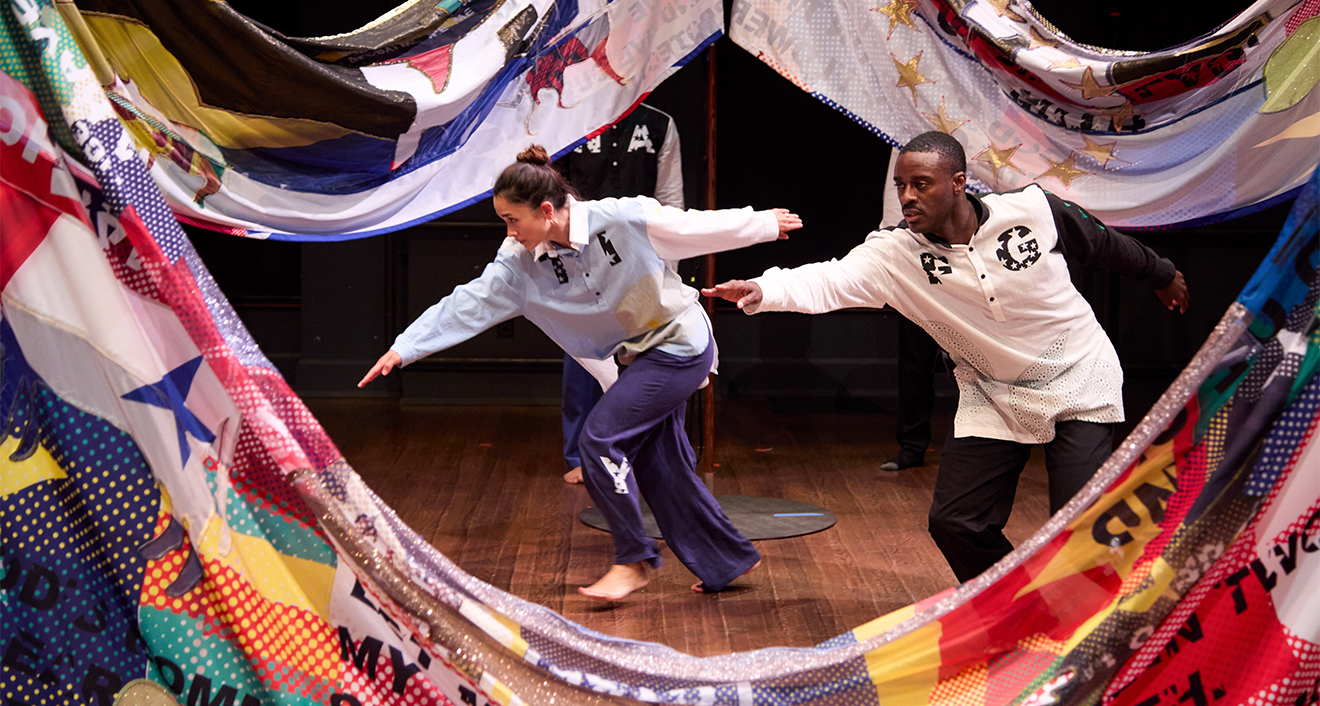
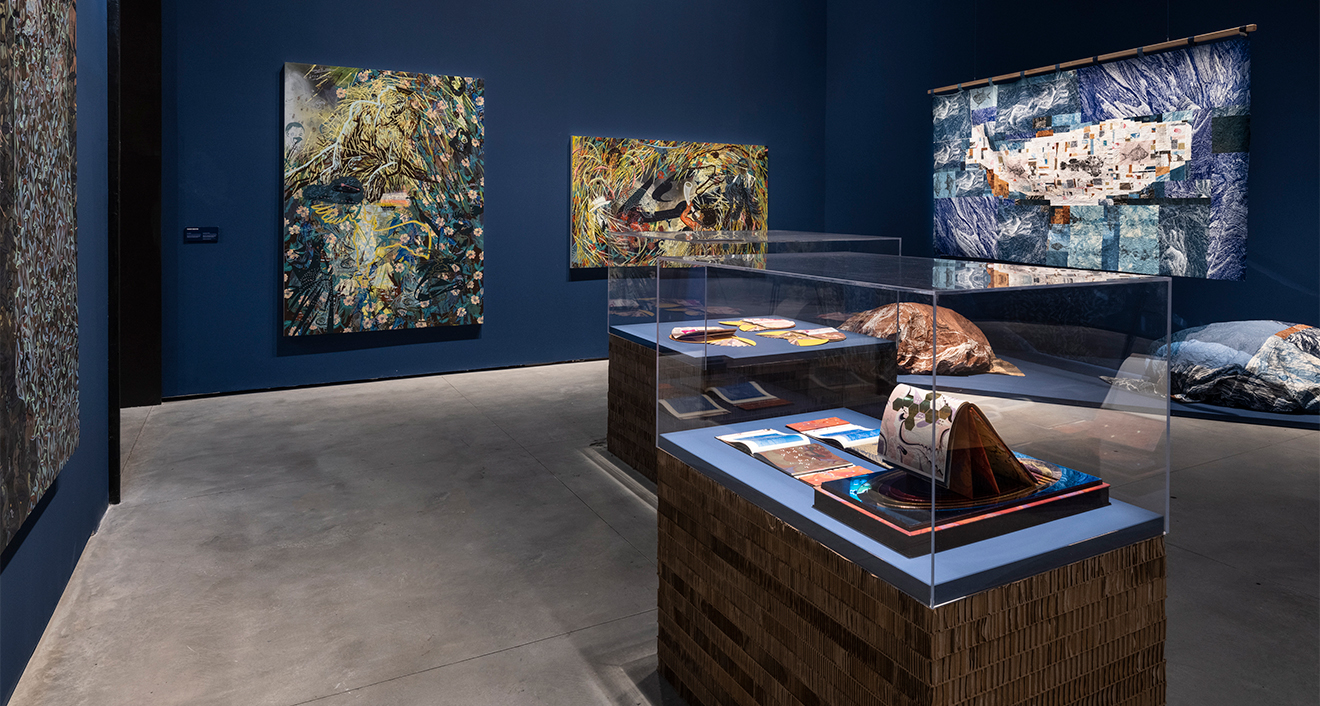
Nguyen’s works bring together painting, printmaking, and collage to explore the intersections of geopolitics, literature, and ecology. For the Biennale, she presents paintings and artist books that connect the legacies of the Cold War and Vietnam War with the persistent threat of nuclear conflict and Dante’s Divine Comedy. Drawing on imagery ranging from the Cuban Missile Crisis to volcanic eruptions and literary references, Nguyen creates densely-layered works that invite viewers to consider the boundaries between what is known and what remains unknowable. Her participation in the Biennale is supported in part by Wesleyan’s Center for the Arts. Nguyen's installation as part of "In Minor Keys," the 61st International Art Exhibition of La Biennale di Venezia, Venice, Italy. May 9–November 22, 2026. Images courtesy the artist and Lehmann Maupin, New York, Seoul, and London. Photography by Studio Kukla. In addition to her visual artworks, as part of their closing program the Biennale will feature the debut performances on November 13 and 14 of “Timaeus and The Teacher: Foreword,” an aria from the new opera Timaeus and The Teacher written and directed by Nguyen and commissioned and produced by the Center for the Arts. Nguyen was invited to present the work, which brings together music, performance, and visual art; and explores themes of freedom and nationhood, drawing on her family history and multidisciplinary practice.
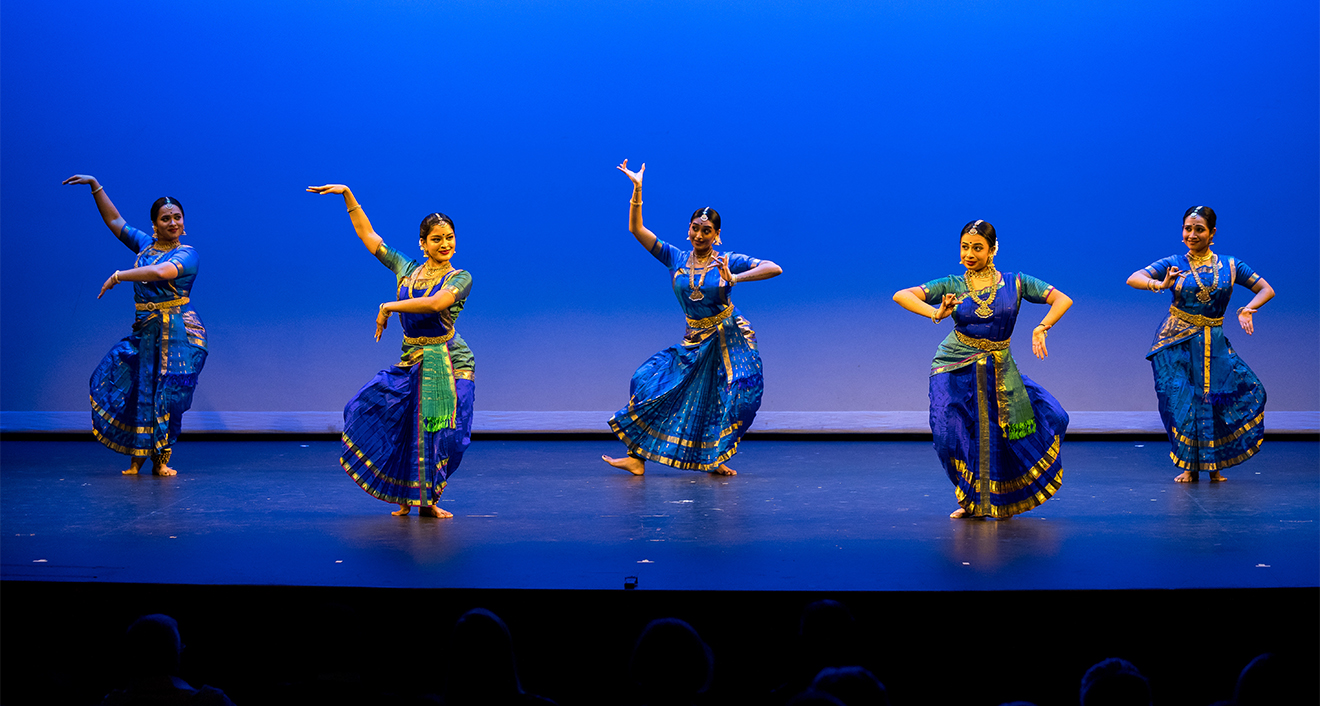
Sung by a Vietnamese English teacher turned refugee while lost at sea, the performance unfolds within a panoramic tapestry designed by Nguyen and manipulated by a team of dancers. In the spirit of Nguyen’s approach to painting, an entire world emerges from this quilted ring, whose form references the diagram of the cosmos in Plato’s Timaeus. Synthesizing symbols and music associated with the maritime practice of ‘Flags of Convenience,’ Timaeus considers what it means to search for national belonging in a world steadily shaped by the will of nature. Composed by John Spencer Camp Professor of Music Neely Bruce, choreographed by Jamal Jackson, and performed by Brian Vu, the full opera will premiere at a later date.
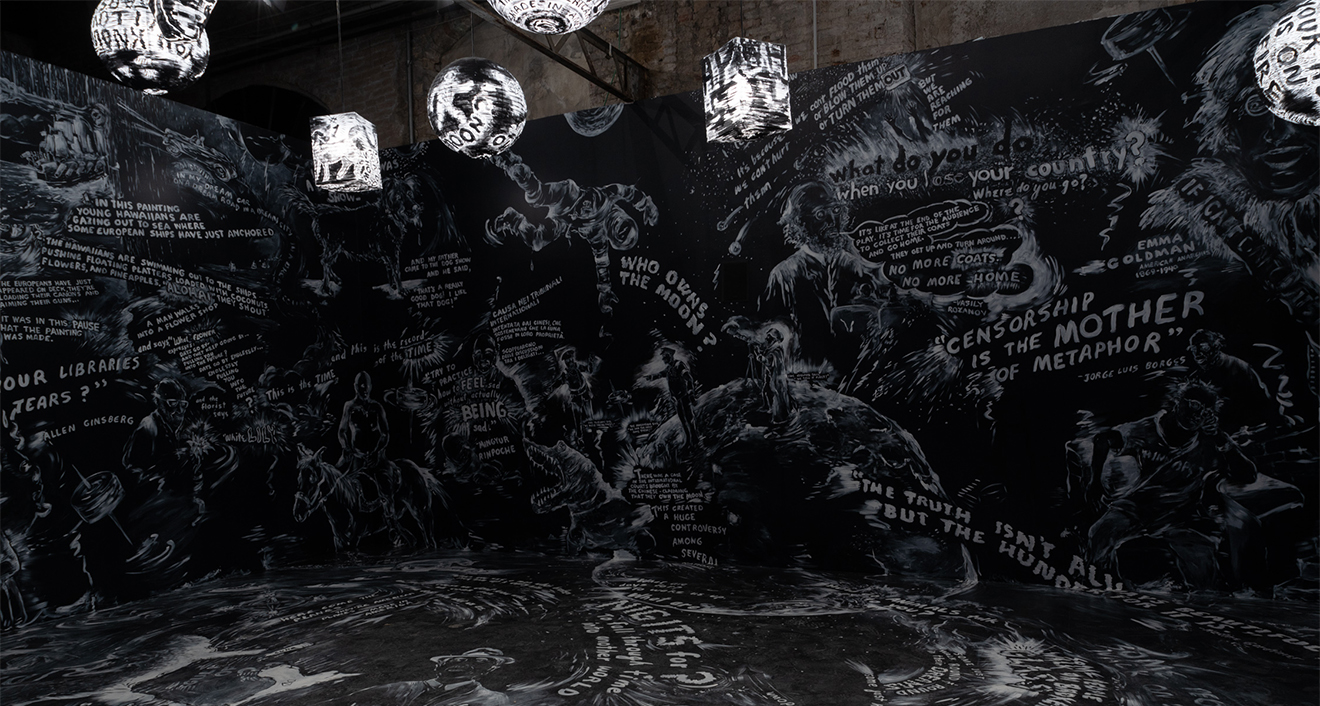
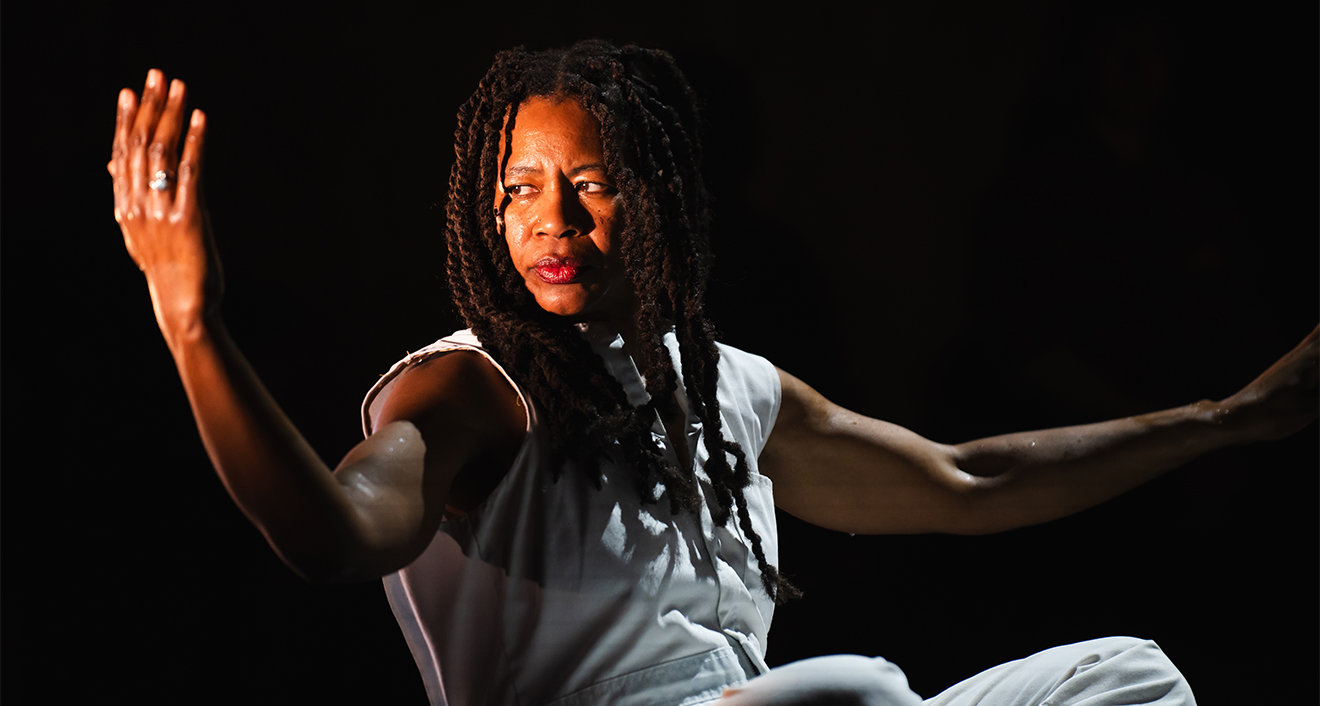
Anderson brings her signature multisensory, psychologically resonant practice to the Biennale. While traditional paintings remain external objects of observation, Anderson’s work defies traditional boundaries, penetrating the viewer's consciousness with the immediacy and rhythm of music. As writer Benjamin Moser observes, Anderson collapses the line between artist and audience, awakening internal landscapes and underlying rhythms to show viewers "what was already in there."
“I really enjoyed meeting other artists who also had a lot of challenging questions about the political aspects of the Biennale,“ said Anderson. Anderson's installation as part of "In Minor Keys," the 61st International Art Exhibition of La Biennale di Venezia, Venice, Italy. May 9–November 22, 2026. Images courtesy La Biennale di Venezia. Photography by Luca Zambelli Bais. "All in Your Head," 2026. Sound installation, binaural stories. 20 min. Dimensions variable. "Notebook," 2026. Immersive painting installation, sound. Dimensions variable. Yamaoka examines relationships between individual and collective art practices in counterpoint to the political landscape. Working with a restrained vocabulary of reflective Mylar film, black vinyl, and resin, her practice intuits alchemical outcomes while gesturing at social erasures. Spanning from 1991 to 2026, the works take on renewed resonance in the Biennale against the backdrop of climate collapse and a global authoritarian turn.
Also on View in Venice
Assistant Professor of Art and Design and Engineering Studies Yu Nong Khew presented work in Venice in July as part of the group exhibition Visions, Anima Mundi, hosted by ITSLIQUID International Art Fair at the Palazzo Albrizzi-Capello.
“Venice is a city shaped by material history, atmosphere, and fragility, so presenting my sculptural textile work there felt especially resonant,” Khew said. “It was a powerful opportunity to see Tactility be in conversation with a place where art, architecture, craft, and environment are so deeply intertwined.”
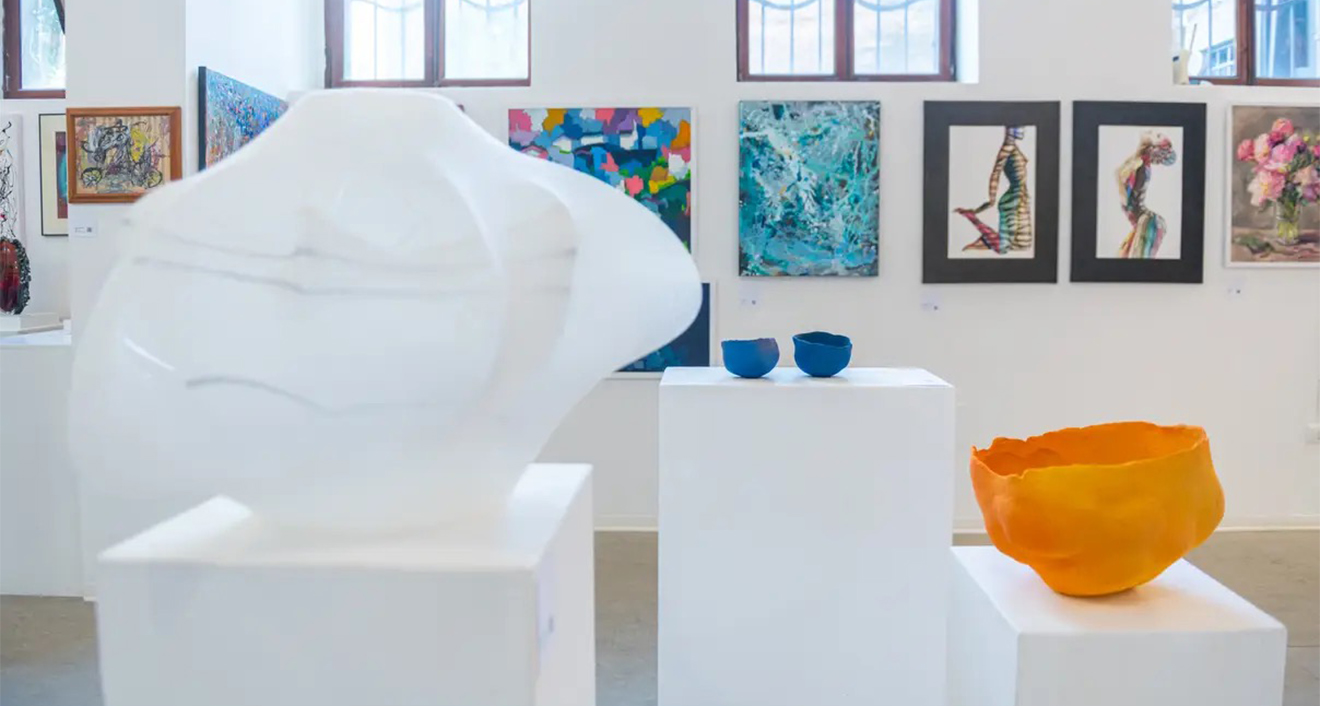
Khew's installation as part of the group show "Visions," Anima Mundi, ITSLIQUID International Art Fair, Palazzo Albrizzi-Capello, Venice, Italy. July 17–31, 2026. Images courtesy of ITSLIQUID Group. "SSH 02," white and grey lambswool with acrylic structure. Created on Wesleyan's Shima Seiki 3D knitting machine in the Textiles Hub.