
Artist-in-Residence Uses Senses to Explore Nature
Movement-based performance artist mayfield brooks first fell in love with the ocean as a child during a visit to Hammonasset Beach State Park in Madison, Connecticut. “It's a day that stands out in my mind from my childhood,” brooks said.
A resident of New York, brooks returned to their home state as the 2025-2026 artist-in-residence at Wesleyan’s Center for the Arts. They said what emerged from their work is a gesture toward understanding that there is no separation between us and the natural world, and how to activate that awareness and feeling for people. “I am not separate,” brooks said. “I am one with the ocean.”
Their residency culminated in the performance of a new sonic dance installation, dArK oXyGen, and their first major solo exhibition, Whale Fall with Me, in the Ezra and Cecile Zilkha Gallery. “I think Wesleyan is such a great incubator,” brooks said.
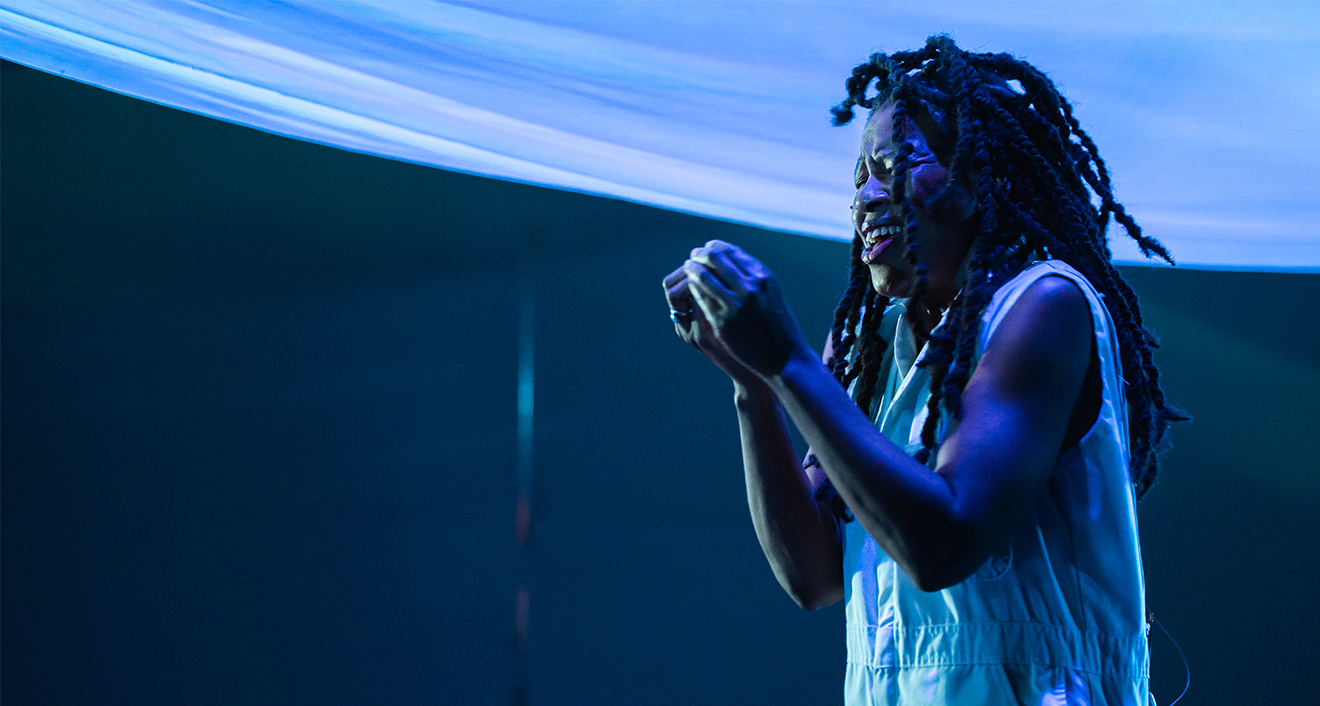
During dArK oXyGen, a dance exploring choreographies of breath, brooks recites their Whale Fall poem. “In my work, I’m always letting the embers of whatever I worked on before be present,” brooks said. “It's an interesting thing that happens in the creative process, where something might emerge that's from something else, and it's just a different expression of it.”
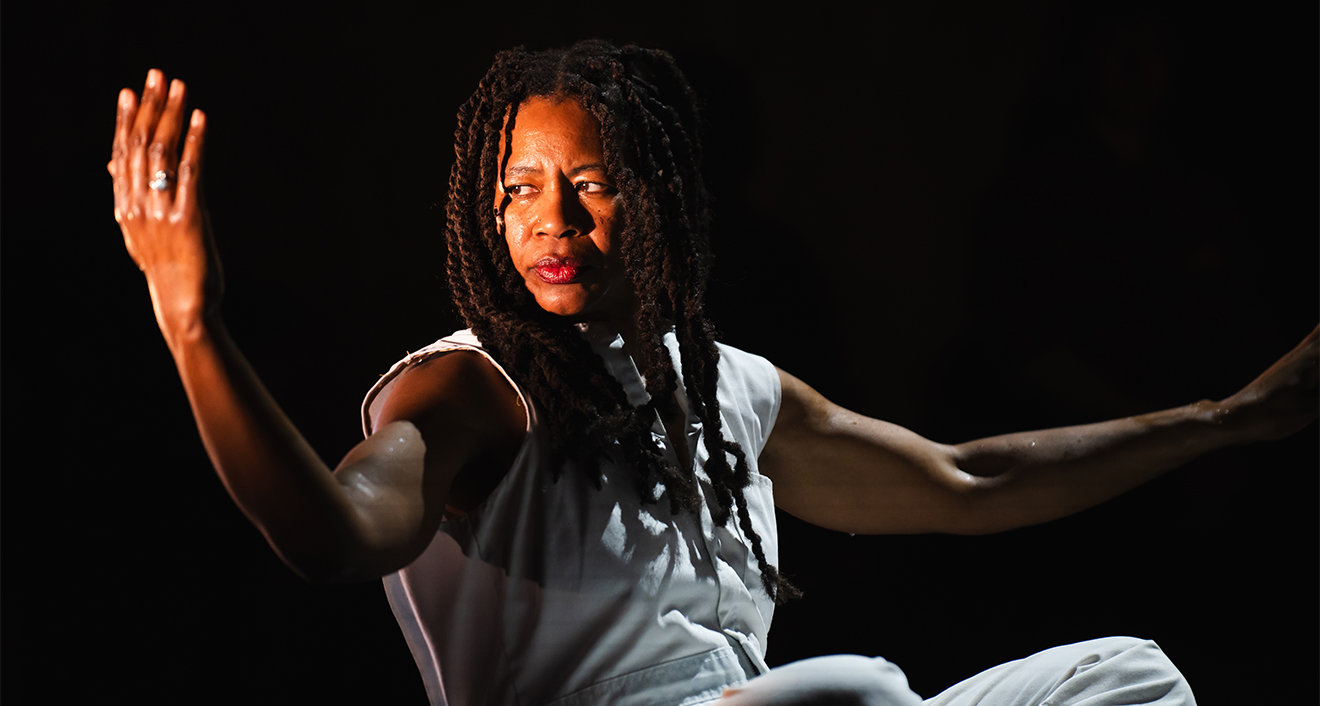
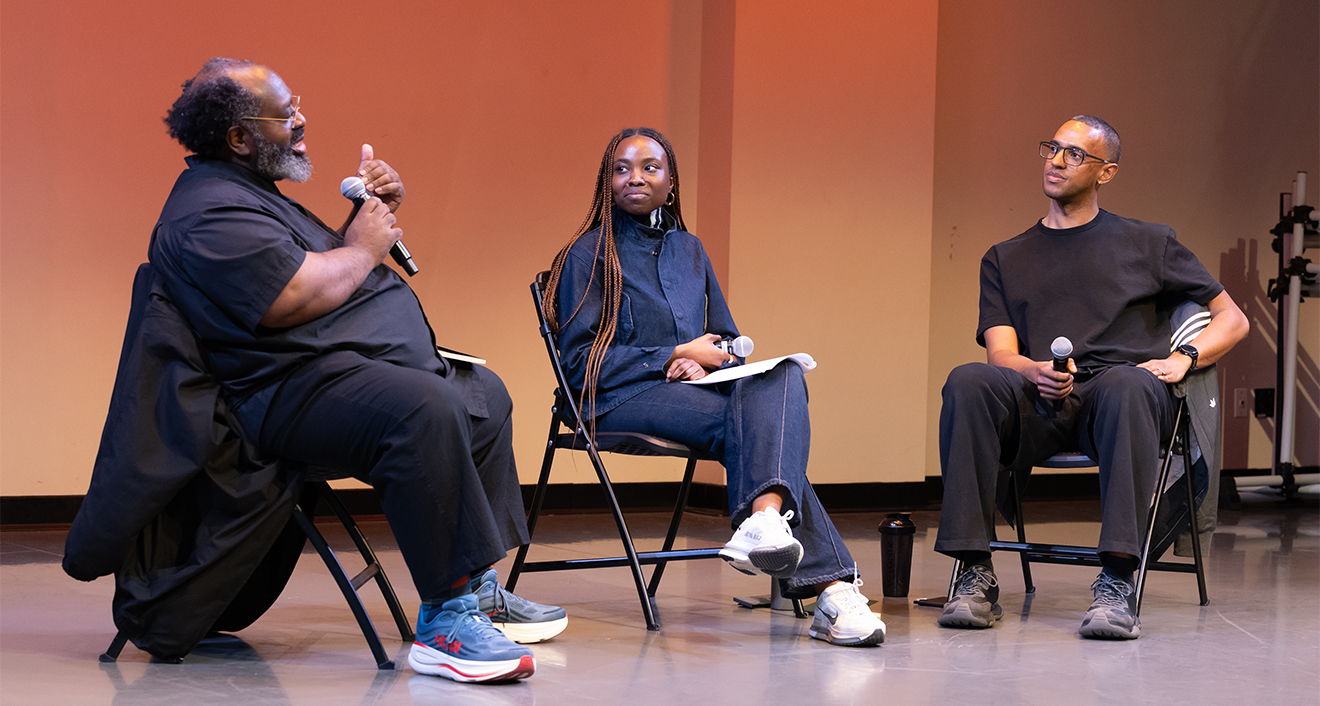
mayfield brooks performed "dArK oXyGen," their new sonic dance installation which explores choreographies of breath, in Wesleyan's Center for the Arts Theater in February 2026.
Their exhibition featured a newly commissioned, site-specific film of a performance on the 1885 Tall Ship Wavertree in the care of the South Street Seaport Museum in New York. “It's a historic monument, and the fact we got to be there was the most incredible experience I've had in my life as an artist,” brooks said. “It's so iconic and interesting to make a piece there.”
Throughout the residency, brooks deeply explored the concept of decomposition—what it means to decompose a creative impulse, an idea, or a theater space. "That's something that I'm really massaging or metabolizing as a pedagogy, as a methodology, as a way of being in the world, especially in these dark times,” brooks said.
For brooks, incorporating gospel music —with the familiar hymn “Amazing Grace”—into their performance is a sonic and physical expression of light in the dark, or a breath that happens when there’s no breath left. “If we’re going to do a call and response, I feel like gospel music is the response to the refrain ‘I can’t breathe,’” brooks said, referencing the last words of Eric Garner, George Floyd, and other Black men killed by police.
brooks grew up singing gospel in Manchester. “I could easily decompose ‘Amazing Grace’ and play with it—shift it into a whole other field of sonic resonance,” brooks said.
During the fall 2025 semester, brooks was a visiting professor of dance, and co-taught the course DANC 377 “Perspectives in Arts as Culture: (DE)Composing Dance (Let's Play!)” with their collaborator and Visiting Scholar in Dance camilo camar. During the course, brooks said the students tried various dance scores that would allow them to let go of their expectations and anxiety around being seen or not being seen in order to create a dance in an expansive space of exploration and joy. “I felt really fortunate to be able to work with them because they were so open to say ‘yes’ to everything,” brooks said.
Rory Joslin ‘28, a double major in dance and environmental studies, said brooks cultivated an accessible environment where students in the class were comfortable experimenting and trying new things. “Being in collective with other people was super impactful,” said Joslin. “How do we move together and find community in that? There's so much joy that comes out of that, and so much inspiration you can find through how other people move.”
During dArK oXyGen, brooks and camar presented a blindfolded duet to drop any pretense of thinking or doing. “It's such a wonderful opening to discover something different that I might not have expected,” brooks said of the duet, which they first presented at New York’s Danspace Project in 2023 as part of Whale Fall.
The six students in brooks’ class adopted this practice for their final sharing. “It felt very freeing to not have to consider other people's reactions,” said Joslin. “It was a new kind of vulnerability that I really appreciated and I definitely want to lean into that more going forward.”
Noelle Schultz ‘26, a double major in dance and film studies, said she grew and improved because of brooks’ class, and enjoyed the sightless exploration and blindfold prompts, which helped to build trust. "That was a super impactful score for me because I was really able to let go of the fear of being watched, because I couldn't see anything,” Schultz said. “That was really special.”
Schultz worked in the gallery during the residency, noting that the experience directly shaped her own artistic development and senior thesis dance film. She used one of the scores from brooks’ class in the film, which brooks advised.
Coming full circle, brooks also took the class on a field trip to Hammonasset Beach. Joslin noted that dance as research can be an impactful way to explain or understand nuanced scientific concepts. “I think dance is such an important way to convey environmental issues,” Joslin said. “Dancing in natural environments is so meditative.”
brooks said they are challenging the idea in their field that the creative process of a new work emerging is ever finished. “Nothing's ever done,” brooks said. “I don't have any expectations around finishing something because it'll never be finished—it’s always decomposing.”