As an improvising musician, Assistant Professor of MusicDarius Jones said he is often eager for the moments when he has to navigate the unknown, whether in life or on the alto saxophone as part of his artistic practice. “I relish it,” Jones said during a conversation with Assistant Professor in the Department of Dance at Hunter College Jonathan González.
Their talk, on April 24, capped the second season of the AFTERWORDS series of Center for the Arts public programs, which explore what happens after an encounter with a work of art through reflections and interdisciplinary inquiry.
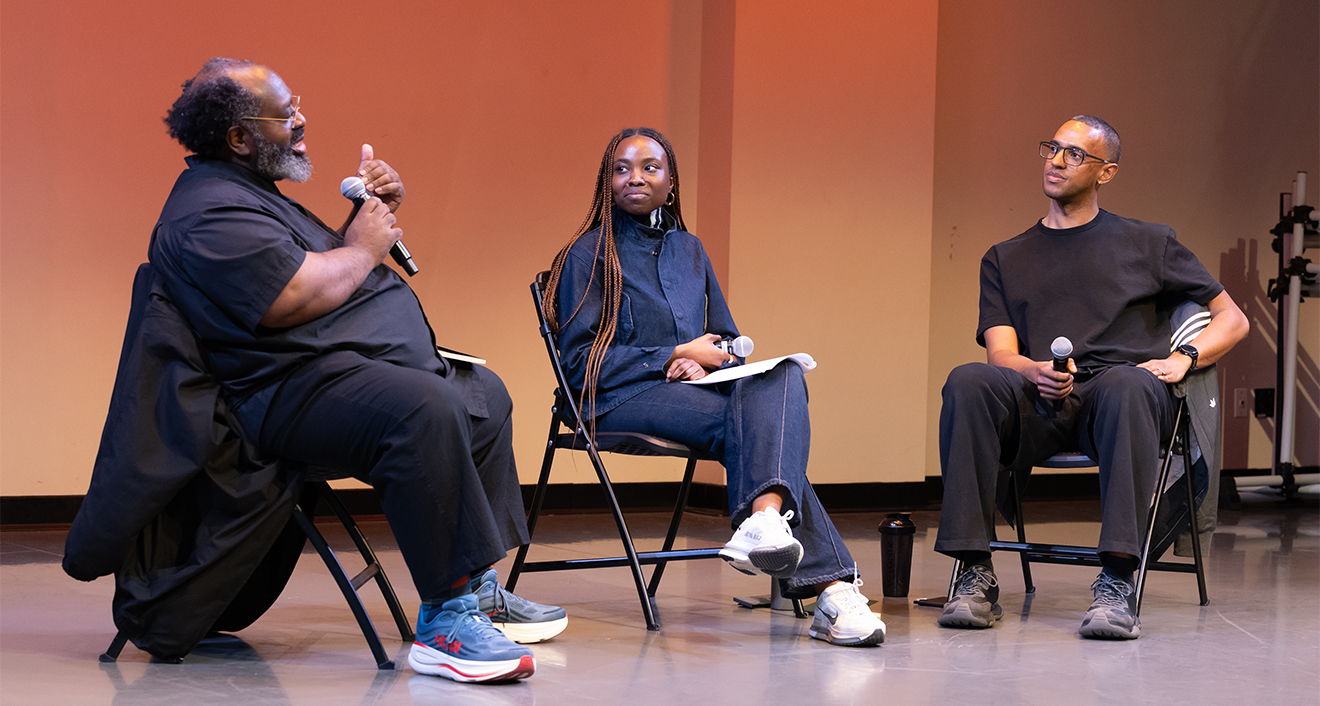
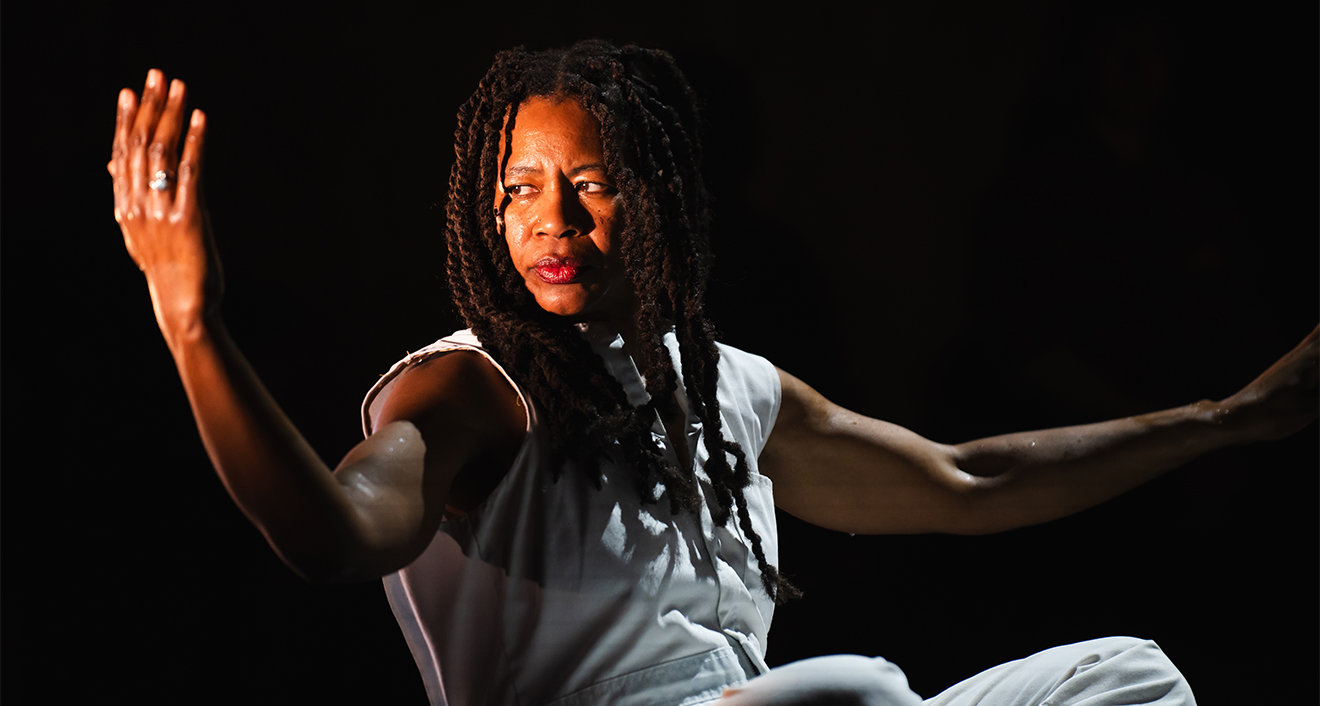
(Left to right) Assistant Professor of Music Darius Jones, Assistant Director for Programming and Assistant Curator for Performing Arts Kiara Benn ’20, and choreographer, artist, and writer Jonathan González explored the relationship between dance and music as ways of mapping alternatives to the present. Photo by Sandy Aldieri of Perceptions Photography.
The AFTERWORDS series, which is presented each season, examines the role of art in personal and public life, revealing how the arts shape the world. This year the keyword that guided programming was “entanglement”—how we are attuned to the intimate and often unconscious threads that connect us to each other and the world around us.
The conversation, moderated by Assistant Director for Programming and Assistant Curator for Performing Arts Kiara Benn ’20, explored the relationship between dance and music as Black counter-hegemonic practices, or ways of mapping alternatives to the present. Benn asked both Jones and González about how they intentionally work to center their artistic process, prioritizing their practice over the resulting project or moment of performance.
As a professor and a musician, Jones said he always deals with artistic process and progress. “Do I see myself growing? Do I see myself developing in certain ways that I couldn't see before?” Jones asked.
He spoke about his desire to explore whatever he is curious about with other musicians, without necessarily wanting there to be any type of ending. “When I perform, I'm always putting myself in the mindset of learning,” Jones said. “I feel like sometimes as a musician in a performative practice, there is that idea that you're aiming at something. I find myself at times not trying to aim at anything, not trying to have a particular outcome.”
Jones described his pedagogical practice at Wesleyan as getting students to a place of living inside of music and artistic existence, and to look at the learning experience of performing a concert as only one part of the journey. "When we attach ourselves to this idea of a performance, we are limiting the scope and the possibility of what can happen,” Jones said. “It is more about the idea of existing inside of the practice. I want students to utilize the practices of improvisation in their work because it will create a sense of fascination.”
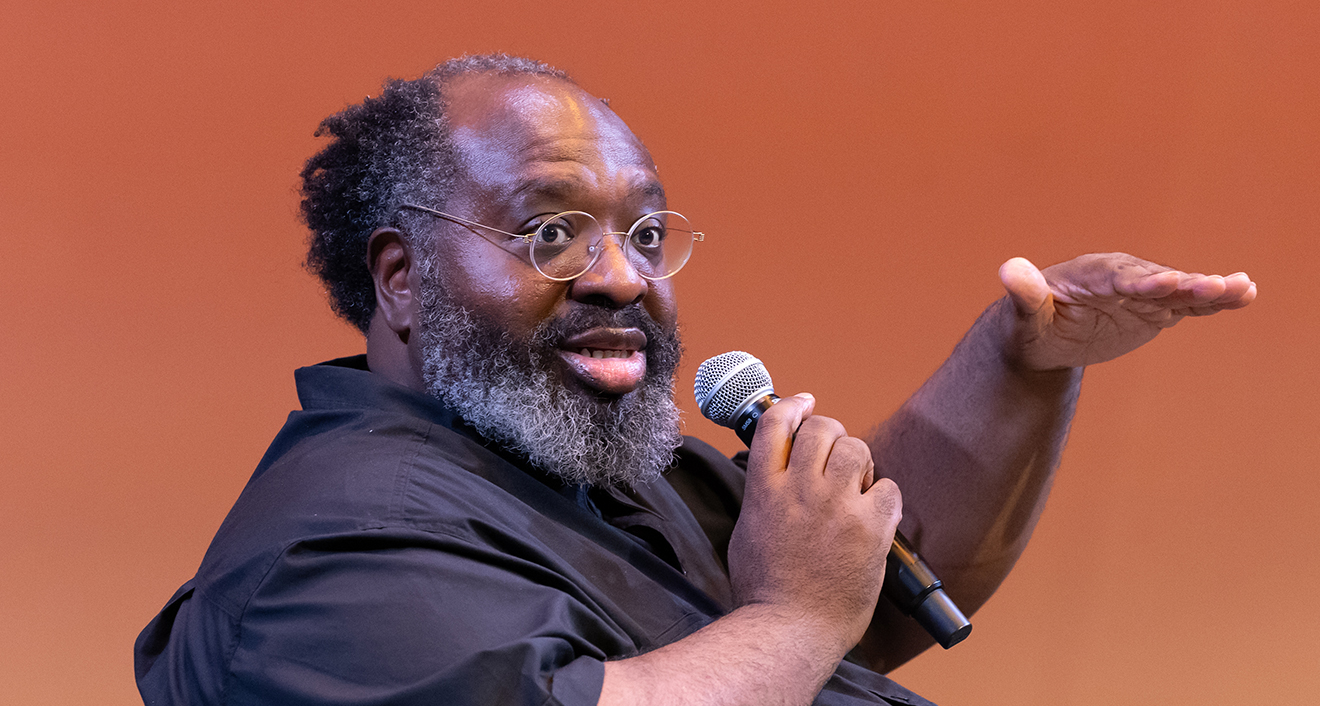
Assistant Professor of Music Darius Jones discussed his practice as an improvising musician during the Center for the Arts' AFTERWORDS talk in the Cross Street Dance Studio. Photo by Sandy Aldieri of Perceptions Photography.
Recently, González said they have started dance performances with their collaborators 30 minutes before the doors open to the public, to establish that the movement is primarily for the group to explore an idea, and that the audience is brought in later to witness their process.
González observed their mutual interest with Jones in moving away from the finality of a fixed, repeatable performance and their focus on process, which Jones recognized as an embrace of the unknown. “We found the pleasure in that unknowing,” Jones said. “I want to find more.”
Benn asked how Jones and González approach improvisation as a method for unknowing in their work. “I think improvisation exists in a place that creates the ultimate fear in us as humans,” Jones said “I very much consider myself an improviser. I also am a composer. These two worlds collide in my work a lot.”
“As an improviser, you're trying to put enough method together within yourself to be able to deal with what comes,” he continued. “You’ve got to put yourself in situations that are a little uncomfortable sometimes to help you to see who you really are.”
González said they trained as a classical opera singer and also found dance liberating. They said that in order to improvise, you need to accept a state of uncertainty or precariousness as a part of the equation to creative invention, the potential of something unplanned happening, or perhaps failure.
”There are various ways that we can form collectivity and figure out how to take a risk when we get conservative, or we fear a threshold in what we're working on,” González said of composing a movement work that includes varying levels of vulnerability. “That taught me a lot about the kind of connective tissue of group social dynamics when it comes to trying to do something in real time and reveal it to the public. The university is an extension of that.”
The day began with a historical grounding facilitated by Mardi Loman, Cross Street AME Zion Church historian, who traced the legacy of Middletown’s Beman Triangle as a site of 19th-century Black land ownership and collective resistance. The walking tour was followed by a performance workshop led by González, who used their recently published book Ways to Move: Black Insurgent Grammars (2025) as a prompt for participants to translate historical echoes into movement.
“The progression over the course of the day was an attempt to construct place together, and propose a map towards resistance,” said Benn. “The act of coming together is itself a form of possibility.”