
From Classroom to Record Label: Students Pitch New Artists
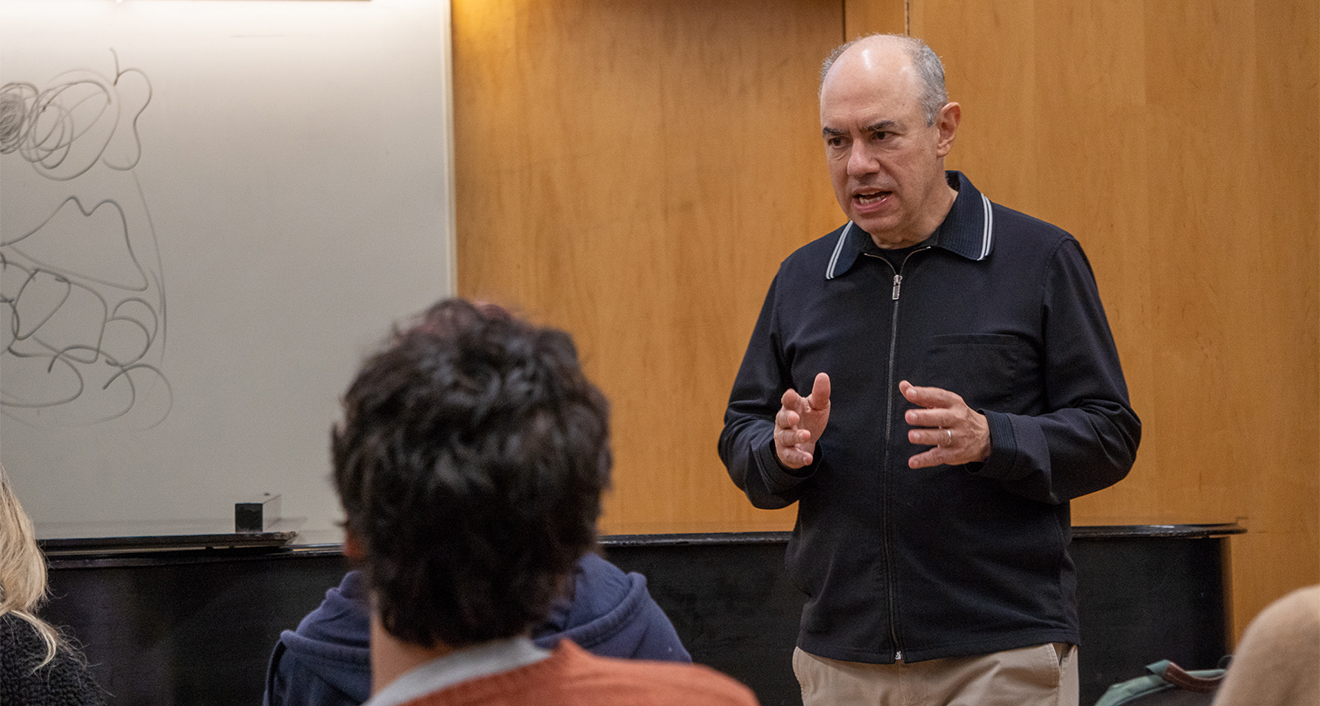
Behind many of the musical artists that guide our culture are teams of executives and production staff who help to discover, support, and market them. “Artist and Repertoire”—also known as A&R—is the specialization within the recording industry charged with discovering new artists and overseeing all aspects of their creative process. This semester, 18 Wesleyan students tried their hand at discovering new artists before pitching them for potential signing to Pure Tone Music through a class taught by Visiting Professor of Music Pete Ganbarg ’88.
Ganbarg, president of Pure Tone Music and two-time Grammy-award winning A&R executive, returned to Wesleyan this semester to teach MUSC270: A&R: Past, Present & Future–A Deep Dive into the Recording Industry. In this class, he taught students the history and evolution of the music business and what it takes to be successful in the industry today. Then he gave them a chance to prove what they have learned in a professional setting.
“I want them to walk out of this class knowing everything there is to know about the music business,” Ganbarg said.
After over 35 years in the industry, Ganbarg has worked with stars like Santana, Miley Cyrus, Twenty One Pilots, Chaka Khan, Christina Perri, and Alex Warren. He also produced the original Grammy-award winning Broadway cast recordings of Dear Evan Hansen and Jagged Little Pill, and A&R’d the cast album for Hamilton—the world-famous musical created by Lin-Manuel Miranda ’02, Hon.’15. Before all this success, he was introduced to the industry through a friend made at Wesleyan when he was a student here. Now he’s looking to pay it forward and serve as a conduit to the business for current students.
“One of the reasons that I have come back here to do it is to prove to the students you can make a living in the music business even if you're not a musician, songwriter, or artist,” Ganbarg said.
Teaching A&R
While working at Atlantic Records several years ago, Ganbarg noticed many of his younger staff were missing the knowledge of music history to do A&R successfully. He started a small informal class at the label to teach them about pillars of contemporary music like Chuck Berry, Little Richard, James Brown, and Buddy Holly. Before long, the group grew from eight attendees to over 100 young music professionals each week, all eager to learn. Then he started bringing in the history-making artists, producers, and executives behind his lessons for live interviews. This was the foundation of his podcast, Rock & Roll High School, and now his class at Wesleyan.
Like his course at Atlantic Records, Ganbarg’s Wesleyan class focuses on history, then looks forward to the present and into the future. In the first half of the course, he mapped out the evolution of the music business from the invention of recorded sound to today, outlining how technology has impacted the field; largely gone are the days of in-person talent scouting and many new artists are now discovered on social media platforms like TikTok and Instagram.
Ganbarg said that understanding the history first gives students an edge in A&R work, offering a larger knowledge base to connect with artists they are trying to sign. “If you want to sign an artist who is a singer-songwriter and their favorite artists that influenced them were the artists in their grandparents' record collection, and you don't know those records, you're going be at a loss to the competition across the street who does know those records,” he said.
During the second half of the course, the focus shifted from history to theory, then to practice. After coming back from spring break, Ganbarg took students through the highs, lows, and lessons from his career before reviewing how to pitch an artist for signing. For their final projects, students were assigned to discover an unsigned artist and pitch them to Pure Tone Records. Ganbarg is now in contact with three of the artists pitched in the class.
Aaron Gill ’28, a College of Social Studies major, said the class has sparked his interest in a career in the music business. The class has shown him the collaborative nature of the industry and has reinforced the value of maintaining relationships, he said.
Like Gill, Lola Cortez ’26, a music major and songwriter, joined the class to learn more about how the business side of the music industry works and improve her chances to be successful in an artistic career.
“I think it makes an impossible industry feel a little bit more grounded,” Cortez said. “[A career in entertainment] sometimes, it just feels so out of reach. Having someone who's been in it, who's experienced it, who's worked, who's talked to us, and explained his strategies, makes it feel a little bit closer.”
Ganbarg’s A&R class, which will be offered again in the fall, is one example of an emerging trend at Wesleyan to intertwine professionalized experience into arts education. Students have also worked with dance companies like Professor of Dance Hari Krishnan’s InDance and Assistant Professor of the Practice in Dance Joya Powell’s Movement of the People. Artist Tammy Nguyen, assistant professor of art, has welcomed students into her workshop to aid in his process and gain in-person arts experience.
This fall, Assistant Professor of Theater Maria-Christina Oliveras will teach a class, THEA385: The Working Theatermaker: Acting Beyond the University, preparing students to audition for film, television, and theater opportunities. Throughout each of these opportunities, students have been given unique practical exposure into fields before pursuing them after graduation.