In the Test Kitchen with Lan Lam '01
On the table in front of Lan Lam ’01 is a sheet pan full of colorful, interlocking, accordion-style tubes. “Imagine that these little bendy tubes here are a piece of meat,” says Lam, “and each individual tube is a protein.”
The colorful plastic props enable Lam, the host of America’s Test Kitchen’s Techniquely with Lan Lam, to illustrate why a piece of meat sticks to a skillet. Cooking causes the proteins to unwind and coil, she says, exposing edges that are attracted to metal and causing them to adhere to the pan at first. Keep on cooking, however, and the edges of the shapeshifting proteins start sticking to each other instead. “Kind of like this,” she says, linking the tubes into one connected network. “And when they all bond with each other, they release from the pan and the whole piece of meat can be lifted from the skillet.”
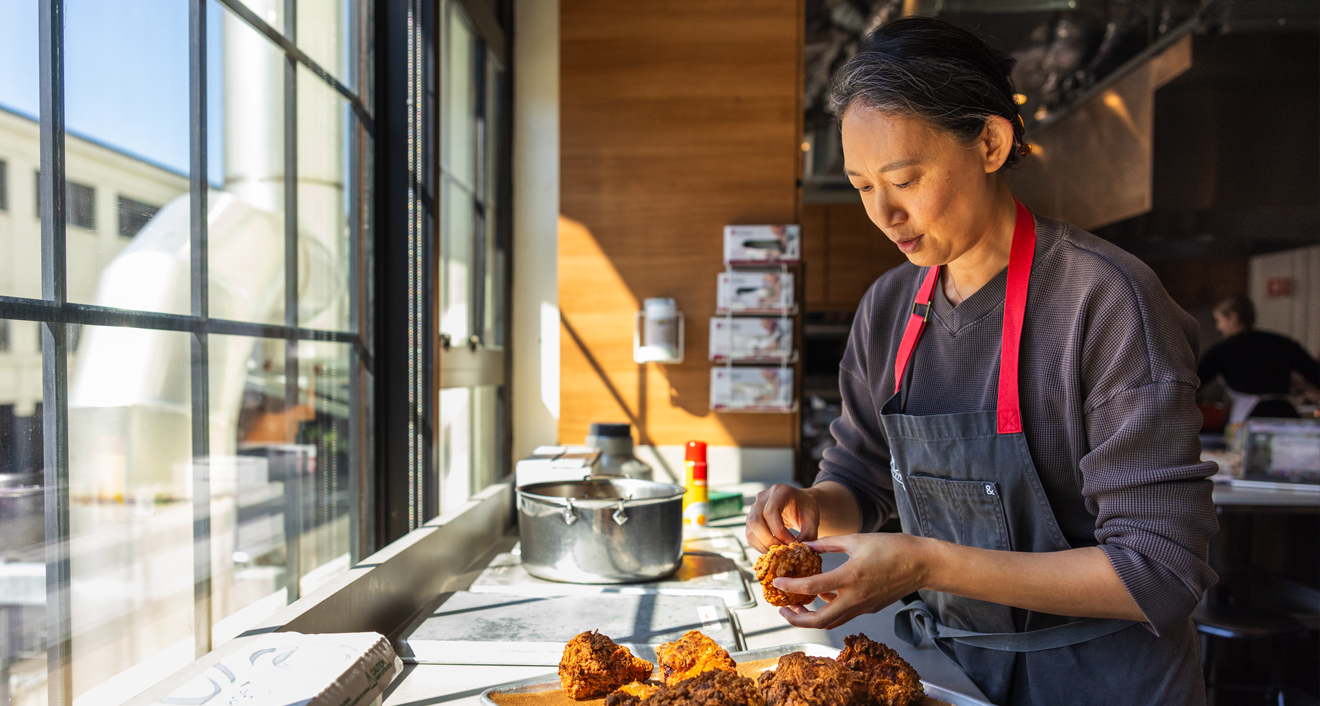
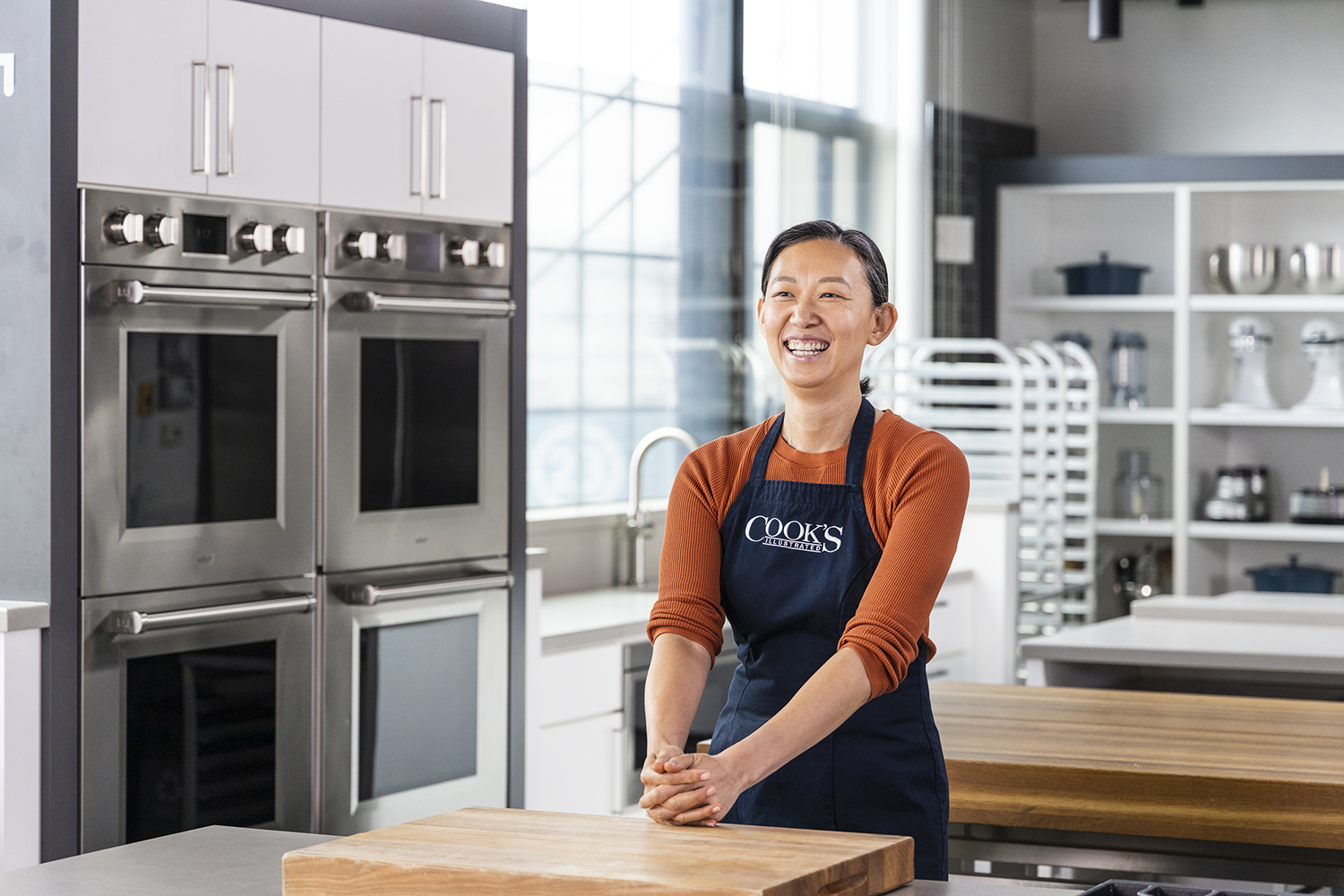
An episode of Techniquely brings together at least two types of chemistry: the science behind popular recipes, and Lam’s charisma in front of the camera. A seasoned cook who spent years in restaurant kitchens before joining the Boston-based America’s Test Kitchen (ATK), Lam shares her unique alchemy of science expertise, culinary acumen, and storytelling prowess with ATK’s three million followers on YouTube. Earlier this year, Lam began popping up in Netflix queues as a co-host of the new video podcast In the Test Kitchen. Across platforms, Lam has a penchant for making viewers feel like they’re in the presence of a remarkable educator—one who doesn’t talk down to you, but instead makes you feel like you’ve just learned something surprising together.
“I like to think I’m a good student,” says Lam, who majored in chemistry while at Wesleyan. “And you have to be a good student in order to be a good teacher.”
Lam’s relationship to cooking has a long history—one that begins with the story of her family immigrating to the United States from Vietnam after the end of the Vietnam War in the 1970s. Lam’s family spent nearly 10 months in a refugee camp in Indonesia before being sponsored by a church in Palo Alto, California, and arriving in the United States to make a new life. “My grandmother lived with us, and she handled most of the childcare and cooking while my parents held down all of the jobs they took on,” Lam says, “and she felt it was her responsibility to teach [my siblings and me] to cook.”
While Lam didn’t attend Wesleyan with the intention of becoming a professional chef, a chance encounter during the summer before her senior year proved to be an important waypoint in her culinary education. Lam was working in interlibrary loan when library staff member Leslie Starr pulled her aside and gave her a copy of Harold McGee’s On Food and Cooking: The Science and Lore of Cooking. “I have memories of that hot Connecticut summer, flipping through the section on eggs and reading about albumin and egg whites, and how there are different types,” Lam says. “I should have recognized back then that I would move into this field eventually, but it took a while to get here.”
Not sure of her next steps after graduation, Lam followed her friends to Boston, where a friend’s mother got Lam a job working as a line cook at a restaurant in the city. For the next decade, Lam would master the tools of that hardscrabble trade at a series of restaurants. “Even though I loved the people and I loved a lot of the aspects of the work, it just didn’t make sense—it was just physically debilitating,” she says. To pivot, she landed a gig as a recipe writer for ATK’s flagship publication Cook’s Illustrated, a job that required far more than jotting down the steps to make a delicious dish.
“I like to think I’m a good student. And you have to be a good student in order to be a good teacher.”
“What are broader takeaways, lessons that you can take from this one recipe and apply to the rest of your cooking?” Lam says. “[If] it’s a culturally important dish, what is the story behind this dish? Why is it so valued, why has it survived as long as it has, how has it changed over time? You have to make it taste good; you have to write it so that people can [recreate it]. But also, what’s the story?”
Lam would spend the next 10 years in the ATK test kitchen developing recipes, learning about world cuisines, and exploring the science behind her growing repertoire of culinary techniques. Then, after impressing during a screen test, Lam was brought on to the cast for a season of ATK’s Cook’s Country. Spending time in front of a camera revealed to her how the storytelling and exposition involved in writing magazine pieces translated to pulling together a cooking show. In 2021, Lam created her eponymous YouTube show with one simple goal. “I wanted to make a show for people who want to understand how recipe developers and chefs think,” Lam says. “How do they approach flavor and appliances and tools? How do they justify the choices that they make when they’re cooking?”
On one episode, Lam might discuss the subtleties of procuring fish that’s intended to be eaten raw as she prepares a marinade for a tuna bowl. On another, she’ll talk about why the chloride ions in salt prevent cooked shrimp from losing water, or how the crispiness of a french fry reflects the density of its starch molecules.
The show has found a receptive audience and Lam, who was recently promoted to supervising producer to help develop more video offerings from America’s Test Kitchen, is excited to go further. “[My producers and I] spend so much time thinking not about the things I want to cook, or even the specific recipes that I’m personally interested in. We’re trying to figure out, what do people want to learn?” she says. “Or, better yet, what do they not know that they want to learn?”
Lead image: Photo courtesy of America's Test Kitchen, All Rights Reserved. Photo: Steve Klise