
Current Students
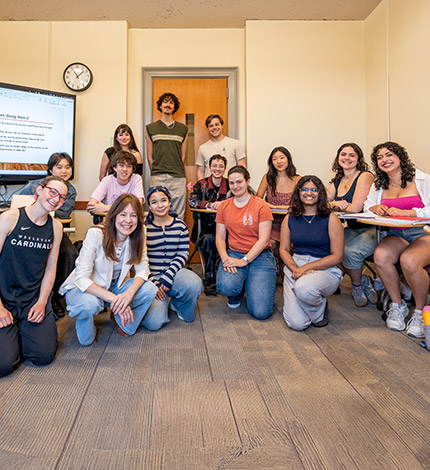
As a Feminist, Gender, and Sexuality Studies Major, you join a community of scholars, mentors, and peers interested in understanding social norms, power structures, and systemic inequalities related to gender and sexuality. This page serves as a hub for essential resources including department policies and academic advising, as well as student opportunities such as research, community engagement, and study abroad.
Student Resources
Academics
Accounts and Support
Academic Advising
Students' Top Questions
Yes, you may count a second Gateway towards the major, either as a Distribution or Concentration credit.
In consultation with your FGSS advisor, you’ll select four courses that together comprise a focused area of study. Not all of the courses that contribute to the concentration need be FGSS listings; you may use courses from any discipline, including a co-major, though must together make up a coherent topic or focus. A 500-word proposal describing the concentration must be approved by your advisor, and submitted to the FGSS office by the end of the fall semester of the junior year. Past FGSS majors have created a wide variety of concentrations. Some recent examples include: Gender and Music; Feminist Science and Technology Studies; Transnational Feminisms; Transformational Strategies and Social Change; Black Feminist Poetics and Literary Aesthetics; Feminist and Queer Performance Studies; Women and Queer People in Media; Sex, Love & Intimacy; and Queer Theory and Literature.
Yes, up to two credits transferred from another institution may be applied to the major.
It is not difficult. The FGSS Department encourages interdisciplinary study, and thus the FGSS major is structured to work well with other majors. For example, the FGSS concentration of 4 courses may combine a student’s interest in gender and sexuality with the topics addressed in another major and may include courses studied as part of the second major. The senior capstone requirement may reflect interests in both majors, and with the approval of both departments, an Honors Thesis may be submitted jointly for two majors.
Post-graduation, Wesleyan alumni have gone on to do work in a wide range of fields, including public relations, media and communications, marketing, law, medicine and public health, social work, social policy, social justice advocacy, K-12 education, higher education teaching and administration, and the arts. Alumni report that they use their FGSS education in myriad ways in the workplace. In addition, about one-third have gone on to graduate study at a wide range of universities and programs, including at Yale, Columbia, University of Pennsylvania, University of Minnesota, Johns Hopkins, George Washington, University of Chicago, University of Southern California, Boston University, Northeastern, Drexel, University of California-Berkeley, and CUNY Graduate Center. Alumni undertake graduate work in a range of fields, such as anthropology, psychology, law, history, and health disciplines, and they report that their training in FGSS served them well.
Student Opportunities
Student Research
Students design their own research projects for their senior essay or thesis. They also have opportunities to collaborate on faculty research often supported through grants provided by Wesleyan. Student research examples:
- Environmental Health & Cultural Fears: A recent senior capstone project analyzed mainstream media narratives surrounding endocrine disruptors (BPA, parabens) and how these narratives reflect cultural fears about reproduction.
- Creative and Academic Intersections: Projects combining creative writing with analytical prose to explore femininity, sexuality, trauma, and personal history.
- Intimate Journalism and Activism: Research focused on reporting within communities, covering topics like LGBTQ/trans rights, Black Lives Matter, and the #MeToo movement.
- Historical and Theoretical Analysis: Investigations into Renaissance representations of love, sex, and marriage in contemporary literature.
- Intersectionality in Policy: Studies analyzing law and policy through an intersectional, critical lens.
Community-Based Projects
Feminist, Gender, and Sexuality Studies students regularly engage in community projects focusing on public health, education, and social justice such as the Doula Project, the Adolescent Sexual Health Awareness (ASHA), and the Center for Prison Education (CPE).
Study abroad
Feminist, Gender, and Sexuality Studies majors are encouraged to study abroad, with many choosing programs that allow them to examine transnational feminism, queer theory, and intersections of race, class, and sexuality globally. Students often pair study abroad with their senior essay or thesis, applying their international experiences to projects on feminist, gender, or sexual politics.