AFTERWORDS: entanglement—Adrienne Edwards and Natalie Diaz
Friday, February 6, 2026 at 12:00pm
Reading Room, South Gallery, Ezra and Cecile Zilkha Gallery
 RESERVE NOW
Free and open to the public.
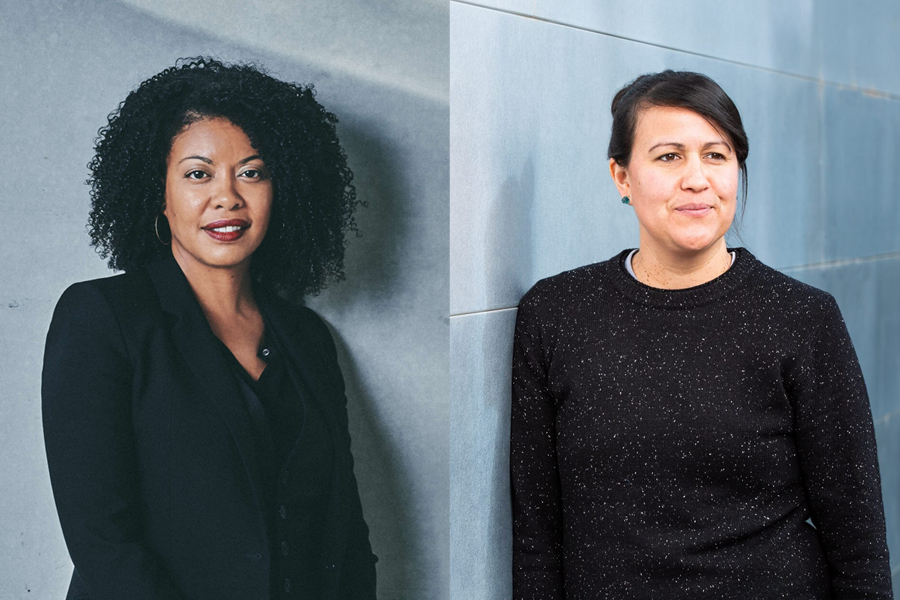
For the fifth event in the AFTERWORDS: entanglement series of public programs curated by CFA Director Joshua Lubin-Levy ’06 and ICPP Director Noémie Solomon, Natalie Diaz and Adrienne Edwards will reflect on their ongoing collaboration and dialogue on modes of reframing time that centers Black and Indigenous practices of language, art, and exhibition-making.In two concurrent projects—“Toward Morning—Nyamathaam’im—‘Abíní” and “The Tendency”—Diaz and Edwards convened artists and scholars at Arizona State University around questions of collective engagement: “Toward Morning…” was seen as an action, a call to do things differently and anew; and “The Tendency” gestured to the pull to come together and “be with” one another. As part of the larger 210 Project (an initiative that uses seven generations of time, or 210 years, as a portal to imagine old and new ways of engaging communities and worlds), both centered Indigenous and Black practices that look to the dawn as the arrival of the new. This horizon meets us as that which is not yet here, but represents the beginning of what could be when we assess what lies behind us and before us and plot our way forward. Diaz and Edwards will reflect on these projects and their ongoing collaboration at the intersection of language and exhibition-making.
Adrienne Edwards is the Engell Speyer Family Senior Curator and Associate Director of Curatorial Programs at the Whitney Museum of American Art, where she most recently curated the blockbuster exhibition “Edges of Ailey,” which was presented from September 2024 to February 2025. Edwards has been a curator at the Whitney since 2018. Her forthcoming exhibition is “Grace Rosario Perkins: Circles, Spokes, Zig Zags, Rivers,” the artists' first museum exhibition in New York City. She co-curated Whitney Biennial 2022: “Quiet as It’s Kept” and enhanced the strength and vitality of the museum's performance program. From 2021 to 2024, she also served as the Whitney’s Director of Curatorial Affairs.
Natalie Diaz was born on the Fort Mojave Indian Village in Needles, California on the banks of the Colorado River. She is Mojave and an enrolled member of the Gila River Indian Tribe (Akimel O’odham). Diaz is the author of Postcolonial Love Poem, winner of the Pulitzer Prize in Poetry, finalist for the National Book Award, Forward Prize in Poetry, and Los Angeles Times Book Prize, and winner of a Publishing Triangle Award. Her first book, When My Brother Was an Aztec, was the winner of an American Book Award. She is a MacArthur Foundation Fellow, a Lannan Literary Foundation Fellow, a Native Arts and Culture Foundation Fellow, and a former Princeton University Hodder Fellow. She was awarded the Princeton Holmes National Poetry Prize and is a member of the Board of Trustees for United States Artists, where she is an alumnus of the Ford Fellowship. Diaz is Founding Director of the Center for Imagination in the Borderlands, and the Maxine and Jonathan Marshall Chair in Modern and Contemporary Poetry at Arizona State University, where she is a Professor in the English MFA program. In 2021, Diaz was elected a Chancellor of the Academy of American Poets, and was a finalist for the Neustadt International Prize for Literature. Diaz resides in Phoenix, Arizona, where she continues the life-long work of documenting Native and Indigenous languages. She is a Mellon Foundation Research Residency Fellow, an inaugural Baldwin-Emerson Fellow, and a Senior Fellow at The New School Institute on Race, Power and Political Economy. She was the 2024 Yale Rosenkranz Writer in Residence.
“Entanglement” is a keyword for studying how human existence is bound up with the more-than-human world, and a call to imagine the web of relations that bind us to each other and the world across space and time. To recognize one’s entanglement complicates one’s sense of agency; to embrace one’s entanglement is to resist the notion of critical distance or objectivity. How do artists and curators navigate their own entanglements? How have they developed practices out of entanglement’s creative possibilities, and in the process transformed traditional ideas of authorship and agency? What work can art do to attune audiences to both the painful and pleasurable ways we are all entangled with each other and the worlds that exist around, before, and after us?
AFTERWORDS: entanglement is a series of public programs sponsored by Wesleyan University’s Center for the Arts (CFA) and the Institute for Curatorial Practice in Performance (ICPP). Guest speakers include artists and curators reflecting on their own practice, process, or method while also attending to a shared keyword. All events are hybrid, featuring speakers both in-person and online.
Curated by CFA Director Joshua Lubin-Levy '06 and ICPP Director Noémie Solomon.
About ICPP
The Institute for Curatorial Practice in Performance fosters the collective study of art and its histories with a focus on developing new critical methods for curating time-based art. Rather than narrowing in on a single authoritative definition of performance curation, ICPP’s aim has been to create a pluralistic conversation specifically around contemporary performance, providing fundamental tools with which artists and curators can develop their own approaches to the work. ICPP was created in 2011 by Sam Miller ’75, P’09 and Pamela Tatge ’84, MALS ’10, P’16 at Wesleyan University.
Admission is free, and everyone is welcome. We encourage you to RSVP to help us with our planning and to get a reminder the day before this event. While RSVPs are not required for entry, they are a big help! While you're on campus, feel free to talk with our gallery assistants about the exhibitions and other upcoming special programs, like our student-led tours.