AFTERWORDS: entanglement—Emma Bigé, mayfield brooks, Katie Brewer Ball
Tuesday, February 17, 2026 at 12:00pm
Reading Room, South Gallery, Ezra and Cecile Zilkha Gallery
 RESERVE NOW
Free and open to the public.
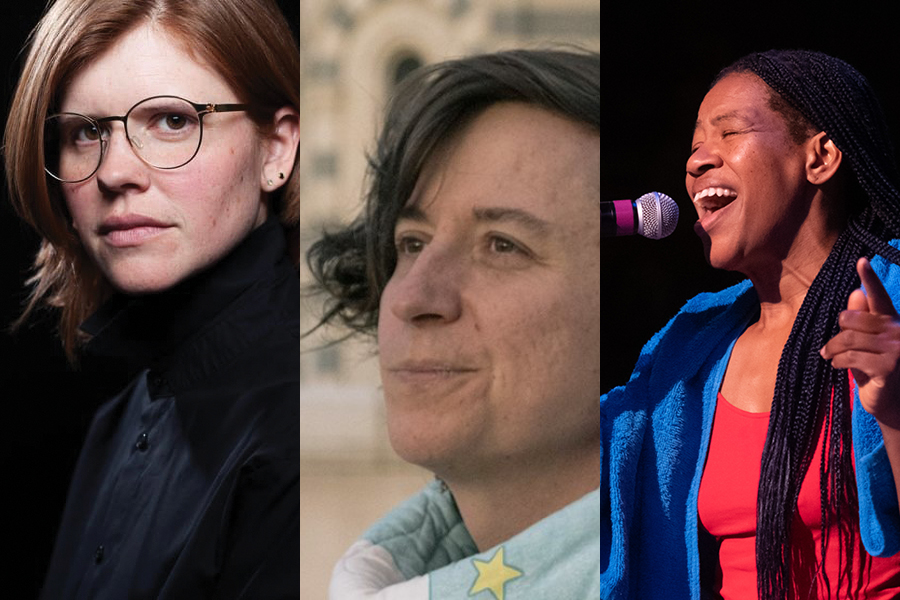
The sixth event in the AFTERWORDS: entanglement series of public programswill feature Emma Bigé, 2025–2026 CFA Artist in Residence mayfield brooks, and Katie Brewer Ball, Associate Professor and Chair of the Theater Department, Associate Professor of Feminist, Gender, and Sexuality Studies, and Faculty Coordinator of Sustainability and Environmental Justice Initiatives, who will explore queer and trans approaches to art making as a practice of environmental justice.“Every shoreline in the world has some entanglement with the late capitalist project.”
—mayfield brooks
How can art provide a means of unlearning the choreographies of capitalist and colonial regimes? From Bigé’s movementements (these “movements in me that are not of me”), which brings attention to how certain forms of dance (collective improvisations, somatic practices, dissident choreographies) work as potent antidotes to the collective numbness to a world in crisis; to brooks’ provocation to surrender to decomposition as liberatory act—we ask what environmental attunement does to reframe one’s relation not only to creation but to the sense of agency, autonomy, and individualism that belies conventional notions of what it means to be an artist today. Whether exploring art making in Alaska, catching breath at the bottom of the ocean floor, or ways of dancing-feeling-thinking entangled with the Earth’s uprisings—this session’s presenters constellate around questions of how to move and make within the folds of ecological ruin.
“Entanglement” is a keyword for studying how human existence is bound up with the more-than-human world, and a call to imagine the web of relations that bind us to each other and the world across space and time. To recognize one’s entanglement complicates one’s sense of agency; to embrace one’s entanglement is to resist the notion of critical distance or objectivity. How do artists and curators navigate their own entanglements? How have they developed practices out of entanglement’s creative possibilities, and in the process transformed traditional ideas of authorship and agency? What work can art do to attune audiences to both the painful and pleasurable ways we are all entangled with each other and the worlds that exist around, before, and after us?
AFTERWORDS: entanglement is a series of public programs sponsored by Wesleyan University’s Center for the Arts (CFA) and the Institute for Curatorial Practice in Performance (ICPP). Guest speakers include artists and curators reflecting on their own practice, process, or method while also attending to a shared keyword. All events are hybrid, featuring speakers both in-person and online.
Curated by CFA Director Joshua Lubin-Levy '06 and ICPP Director Noémie Solomon.
Emma Bigé studies, writes, translates, curates, and improvises between the fields of dance, transfeminist, and environmental studies. She used her PhD in philosophy (Sharing movement, ENS, 2017) as an excuse to curate two dance exhibitions on the histories of contact improvisation (Musée de la danse, Rennes, 2018) and on the life and works of dance improviser Steve Paxton (Culturgest, Lisboa, 2019). Co-editor of anthologies on improvisation (Steve Paxton: Drafting Interior Techniques, 2019; La perspective de la pomme. Histoires, politiques et pratiques du Contact Improvisation, 2021), and author of Mouvementements. Écopolitiques de la danse (La Découverte, 2023), she is currently working with trans* and ecological studies, translating queer theorists and writers (Jack Halberstam, Sara Ahmed, Alexis Pauline Gumbs, and Eva Hayward), and preparing two books on ecosex theory and transecofeminism.
mayfield brooks improvises while Black and is based in Lenapehoking, the unceded land of the Lenape people, also known as Brooklyn, New York. brooks is a movement-based performance artist, vocalist, urban farmer, writer, and wanderer. brooks teaches and performs practices that arise from Improvising While Black (IWB), their interdisciplinary dance methodology which explores the decomposed matter of Black life and engages in dance improvisation, disorientation, dissent, and ancestral healing. brooks is the 2021 recipient of the biennial Merce Cunningham Award from the Foundation for Contemporary Arts, a 2021 Bessie/New York Dance and Performance Award nominee for their experimental dance film Whale Fall, a 2022 Danspace Project Platform artist, a 2022-2023 Hodder Fellow at Princeton University, the 2024 Alma Hawkins Visiting Chair at UCLA with the World Arts and Cultures/Dance program, and are currently a Creative Time Research and Development Fellow, and the 2025–2026 CFA Artist in Residence at Wesleyan University.
Katie Brewer Ball is a writer living on Nonotuck land in Western Massachusetts. They are the author of The Only Way Out: The Racial & Sexual Performance of Escape (Duke University Press, 2024), which examines contemporary literary and performance works that deal with narratives of escape. Brewer Ball is currently working on two book projects: Unsettling Art Criticism: Alaska Native Art After 1960, for which they are a 2024 recipient of The Andy Warhol Foundation Arts Writers grant; and a book on the history of Arctic science on the North Slope of Alaska. Their writing has been published in The Mass Review, Room Magazine, ASAP/Journal, Women and Performance: A Journal of Feminist Theory, WSQ: Women’s Studies Quarterly, TDR: The Drama Review, Artforum, Little Joe, Bomb Magazine, Dirty Looks, and by ONE National Gay and Lesbian Archives. Brewer Ball is Associate Professor of Performance Studies in the Theater Department at Wesleyan University, affiliated faculty in Feminist, Gender, and Sexuality Studies, and Faculty Coordinator of Sustainability and Environmental Justice Initiatives.
About ICPP
The Institute for Curatorial Practice in Performance fosters the collective study of art and its histories with a focus on developing new critical methods for curating time-based art. Rather than narrowing in on a single authoritative definition of performance curation, ICPP’s aim has been to create a pluralistic conversation specifically around contemporary performance, providing fundamental tools with which artists and curators can develop their own approaches to the work. ICPP was created in 2011 by Sam Miller ’75, P’09 and Pamela Tatge ’84, MALS ’10, P’16 at Wesleyan University.
Admission is free, and everyone is welcome. We encourage you to RSVP to help us with our planning and to get a reminder the day before this event. While RSVPs are not required for entry, they are a big help! While you're on campus, feel free to talk with our gallery assistants about the exhibitions and other upcoming special programs, like our student-led tours.