



In Process
Where new works take shape through collaborative development residencies that bring visiting artists into dialogue with students, faculty, and the broader Wesleyan community.
Program Overview
"In Process" is the Center for the Arts’ development residency program, offering visiting artists time, space, and collaborators to shape new work within Wesleyan’s culture of creative research.
Across theater, music, dance, performance, and interdisciplinary practices, "In Process" invites artists to experiment outside the pressures of production, testing ideas with students, trying out new forms, and engaging in conversations that will continue long after the residency ends.
Each residency looks different. Some focus on script development or score-writing; others explore movement, sound, or visual worlds in process. All are grounded in the belief that students learn best by working alongside artists as they think, make, revise, and imagine what comes next.
2026-2027 Projects
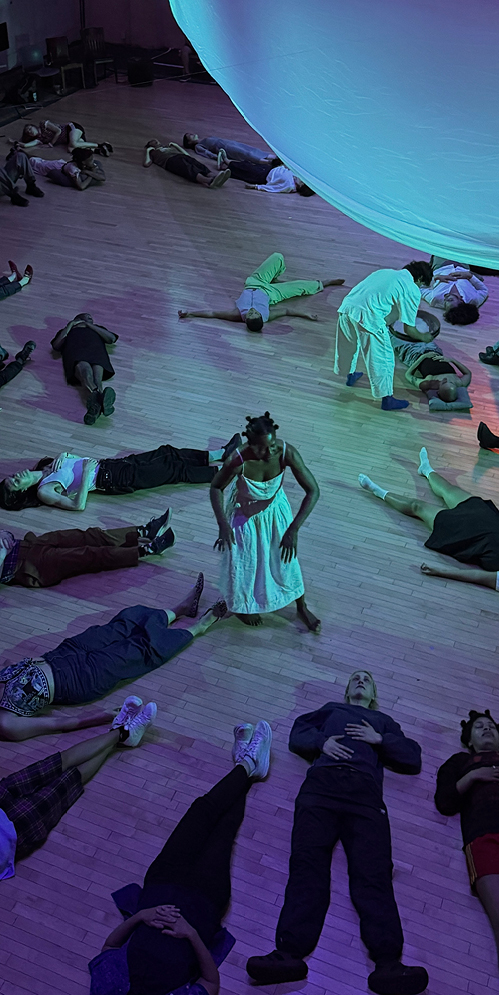
Movement intertwined with fabric, Korean ritual acts and singing, ontological questions surrounding the technical apparatus, and layers of mixed realities are brought together in an ongoing conversation around healing—one that is ritualistic, participatory, and communal. The work grounds itself in a visceral recognition of personal and societal trauma and suffering, while approaching hope with humility. It becomes a collective ritual of witnessing, remembering, releasing, and ultimately cleansing.
Dean Moss is an transdisciplinary artist who’s been a significant part of the New York experimental dance/performance scene for four decades. His practice, defined by a sustained commitment to experimentation, challenges normative structures of time, narrative, and spectatorship, bridging dance, experimental film, theater and installation art: inviting audiences into immersive, participatory experiences focused on perception and fluidity.
Moss’ projects have been presented nationally by the New York Museum of Modern Art; The Whitney Museum of American Art; PS 1 Contemporary Art Museum; The Massachusetts Museum of Contemporary Art; The Walker Art Center; Yale University; and The Kitchen. Internationally they have been presented by The Bitgoeul Citizen Cultural Center; The Seoul International Dance Festival; The New Visions Art Festival, Hong Kong, China; Tanzquartier Wien, Vienna Austria; FNB Vita Dance Festival, Johannesburg, South Africa; Ksirarnawa Art Center, Denpasar Indonesia among many others.
He is the recipient of a John Simon Guggenheim Fellowship in Choreography; the Doris Duke Impact Award in Theatre; a Foundation for Contemporary Arts, Artists Grant; and received awards in both “Choreography” and “Multidisciplinary Works” from the New York Foundation for the Arts. He is a two time Asian Cultural Council grant recipient and was awarded a New York Dance and Performance “Bessie” for his performance work “Spooky action at a distance.” His most recent experimental film, “surface tension” (2024), has been an Official Selection in multiple international film festivals receiving an “International Award” in the 2025 Under the Radar Festival for Artistic Film, Animation and Experimental Sequential Media in Vienna.
Moss is a frequent visiting artist and faculty member. At Harvard University he taught performance creation in the Visual Arts department and received a Certificate of Distinction in Teaching from the Derek Bok Center for Teaching and Learning. At Yale he lectured in the Theatre department investigating audience participation. At Rhode Island School of Design, and at Skowhegan School of Painting and Sculpture as Resident Faculty, he mentored visual artists as they integrated performance and media. He was long time dance faculty at Princeton University, and at Sarah Lawrence College mentoring Choreography MFA students. Moss has also taught internationally including a year in Japan lecturing on Arts Management, at Tokyo University of the Arts. Most recently Moss was Distinguished Visiting Faculty in the department of Kinetic Imaging (hybrid media, video, performance, sound and animation) at Virginia Commonwealth University.
Beyond his individual practice, Moss has played an active leadership role within the wider arts ecosystem. He was the Curator of Dance and Performance at The Kitchen from 1999–2004 and Curatorial Advisor until 2009. Currently he serves as an Artist Advisor to the Asian Cultural Council, and for nearly a decade as a Trustee for the Foundation for Contemporary Arts: an artist run grant giving organization founded by Jasper Johns and John Cage. To learn more, visit www.deanmossgametophyte.org/about.
Semi Ryu 류세미 is a media artist and Professor of Kinetic Imaging at Virginia Commonwealth University (VCU), Affiliate Associate Professor at VCU School of Medicine, and Director of EXE Lab: Embodied XR + Emotion AI. Inspired by Korean healing rituals, her transdisciplinary practice bridges art, technology, and healthcare through avatars, extended reality (XR), and affective computing.
Her work has been presented in 23 countries at international venues, including SIGGRAPH, ISEA, Transmediale, VideoBrasil, Hong Kong City Hall, and Chelsea Art Museum in New York. Her research has been widely published in leading academic journals. She serves on the editorial board of Arts & Health and has contributed chapters to The Routledge Handbook of Arts and Health and The Point of Being, co-edited by Derrick de Kerckhove, former Director of the McLuhan Program in Culture and Technology.
Ryu’s research engages diverse communities, including older adults, cancer patients, and children with mental health conditions. Her current projects explore VR-based life review and end-of-life conversations for older adults with cognitive impairment, as well as SentimentVoice, an AI-integrated VR project examining underrepresented narratives and the cultural specificity of emotion.
A TEDx speaker, Ryu has received the Hamilton International Arts in Health Award (First Place, Arts for Innovation), the VCUarts Faculty Award for Distinguished Achievement in Research, and the VCU National/International Recognition Award. She holds a BFA from Korea National University of Arts, an MFA from Carnegie Mellon University, and a Ph.D. in Humanities and Communication from Universitat Oberta de Catalunya, Barcelona. For more information, visit www.semiryu.net.
Chae Soojung 채 수 정 graduated from the Department of Korean Music, Ewha Womans University as the first-ever doctoral degree holder specializing in Pansori. She is a certified successor (Isuja, 이수자) of Heungboga, one of the five surviving stories of the pansori tradition and has received numerous awards, including a KBS Korean Traditional Music Award (2009), a Presidential Award from the 19th Imbang-ul Korean Traditional Music Festival (2011), and the 6th Imbang-ul Master Singer (Guk-chang) Award (2024). She is currently a professor in the Department of Music, Korean Traditional Performing Arts School, at Korea National University of Arts. She is also the Chairperson of the World Pansori Association, which she helped to establish and which aims to lead the globalization and popularization of pansori in Korea and throughout the world.
2025-2026 Projects
In 2011, a group of private school boys in New York City gather on an apartment rooftop to help a friend through his first break-up. Seven years later, the same group finds themselves on the same roof dealing with what actually happened all those years ago. Rats When It’s Night Out examines guilt, complicity, male friendship, and the possibility of accountability without performativity.
Max Wolf Friedlich ‘17 is a writer from New York City. His play JOB (Outer Critics Circle Award nominee, Off-Broadway Alliance Award nominee), after two sold-out runs off-Broadway, opened at the Hayes Theater on Broadway in July 2024. He has been in residence/developed work with Berkeley Repertory Theatre, Pasadena Playhouse, New York Stage and Film, IAMA Theater, Huron Station, Powerhouse Theater at Vassar College, The Silver Sun Foundation, Less Than Rent, New York International Fringe Festival, and IRT. In TV/film, he is currently developing new work with Jesse Eisenberg, Crunchyroll/SONY Animation, Harris Dickison's Devisio Pictures, Scott Free, 2am, and Marc Platt Productions.
Michael Herwitz directs plays and musicals in New York City and beyond. He is the director of JOB, which recently concluded its Broadway run at the Hayes Theater. He is currently developing new plays for Berkeley Repertory Theatre, Powerhouse Theater, and Martha’s Vineyard Playhouse. For more information, please visit www.michaelherwitz.com.
When an indie theater adaptation of The Seagull is derailed mid-performance after an actor suffers an aneurysm onstage, the cast and audience grapple with twin crises of purpose and powerlessness while waiting for updates on their friend's condition. what if everyone lives? is a play about being a doctor, and being an actor, and being a witness to a tragedy, and being capable and knowledgeable and helpless.
Ryan Dobrin ’18 is a queer and biracial director and producer of musicals, plays, and digital collaborative work. He facilitates work centered on otherness, emotional growth, and connection through dramaturgy, text study, and intentional conversation. In 2025, Dobrin was included on the Theatrely31: Class of 2025 list comprised of “theatre makers poised for a meteoric rise,” and received a Drama Desk nomination for Unique Theatrical Experience as director of the world premiere of Billy McEntee and Grier Mathiot’s The Voices in Your Head , which was also on Theatrely’s Best of 2024 List. His world premiere production of Ryan Drake’s you don’t have to do anything was on Vulture/New York Magazine’s Best Theater of 2024 List. As a producer with The Movement Theatre Company, he was nominated for a 2021 Drama League Award. For more information, please visit ryandobrin.com.
Sophie McIntosh is a New York–based playwright and theatermaker. Her writing gives voice to women and queer folks, examines life in the small-town Midwest, and explores how our interactions with animals reflect back our own humanity. McIntosh is the co-founder of Good Apples Collective, a developmental orchard for new theatrical works that she co-leads with her frequent collaborator Nina Goodheart. Recent productions of McIntosh’s work include the world premiere of macbitches ( New York Times Critic’s Pick), the premieres of Road Kills (recommended by The New York Times and The New Yorker), cunnicularii, and cityscrape with Good Apples Collective, and Eleven Weeks of Nuclear Summer at Notre Dame University and the University of Michigan. For more information please visit www.sophiemcintoshwrites.com.
What happens when a basic fish shows up to shul (synagogue) instead of the hillazon, the keeper of Tekhelet—the sacred blue dye in Judaism? Song of Sardine is a solo performance navigating the thin line between humor and grief, chronicling the life of Isador, a sardine rumored to have blocked the Port of Marseille. Packed with protein yet seemingly disposable, Isador gathers wisdom from years navigating the sacred seas—from the Mediterranean to the Atlantic—wrestling with ideas of holiness, extraction, love, collective action, and diaspora. Blending theater and queer performance art with expanded concepts of “wisdom literature” and Torah study, the piece unfolds through diary entries, poems, sketches, and songs, all centered around the question: what does an ordinary fish have to offer in this moment?
Sacha Yanow is an actor, performance artist, and organizer. Yanow’s performance practice draws on theater, dance, queer performance, and Jewish cultural traditions to reckon with ancestral trauma, gender and sexuality, anti-Zionism, and assimilation. Since 2015, Yanow has created a trio of solo performances based on familial archetypes—Dad Band (2015), Cherie Dre (2018), and Uncle! (2024)—embodied portraits which act as an entry point to discuss broader social issues, and connect to estranged personal and cultural histories. Yanow’s work has been presented by venues including The Kitchen, MoMA PS1, Danspace Project, Joe's Pub, and the New Museum in New York City; the Portland Institute for Contemporary Art’s Time-Based Art Festival/Cooley Gallery at Reed College in Portland, Oregon; and Festival Theaterformen in Hanover, Germany. They have received residency support from Baryshnikov Arts Center, Denniston Hill, LIFT Festival UK, Lower Manhattan Cultural Council, Mass MoCA, SOMA Mexico City, and Yaddo. For more information please visit www.sachayanow.com.
Nemuna Ceesay is a New York-based artist. Select directing credits include The Kitchen (Uncle!), Playwrights Horizons (Amusements), 66th Obie Awards, and Associate Director of A Strange Loop (Broadway). Ceesay was the 2022 Clubbed Thumb New Play Directing Fellow. Select acting credits include New York Theatre Workshop (Here There Are Blueberries), Actors Theatre of Louisville (Loving and Loving), The Shed (Straight Line Crazy), Second Stage (Patience), and the Oregon Shakespeare Festival (2015/2016 seasons). Ceesay received an MFA in acting from the American Conservatory Theater. For more information please visit nemunaceesay.com.
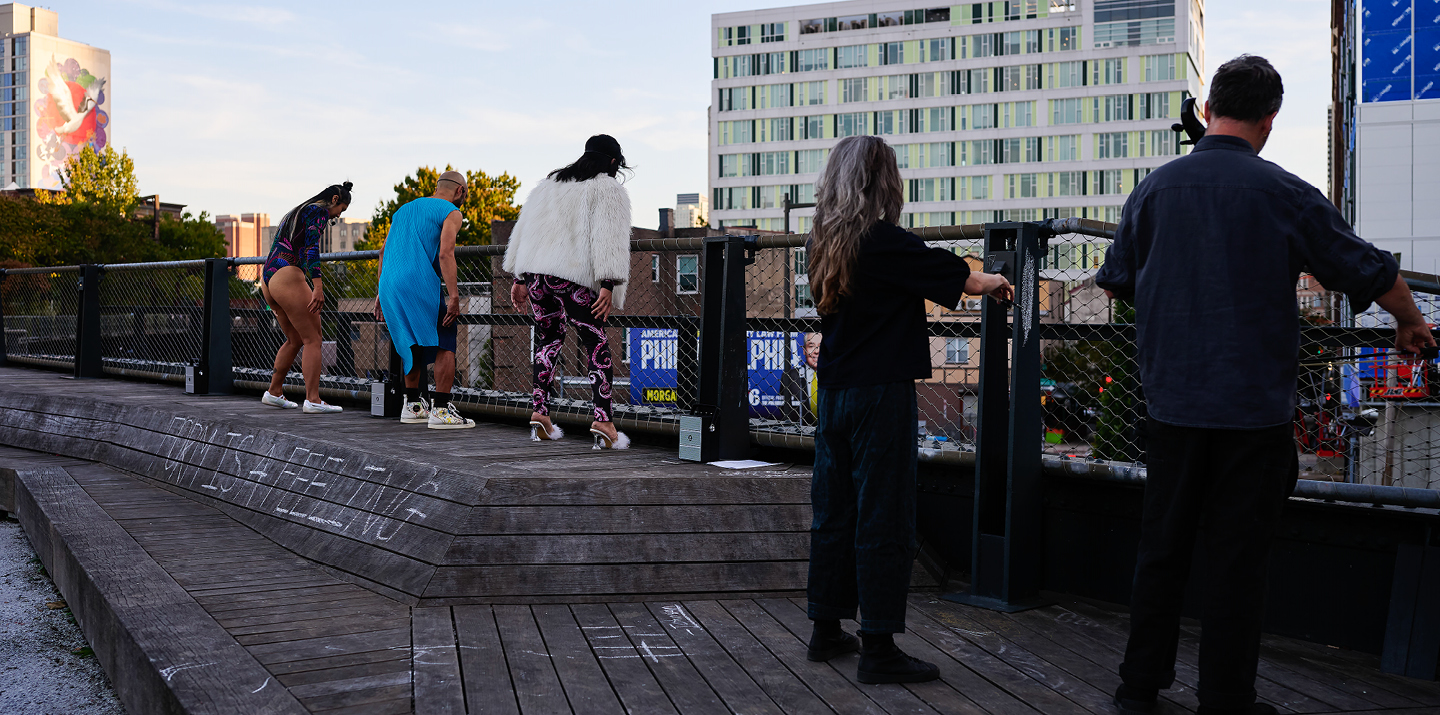
In collaboration with Hanoi-based musicians Thuy Linh Vu (vocals, phách percussion instrument) and Dinh Hoang Pham (đàn đáy plucked lute) of the Ca Tru Phu Thi Ensemble, choreographer Anh Vo explores the sensual and controversial legacy of Ca trù—a northern Vietnamese chamber music form once persecuted for its historical associations with prostitution and opium smoking. Song and Sex listens to what official history has silenced, attuned to the murmur of desire that once animated Ca trù’s singing houses of the 1920s and 1930s. Through live music and movement, this work collaborates with celebrated Ca trù practitioners to imagine the traditional artform as a living, transgressive practice, vibrating between counter-memory and speculative imagination.
Based in Brooklyn and Hanoi, Anh Vo is a Vietnamese choreographer and writer working in the expanded field of performance. Their practice mobilizes the naked body in its variations to make explicit the entanglement of power and apparitional forces that cut across flesh. Their work is situated in the unlikely convergences between downtown New York experimental performance, Hanoi performance art, and Vietnamese folk ritual practices. Described by The New York Times as "risky, erotic, enigmatic and boldly humorous," their choreographic work has received critical recognition for its research-driven and boundary-pushing formal investigation. Significant fellowships and grants include a Jerome Hill Artist Fellowship, NYSCA/NYFA Interdisciplinary Artist Fellowship, Dance/NYC Disability Dance Artistry Fellowship, a USArtist International grant, the Franklin Furnace Fund for Performance Art, Brooklyn Arts Council grants, and FCA Emergency Grants. For more information, please visit www.anhqvo.com.