




Mozart’s Chair
Tuesday, September 15, 2026 through Sunday, February 28, 2027
Ezra and Cecile Zilkha Gallery
283 Washington Terrace, Middletown, Connecticut
Gallery Hours
Tuesday through Sunday, Noon to 5pm.
Free and open to the public.
This exhibition will be closed from Saturday, October 24 through Tuesday, October 27, 2026; from Tuesday, November 24 through Monday, November 30, 2026; and from Monday, December 13, 2026 through Monday, January 18, 2027.
Exhibition Overview
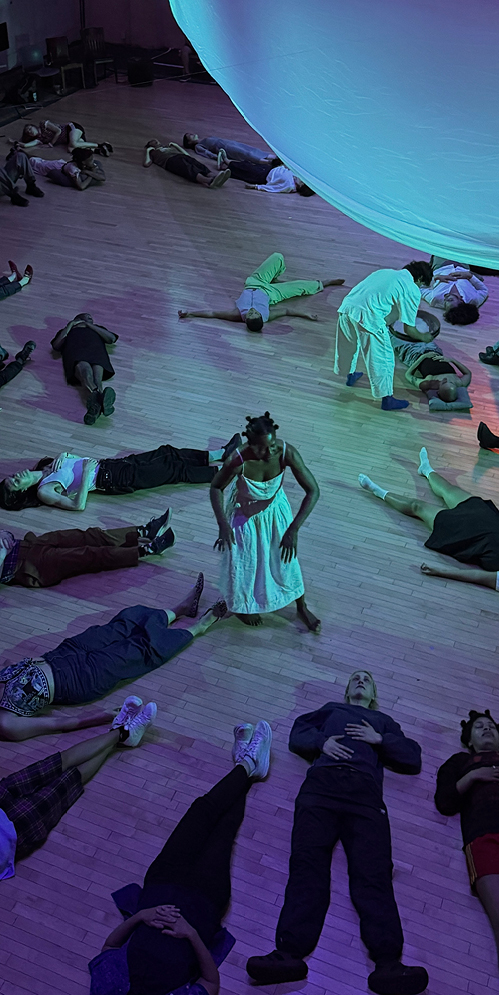
The exhibition Mozart’s Chair considers how furniture establishes the preconditions for action. It does so not by exhibiting furniture (per se), but by assembling works of art that approach the condition of furniture as setting, support structure, and as objects that have an indeterminate relationship to our bodies. Within a gallery, one often assumes that art is always in the foreground, while that which supports the presentation of art is in the background. Artists have long challenged viewers to perceive things otherwise—to admit the influence of what might be dismissed as mere context, atmosphere, ambiance, or decoration. Mozart’s Chair builds on this inquiry. Through sculpture, painting, installation, performance, and sound, the exhibition is like a score, a composition exploring the enabling effect of an object, getting to a fundamental question: what does the art object make possible?
The inverse of this question, what makes art possible, is highlighted by the American composer Morton Feldman in a quote that informs the exhibition’s title. Feldman writes, “[m]y concern at times is nothing more than establishing a series of practical conditions that will enable me to work. For years I said if I could only find a comfortable chair I would rival Mozart.” Known for his embrace of indeterminacy and chance operations, as well his approach to treating music like an object, Feldman inverts the expected agency of the artist over the artwork, subject over object, by suggesting that the difference between himself and Wolfgang Amadeus Mozart might be merely the chair he uses (rather than, say, technical skill or aesthetic interest).
While not all the works in Mozart’s Chair can be considered furniture, they all critically engage three specific qualities of furniture: one’s shifting awareness of furniture’s presence in the foreground/background; furniture’s indeterminate and incidental nature; and the use of furniture as a prop or performance object. Artists featured in the exhibition include Scott Burton, Guy de Cointet, Céline Condorelli, Naotaka Hiro, Helen Marten, Devin T. Mays, Park McArthur, Stephen Prina, and Erik Satie. The exhibition includes an extensive performance series that animates the gallery space, including the first posthumous production of de Cointet’s play A NEW LIFE (1981) with dramaturgy by scholar and curator Marie de Brugerolle. The exhibition itself will shift arrangement over time, suggesting it is not just the works themselves, but the world they create together, that exists indeterminately.
Curated by Associate Director and Curator of Visual Arts Benjamin Chaffee ’00.
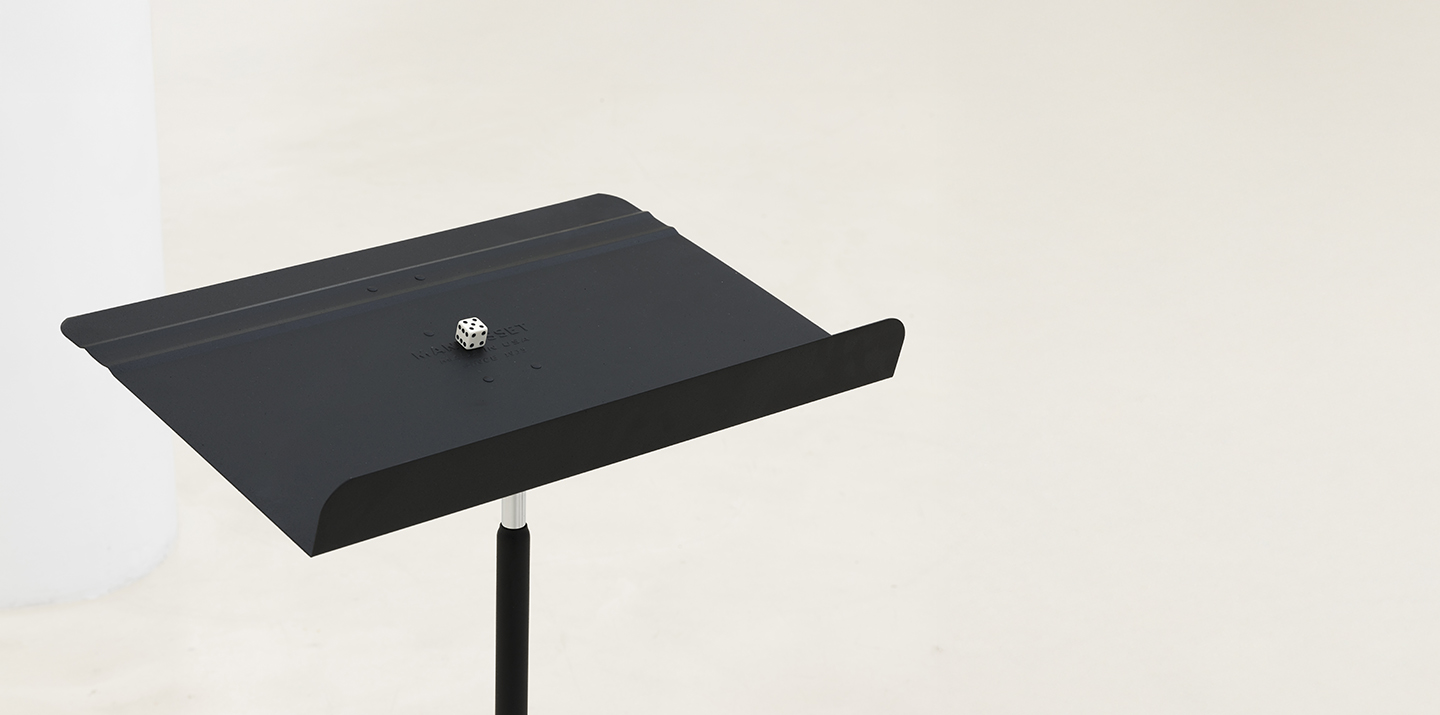
Image above: © Courtesy of Stephen Prina and JUBG, Cologne 2026. Photo by Mareike Tocha.
Artist Profiles
Scott Burton (b. 1939, Greensboro, Alabama; d. 1989, New York) was an American artist and writer who primarily worked in sculpture and performance art. He was best known for his large-scale furniture sculptures in materials like granite and bronze, often made as public art. Born in Alabama, Burton moved as a child to Washington, D.C., and began studying under a series of notable painters while still in high school. He received a BA from Columbia University in 1962, and an MA from New York University in 1963. After graduating from university in New York, Burton began his career as a writer, primarily making works for the stage. He moved on to art criticism in the mid-1960s, working for the magazines ARTnews and Art in America as an editor and critic. At the end of the decade, Burton started making performance pieces, often focusing on the relationships between performers' bodies, and he quickly integrated furniture and sculptures into his performances. He began to use furniture in his art in the early 1970s, creating what he called "behavior tableaux," with silent, interacting performers and found objects of furniture. The first furniture piece he made was the Bronze Chair of 1972/1975. Burton constructed his subsequent furniture pieces from a wide range of natural and fabricated materials, and designed them in forms that invoke, exaggerate, and animate various historical and vernacular styles. Sculpture, particularly sculptures that functioned as furniture objects, became his primary focus by the mid-late 1970s. His late career was defined by furniture sculptures and landscapes built as public art, including for public parks, plazas, and government spaces, as well as for corporate buildings. His work was frequently featured in solo and group exhibitions and performances, including a performance at the 1973 Festival of Contemporary Arts at Oberlin College. Burton died of HIV-related illness in New York in 1989.
Support Structures (2003–2009) was an evolving project produced in collaboration with the artist-curator Gavin Wade (1971–) that drew attention to the conditioned uses of institutionalized space. Each phase of the project progressed and reinterpreted forms of exhibition, reflecting on concepts of “support” and highlighted the often-unseen functions that facilitate services within urban society. The penultimate phase was the establishment in 2008 of Eastside Projects, an artist-run public gallery in Digbeth, Birmingham that continues to operate today (in 2026).
Condorelli received her PhD in Research Architecture from Goldsmiths College, London, England in 2013. Prior to this she completed an MA in History and Theory of Architecture, University of East London, London, England in 2000. Before which, she achieved her RIBA part 2 and diploma from the Architectural Association School of Architecture, London, England in 1999; and her RIBA part 1 and degree from the Architectural Association School of Architecture, London, England in 1995.
She is co-founder of Eastside Projects in Birmingham and is currently Professor of Exhibition Design and Research at Karlsruhe University of Arts and Design (HfG Kalrsruhe). She has delivered talks and presentations across the globe, including the Chisenhale Gallery, the Serpentine gallery, the Tate Modern, The Showroom, London; and IASPIS, Stockholm.
For more information, please visit celinecondorelli.eu.
Guy de Cointet (b. 1934, Paris, France; d. 1983, Los Angeles, California) was a French-born artist based in California who created text and sculptural works, often combining them as props and stage sets in theatrical performance pieces. de Cointet was born in Paris in 1934, the son of a military officer. He attended high school with Yves Saint Laurent and the fashion photographer Jérôme Ducrot, both of whom shared and influenced de Cointet's interest in fashion. After unsuccessfully competing in a 1952 clothing design competition sponsored by the Chambre Syndicale de la Haute Couture, de Cointet attended the École des Beaux-Arts de Nancy. In 1956 he moved to Paris, where he worked as an illustrator for the magazines Vogue and Jardin des Mondes.
de Cointet moved to New York in 1965, following brief stays in the Canary Islands and in central France near Limoges. Shortly after arriving in New York, de Cointet was introduced to the sculptor Larry Bell by their mutual friend Susan Hoffman. Bell hired de Cointet as an assistant, working first at Bell's studio in New York. He later followed Bell to Venice Beach, California, where de Cointet would reside until his death in 1983. Between 1975 and 1977 he taught at the Otis Art Institute in Los Angeles, giving courses focusing on performance art.
de Cointet's text works on canvas and on paper were based on systems of encoding or abstracting text, such as by mirror writing. These pieces used found text from popular culture, everyday conversation, or literary sources, often creating a humorous, droll, ironic, or melancholic effect. He produced several encrypted publications, including a completely encrypted newspaper, ACRCIT. Silkscreen printed by Pierre Picot, a French artist teaching at CalArts, ACRCIT was distributed for free through newspaper boxes across Los Angeles.
His performance pieces combined literary puzzles or codes and the tropes of TV soap opera, drawing inspiration from the works of Raymond Roussel. The pieces were performed by actors such as Factory 'superstar' Viva and diminutive comedian Billy Barty. Theater critic Frantisek Deak once wrote of de Cointet's structuralist approach that the artist juxtaposed "lifelike casual conversation with contrived literary language ... [pointing] out that both are particular styles and that, with a certain distance, the casual conversation will appear contrived as well." Deak was specifically referring to plays such as Tell Me (1979), in which fashionably attired actresses variously describe a white cardboard square featuring the black capital letters A, D, M, and T. From the late ’60s until his untimely death in 1983, de Cointet was an active member of the Los Angeles art scene whose encrypted works on paper and theatrical productions using readymade language—taken from both the high literature of his native France and the soap operas of his adopted land—were often as enigmatic as the man himself. His work has influenced that of Paul McCarthy, Mike Kelley, and Catherine Sullivan, among others.
For more information, please visit www.guydecointet.org/overview.
Hiro received his BFA from the University of California, Los Angeles (1997) and his MFA from the California Institute of the Arts (2000). His work has been exhibited internationally at institutions such as the Museum of Modern Art (MoMA), New York; the Whitney Museum of American Art, New York; the Hammer Museum, Los Angeles; and the Museum of Contemporary Art, Los Angeles. Hiro’s art is included in prestigious collections, including MoMA, the Whitney, and the Los Angeles County Museum of Art. He has received grants from the Art Matters Foundation (2014) and the Asian and Pacific Islander Artist Presenting Initiative (2006). Hiro’s exhibitions, such as Green Door (Herald St, London, 2021) and Sand-man (Bortolami, New York, 2022), have been critically acclaimed for their exploration of the body’s material and psychological dimensions.
For more information, please visit www.bortolamigallery.com/artists/naotaka-hiro.
Her exactingly crafted artworks map a set of relations that cannot be named, as if to diagram the reciprocity between subjects and objects when the lines between them are increasingly blurred. Material is never what it seems, continually deployed in the mode of approximation—only to warp on closer inspection into something entirely other, reparsed into new relation. Her intricate works share an affinity for collage, or what she calls inlay: when disparate things abut or conjoin to obscure their edges and twist their meaning. Though intently material, Marten’s practice is rooted in language—its elastic metaphors and signifying chains—and the work’s sprawling references and density of detail reward close, embodied reading.
Marten’s work probes the boundaries between humble debris and highly sophisticated rendering, representation, and artifice. The artist has expressed a particular interest in language, stating: “Language is a system that we know very well how to exploit and wrap around things. Words are communicating, but at the same time, they're tumbling about themselves in a knotty chaos of pictures and images.” Like her physical works, Marten's texts and titles reflect and reinforce her sense of both logic and play. There is a symbiotic relationship between the text and objects, titles, and images found in the works—a kind of unusual topology or counter-mapping of our usual expectations of how these things function together. Her first novel, The Boiled in Between, was published in 2020; she is currently at work on her second, A Polite History of Vandalism. The youngest recipient of Britain’s Turner Prize, Marten has spent over a decade expanding the network of ideas-made-substance for which she is known. She was included in the 2013 and 2015 Venice Biennales, and her work is held in public collections worldwide.
Marten lives and works in London. In 2016, Marten was awarded the Turner Prize and was the inaugural recipient of the Hepworth Prize for Sculpture. Past solo exhibitions of her work include 30 Blizzards., commissioned by Miu Miu, Art Basel Paris (2025); Greene Naftali, New York (2023, 2021, 2016); Serpentine Gallery, London (2016); Fridericianum, Kassel (2014); Hessel Museum of Art, Annandale-on-Hudson, New York (2013); Kunsthalle Zurich (2012); and Palais de Tokyo, Paris (2012). Her work is in the collections of the Astrup Fearnley Museet, Oslo; Hessel Museum of Art, Annandale-on-Hudson, New York; Hirshhorn Museum and Sculpture Garden, Washington, D.C.; Julia Stoschek Collection, Düsseldorf; The Museum of Modern Art, New York; Moderna Museet, Stockholm; Solomon R. Guggenheim Museum, New York; Stedelijk Museum, Amsterdam; Tate, London; and the Walker Art Center, Minneapolis, among others.
For more information, please visit helenmarten.net.
Mays has exhibited and performed at the Hammer Museum, Los Angeles; Galerie Martin Janda, Vienna; The Power Station, Dallas; The Renaissance Society, Chicago; gta exhibitions, Zürich; Sweetwater, Berlin; F Gallery, Houston; SculptureCenter, New York; Museum of Contemporary Art, Chicago; and Regards, Chicago, among others.
Mays holds a Bachelor of Business Administration from Howard University and a Master of Fine Arts from The University of Chicago.
For more information, please visit regardsgallery.com/artists/devin-mays.
Past solo exhibitions include Leuphana University, Lüneburg, Germany; and Paid, Seattle, Washington; both 2023; Kunsthalle Bern, Switzerland, 2020; Maxwell Graham, New York, 2013, 2014, 2020; The Museum of Modern Art, New York, 2018; San Francisco Museum of Modern Art, California, 2017; Chisenhale Gallery, London, United Kingdom, 2016; Lars Friedrich, Berlin, Germany, 2014; Yale Union, with Alex Fleming, Portland, Oregon, 2014; and Galerie Catherine Bastide, Brussels, Belgium, 2013. McArthur participated in the 2021 Oxygen Biennial, Tbilisi, Georgia; the 57th Edition of the Carnegie International, Pittsburgh, Pennsylvania, 2018; the Whitney Biennial 78th edition, New York, 2017; the 32nd Bienal de São Paulo, São Paulo, Brazil, 2016; and Greater New York, 4th edition, MoMA PS1, Queens, New York, 2015.
With Constantina Zavitsanos, McArthur has published essays and exhibited artworks in group exhibitions held at the Museum of Contemporary Art San Diego, California and Tensta Konsthall, Sweden, both 2024; Museum für Moderne Kunst, Frankfurt, Germany, 2021; Gebert Foundation, Rapperswil, Switzerland, 2020; Charlotte Street Foundation, Kansas City, Missouri and L’Espace Arlaud, Lausanne, Switzerland, both 2017.
In 2015, McArthur and Jennifer Burris edited Beverly Buchanan: 1978–1981, focused on Buchanan’s earthworks and sculptures from that time, which was followed by a 30-year survey of Buchanan’s work held at the Brooklyn Museum, Brooklyn, New York and the Spelman College Museum of Fine Art, Atlanta, Georgia, 2017–2018. With Constantina Zavitsanos, Arika, Amalle Dublon, Jerron Herman, Carolyn Lazard, Michelle Lisa Polissaint, Alice Sheppard, Madison Zalopany, and numerous collaborators, McArthur is part of I Wanna Be With You Everywhere (IWBWYE), a series of gatherings of, by, and for disabled artists.
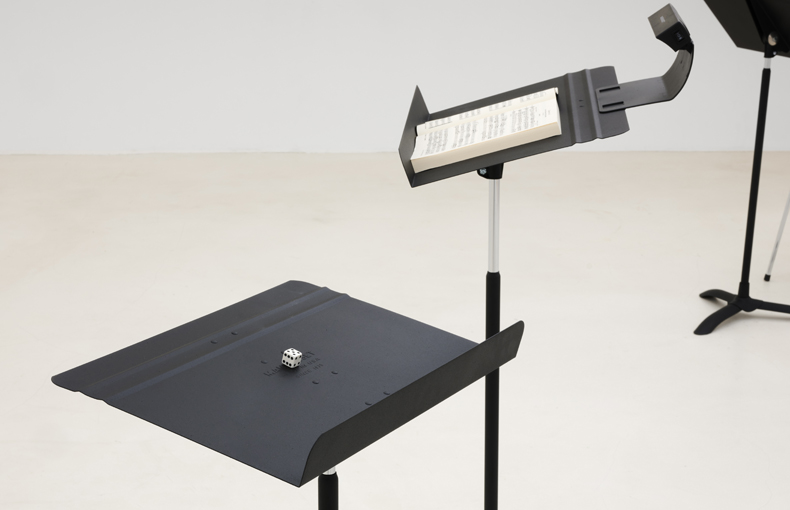
Stephen Prina (b. 1954, Galesburg, Illinois) is an American artist, musician, and composer. He currently splits his time between Los Angeles, California, and Cambridge, Massachusetts where he is a professor at the Department of Visual and Environmental Studies at Harvard University. Prina received his BFA from the Northern Illinois University, and an MFA from the California Institute of the Arts. He is Professor Emeritus at Harvard University.
Prina works in a variety of media including musical performances. Each piece is related in some way and develops in a series of long-term projects that he frequently rearranges and re-presents in different exhibition and associative contexts.
Prina’s work has been shown in solo exhibitions worldwide. Solo exhibitions include A Lick and Promise (2025), The Museum of Modern Art, New York, the first in-depth survey to focus on the artist’s performances, drawing out a central theme in his work: time, and the way it shifts cultural values; String Quartet for Six Players, JUBG, Cologne, (2023); English for Foreigners, Museo Tamayo, Mexico City (2020); galesburg, illinois+, Sprüth Magers, Los Angeles; Stephen Prina, Museo Madre, Naples, Italy (2017); ¡HOLA! ¿QUÉ TAL?, Galerie Gisela Capitain, Cologne (2014); Carve Out a Space of Intimacy, Capitain Petzel, Berlin (2011); Stephen Prina: Modern Movie Pop, Contemporary Art Museum St. Louis (2010); Stephen Prina, Bergen Kunsthall, Bergen (2009); The Second Sentence of Everything I Read is You, Staatliche Kunsthalle Baden-Baden, Baden-Baden (2008); The Queen Mary, Petzel, New York (2006); Gaylen Gerber with Stephen Prina, The Art Institute of Chicago, Chicago (2002); and To the People of Frankfurt am Main: At Least Three Types of Inaccessibility, Frankfurter Kunstverein, Frankfurt am Main (2000); among others.
Prina’s work has also been included in numerous group exhibitions, including Bruce Goff: Material Worlds, Art Institute of Chicago, Chicago (2026); Fragment of an Infinite Discourse, Lenbachhaus, Munich (2023); The Collection, Haubrok Foundation, Berlin (2023); Kollaborationen, Museum moderner Kunst Stiftung Ludwig Wien, Vienna (2022); Schatzhaus & Labor: 25 Jahre Museum Kurhaus Kleve, Museum Kurhaus Kleve, Kleve (2022); Familienbande, Museum Ludwig, Cologne (2019); Double Lives: Visual Artists Making Music, MUMOK, Vienna (2018); Painting 2.0: Expression in the Information Age, Museum Brandhorst, Munich (2016); Take it or Leave It: Institution, Image, Ideology, Hammer Museum, Los Angeles (2014); Outside the Lines, Contemporary Arts Museum Houston (2013); This Will Have Been: Art, Love & Politics in the 1980s, Walker Art Center, Minneapolis (2012), traveled to Institute of Contemporary Art, Boston; Museum of Contemporary Art Chicago; Von realer Gegenwart, Kunsthalle Düsseldorf (2010); Yokohama Triennal, Yokohama; Whitney Biennial, Whitney Museum of American Art, New York (2008); Oh Girl, it’s a Boy!, Kunstverein München, Munich (2007); Who’s afraid of Red, Yellow and Blue? Positionen der Farbfeldmalerei, Staatliche Kunsthalle Baden-Baden, Baden-Baden; Los Angeles, 1955-1985, Centre Pompidou, Paris (2006); Make Your Own Life: Artists In and Out of Cologne, Institute of Contemporary Art, University of Pennsylvania, Philadelphia; The Power Plant, Toronto; Henry Art Gallery, Seattle; Museum of Contemporary Art, North Miami; in capital letters, Kunsthalle Basel (2002); Adorno. Die Möglichkeit des Unmöglichen, Frankfurter Kunstverein, Frankfurt am Main; Beau Monde: Toward a Redeemed Cosmopolitanism, SITE Santa Fe, Santa Fe (2001); Departures: 11 Artists at the Getty, The J. Paul Getty Museum, Los Angeles (2000); Crossings: art to see and to hear, Kunsthalle Wien, Vienna (1998); and Allegories of Modernism: Contemporary Drawing, Museum of Modern Art, New York (1992), among many others.
His work can be seen in public collections at the Tate, London; Carnegie Museum of Art, Pittsburgh; Hammer Museum, Los Angeles; Museum Boijmans-van Beuningen, Rotterdam; Museum of Contemporary Art, Los Angeles; Museum of Modern Art, New York; Museum Ludwig, Cologne; and the Whitney Museum of American Art, among others.
Erik Satie (b. May 17, 1866, Honfleur, Calvados, France; d. July 1, 1925, Paris) was a French composer whose spare, unconventional, often witty style exerted a major influence on 20th-century music, particularly in France. Satie studied at the Paris Conservatory, dropped out, and later worked as a café pianist. About 1890 he became associated with the Rosicrucian movement and wrote several works under its influence, notably the Messe des pauvres (composed 1895; Mass of the Poor). In 1893, when he was 27, Satie had a stormy affair with the painter Suzanne Valadon. From 1898 he lived alone in Arcueil, a Paris suburb, cultivating an eccentric mode of life and permitting no one to enter his apartment. Beginning in 1905, he studied at the Schola Cantorum under Vincent d’Indy and Albert Roussel for three years. About 1917 the group of young composers known as Les Six adopted him as their patron saint. Later the School of Arcueil, a group including Darius Milhaud, Henri Sauguet, and Roger Désormiere, was formed in his honor.
Satie’s music represents the first definite break with 19th-century French Romanticism; it also stands in opposition to the works of composer Claude Debussy. Closely allied to the Dada and Surrealist movements in art, it refuses to become involved with grandiose sentiment or transcendent significance, disregards traditional forms and tonal structures, and characteristically takes the form of parody, with flippant titles, such as Trois morceaux en forme de poire (1903; Three Pieces in the Shape of a Pear) and Embryons Desséchés (1913; Desiccated Embryos), and directions to the player such as “with much illness” or “light as an egg,” meant to mock works such as Debussy’s preludes.
Satie’s flippancy and eccentricity, an intimate part of his musical aesthetic, epitomized the avant-garde ideal of a fusion of art and life into an often startling but unified personality. He sought to strip pretentiousness and sentimentality from music and thereby reveal an austere essence. This desire is reflected in piano pieces such as Trois Gnossiennes (1890), notated without bar lines or key signatures. Other early piano pieces, such as Trois Sarabandes (1887) and Trois Gymnopédies (1888), use then-novel chords that reveal him as a pioneer in harmony. His ballet Parade (1917; choreographed by Léonide Massine, scenario by Jean Cocteau, stage design and costumes by Pablo Picasso) was scored for typewriters, sirens, airplane propellers, ticker tape, and a lottery wheel, and anticipated the use of jazz materials by Igor Stravinsky and others. The word Surrealism was used for the first time in Guillaume Apollinaire’s program notes for Parade. Satie’s masterpiece, Socrate for four sopranos and chamber orchestra (1918), is based on the dialogues of Plato. His last, completely serious piano works are the five Nocturnes (1919). Satie’s ballet Relâche (1924) contains a Surrealistic film sequence by René Clair; the film score Entr’acte, or Cinéma, serves as an example of his ideal background, or “furniture,” music.
Satie was dismissed as a charlatan by musicians who misunderstood his irreverence and wit. They also deplored the nonmusical influences in his life—during his last 10 years his best friends were painters, many of whom he had met while a café pianist. Satie was nonetheless deeply admired by composers of the rank of Darius Milhaud, Maurice Ravel, and, in particular, Claude Debussy—of whom he was an intimate friend for close to 30 years. His influence on French composers of the early 20th century and on the later school of Neoclassicism was profound.