
Student-Led Writing Lab Empowers Mongolian Youth
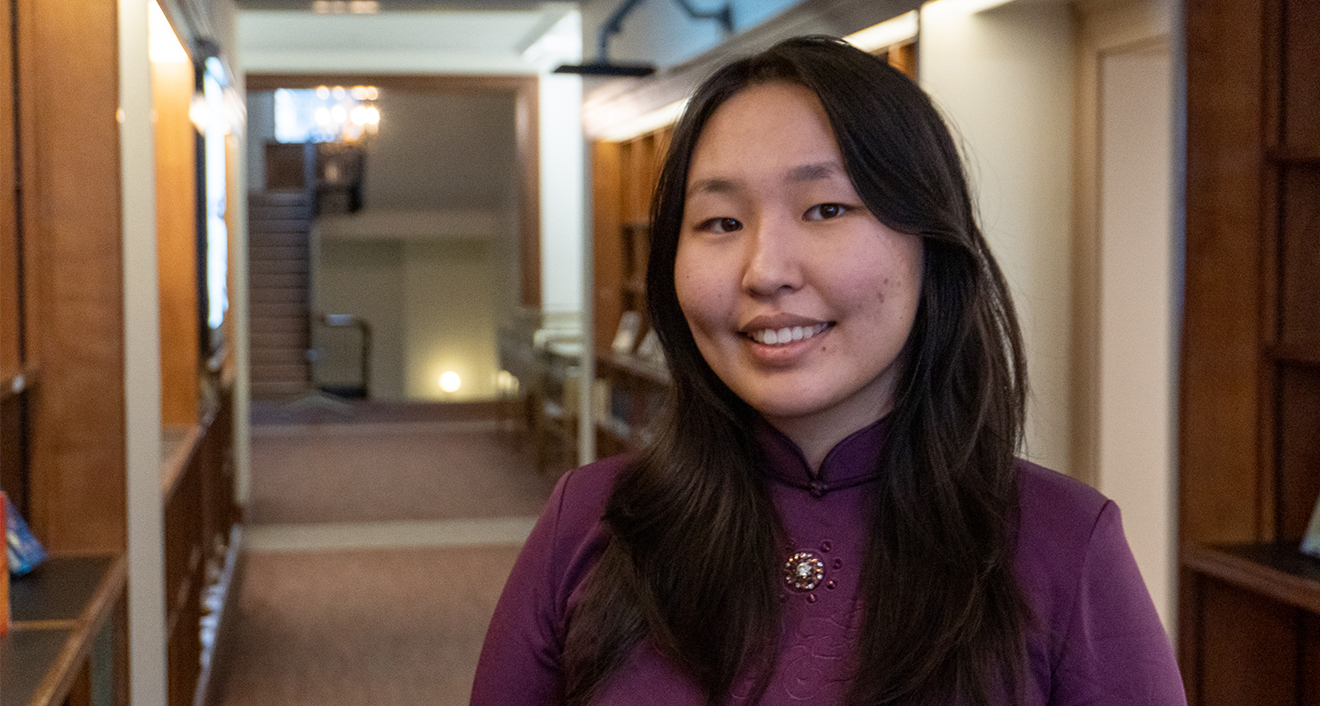
Tamiraa Sanjaajav ’27 used her summer and winter breaks in 2025 to develop the Nomadvocate Youth Civic Writing Lab, an initiative to help underprivileged youth leaders in Mongolia improve their writing skills and amplify the voices and concerns of their community.
Sanjaajav, who came to Wesleyan from Mongolia, is a recipient of the 2024-2025 Student Political Engagement Fund (PEF) grant, a program funded and administered by the Allbritton Center for the Study of Public Life and the Jewett Center for Community Partnerships. The grant program promotes civic engagement and involvement in the public sphere.
Sanjaajav, a computer science and economics double major, was inspired to create the Nomadvocate Youth Civic Writing Lab due to the lack of political engagement among her peers in Mongolia. While developing her project she asked herself, “How do I get more young people involved in politics? What did I need to start engaging more in my community?”
As she began her academic career at Wesleyan, Sanjaajav also found it difficult to adjust her writing style towards being more opinion-based due to curriculum differences in Mongolian schools, and she knew this dilemma was widespread. The formation of the project addresses this difference by giving high school students a space to engage with political and social texts that they otherwise may not be able to, she said.
“Although I was fluent in the English language, I wasn't fluent in expressing myself,” Sanjaajav said. “I went to a public school and as our country has a national curriculum, I knew this experience was shared among hundreds of thousands of students.”
In the first iteration of the program in June 2025, Sanjaajav hosted 30 Mongolian students in-person in Ulaanbaatar, the capital city, for a month-long writing- and discussion-intensive initiative. The second iteration of the program occurred in winter of 2025 online, engaging over 180 participants and 20 volunteers. To accomplish this, Sanjaajav used her PEF grant to travel to Mongolia to establish partnerships with local community centers, using this network to reach students beyond the capital city.
“It was the first time I taught that many people at the same time. We had hundreds of people in the Zoom meeting from all over Mongolia and they were all interacting, and that was interesting to see as an educator,” Sanjaajav said. Through the experience, she learned about some of the societal challenges students face in different areas of the country.
After the conclusion of the program, Sanjaajav conducted a feedback survey to gauge the effectiveness of the sessions and overall impact on her students. Participants rated their confidence levels in writing about a civic or argumentative essay on a scale of one to five. “Every single person had jumped from a two to a four, or a three to a five,” she reports. “The fact that they feel more confident in writing, that is the goal we wanted to accomplish.”
As she plans to continue the program this summer, Sanjaajav will focus on growing the reach to the countryside to develop stronger communication channels to her target demographic of underserved students in rural communities. She aims to expand the reach of the program from 10 different provinces in her winter session to all 21 provinces in Mongolia. “If that is successful, we will be able to reach thousands of students that do not have access to high-quality English writing curriculums,” she said.
To achieve this goal—Sanjaajav is looking to enlist volunteers for the upcoming iteration of the program. Students interested in supporting the Nomadvocate Youth Civic Writing Lab can reach out to Sanjaajav (tsanjaajav@wesleyan.edu) for more information.
The Political Engagement Grant committee is now looking forward to their upcoming 2025-2026 application review cycle. Wesleyan students will be able to apply for grants of up to $5,000 for proposals taking place in Summer 2026. The submission deadline is Sunday, April 5. The funding supports work in voter registration, issues advocacy, and on local and national campaigns. The grants help alleviate costs for expenses including rent, utilities, food, travel, supplies, and equipment.