


A Carpetbagger in Reverse: Book Review
In the narrative of 20th-century Black politics, progress often appears linear: Reconstruction collapses, Jim Crow laws grow harsher, but eventually the modern Civil Rights Movement breaks through. A Carpetbagger in Reverse by John Knapp ’66 unsettles that storyline by centering a figure who operated in the political gray zones between eras. Knapp’s study of Arthur W. Mitchell—the first Black Democrat elected to Congress and the only Black congressman during his four terms from 1935 to 1943—reveals a form of Black political power that was pragmatic, controversial, and deeply shaped by regional realities.
Born in Alabama in 1883 to formerly enslaved parents, Mitchell felt the impact of the fallout of post-Reconstruction America. Educated at Tuskegee Institute under Booker T. Washington, trained as a lawyer in Washington, D.C., and politically forged in Chicago during the Great Migration, Mitchell embodied mobility across geography, ideology, and class. Knapp uses this trajectory to challenge the idea that Black leadership in the early 20th century was ideologically uniform. Instead, Mitchell emerges as a figure whose strategies were shaped less by national movements than by what he believed was politically possible for Southern Black communities.
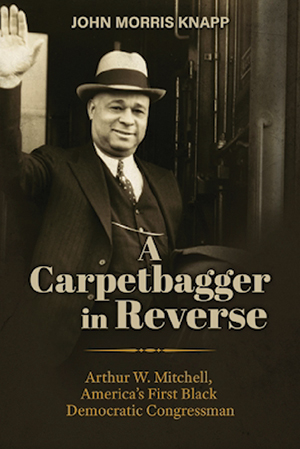
The result is a book whose premise lies in its reassessment of Mitchell’s political philosophy. As a congressman, Mitchell saw himself as a representative of the South’s disenfranchised Black population, even while serving a Northern district. His insistence that racial progress in the South should come from locally trained Black leaders—rather than outside legal or political pressure—put him in frequent conflict with the NAACP, the Republican Party, and much of the Black press. Knapp situates this thought process within a broader debate over respectability, strategy, and survival in a violently segregated nation.
Mitchell’s break with the Republican Party and embrace of the New Deal Democratic coalition marks one of the book’s most significant contributions. Knapp shows how Mitchell helped lay the groundwork for the enduring alliance between Black voters and the Democratic Party, decades before it became electorally dominant. This shift was not inevitable, the book argues, but the result of calculated risk-taking by figures like Mitchell, who believed federal economic policy could offer tangible gains where moral appeals had failed.
The book also highlights Mitchell’s legal achievements, particularly his role as the first Black lawyer to successfully argue before the Supreme Court. His unanimous victory in Mitchell v. United States, which challenged segregation in interstate transportation, had lasting consequences for civil rights litigation. Knapp treats this case as a triumph that makes evident Mitchell’s belief in incremental legal change, a belief that often clashed with more confrontational approaches.
A special Easter egg for Wesleyan alumni is the dedication that Knapp includes at the beginning of the book: For Nathanael Greene of Wesleyan University and all the students inspired by his passion for history. Knapp credits Professor Greene as a mentor who truly inspired him to think deeply and critically. A defining memory: Professor Greene’s famous phrase, “I would argue,” which Knapp inscribed in red pen in his college notes. This impetus to dig deeper and see through face-value assertions is clear in Knapp’s desire to set the story straight after reading another “extremely biased and profoundly unfair” biography of Mitchell. To do so, Knapp combed through 72 boxes of Mitchell’s papers and traveled to western Alabama to “spend ten days in the world where Arthur Mitchell ran schools at a time when rural lynchings were common,” Knapp said.
This archival foundation is what sets the book apart. Drawing extensively from Mitchell’s papers, an oft-overlooked resource, Knapp reconstructs the intellectual and emotional world of a politician who was both influential and deeply misunderstood. These materials allow Mitchell to appear as a real, serious thinker grappling with the constraints of his time. As such A Carpetbagger in Reverse resists easy judgment, as Knapp refuses to force Mitchell into a category of radical hero or simple accommodationist. Instead, the book asks readers to reconsider how Black political power developed in the interwar years, forcing them to confront how disagreement, compromise, and regional strategy shaped paths toward justice.