
Two Students, Staff Member Honored for Social Justice Work
This spring, two students and one staff member were recognized with the Peter Morgenstern-Clarren ’03 Social Justice Prizes for their contributions to the campus and local communities.
The Peter Morgenstern-Clarren ’03 Social Justice Prizes were created in memory of Peter Morgenstern-Clarren ‘03 to honor his commitment to social justice throughout his time as a student at Wesleyan. His activism included securing benefits for Wesleyan custodial staff and participating in the United Student and Labor Action Coalition (USLAC) and campus chapter of Amnesty International.
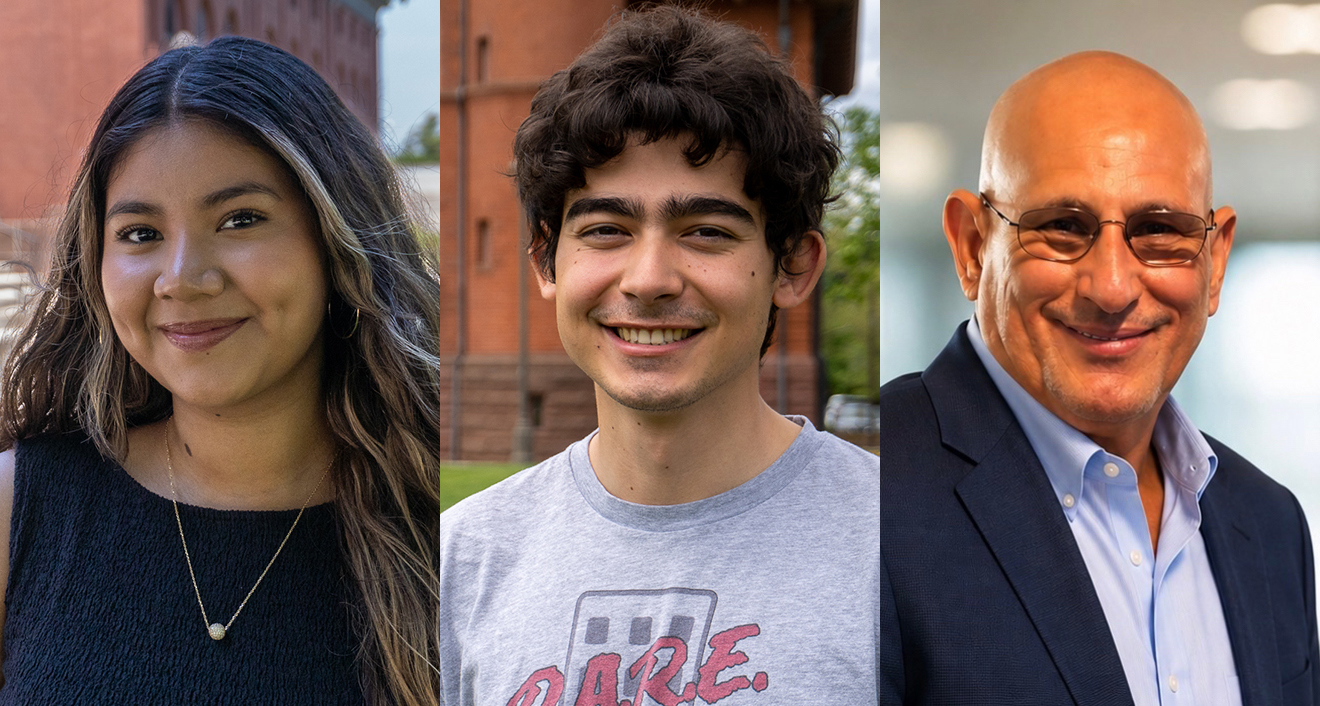
This year’s prizes were awarded to students Genesis Castro ’28 and Luca D’Agruma ’27, and Angel Bonet, a member of the custodial staff in Exley Science Center.
Student awards
Castro and D’Agruma were each given a Peter Morgenstern-Clarren Social Justice Student Award, which recognizes a Wesleyan sophomore or junior who is an exemplary champion of social justice, and has identified a societal problem and taken action to address it.
Both students are leaders of USLAC and together have helped to revitalize the group by raising membership from five members to around 25. Castro leads the Custodial Working Group, which has played a key role in building the relationships between students and custodial workers. D’Agruma has worked to get students involved in labor organizing and policy advocacy through his work at USLAC.
Castro, a government and Latin American studies double major, joined USLAC after attending a talk from an immigration lawyer in her first year on campus. She first started working with the organization since they needed more Spanish speakers to work with custodial staff. “What began as a way to use my language skills quickly became one of the most meaningful parts of my college experience,” Castro said.
With Castro’s leadership, the Custodial Working Group hosted three custodial appreciation events to offer a space for students and custodial staff to connect. Alongside the events, she also set up one-on-one conversations between staff and students. She has also been working to relaunch an English-as-a-second-language program that existed at Wesleyan in the early 2000s by recording videos with lessons on vocabulary words and repeatable, beginner-friendly sentences and uploading them to YouTube. She chose this platform so that workers could review the lessons on their own time, rather than make time for a meeting.
“Through my involvement in USLAC, I have learned that advocacy is not only about policy and organizing, but rather about building lasting relationships that are rooted in trust, empathy, and compassion,” Castro said. She wants to pursue a career in immigration law after graduation.
D’Agruma, a history major, joined USLAC as a first-year student as well. He has been active in campus labor organizing and has helped build connections between students and organizational partners within the labor movement, he said. “I care deeply about this work because I believe everyone should have a say in the material conditions of their lives, including how their workplace functions,” he said.
He has been active in USLAC’s Follow the Thread campaign, which calls attention to structural inequities in the global garment and textile industry, and the organization’s work to support striking Starbucks workers. He also helped organize an event on May 1 to celebrate International Workers’ Day.
D’Agruma said he will continue to focus on this work for the rest of his life. “There's always more work to be done, but in a world that often feels so broken and unequal, I've found that the labor movement offers something really special,” he said. “When workers take action, they materially improve their workplaces, their communities, and their own lives. In doing so, they reshape who holds power and what the future can look like. I don't know what form my involvement will take, but once you've seen what organizing looks like up close, it's impossible to walk away.”
Staff award
Bonet received the Peter Morgenstern-Clarren Social Justice Employee Recognition Award. This award is given to a Wesleyan employee who demonstrates an exceptional commitment to building a sense of community at Wesleyan as exhibited in their engagement with students and efforts to bolster the student experience.
Bonet was nominated anonymously but the student who said “Angel is part of the custodial staff for Exley, where he regularly can be seen going out of his way to interact with community members in Exley, always cheerful and friendly. As the main science building, with a large number of rooms without windows, Exley can tend to be gloomy, but a smile from Angel often helps to brighten it up a bit. If there's ever anything Angel can do to help, he goes above and beyond.”
In response to this award, Bonet, who has been nominated previously, said, “I feel truly honored and grateful to receive this recognition. It means so much to know that my hard work and commitment are appreciated. I sincerely thank my supervisors, coworkers, and everyone who has supported me throughout this journey. Working at the university and sharing and talking and giving good advice to the students and being part of this community has been a blessing, and I am proud to contribute in any way I can. This recognition motivates me to continue giving my best every day.”
All recipients of the Peter Morgenstern-Clarren ’03 Social Justice Prizes receive a plaque and a monetary award for their efforts. The Jewett Center for Community Partnerships considers nominations and applications each spring and stewards the award.
Ziba Kashef contributed to this story.