
Record Number of Alums Awarded Fulbright Fellowships
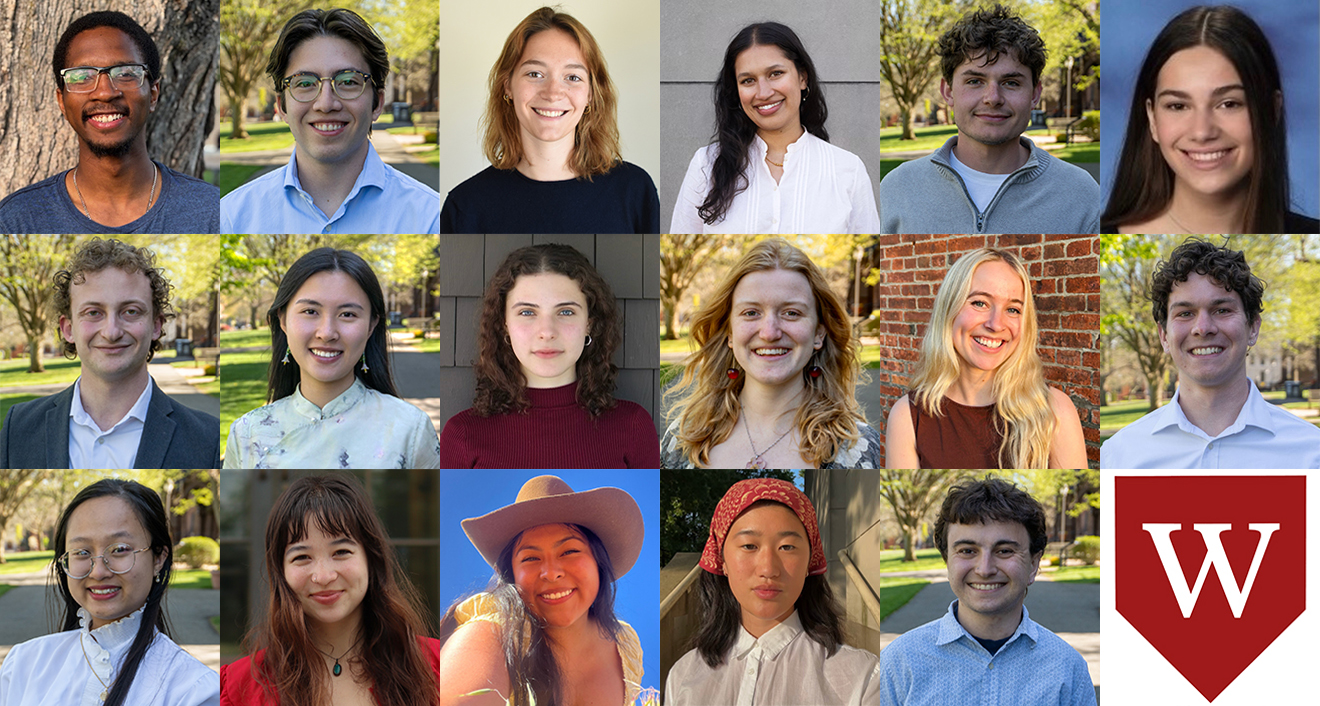
A record 17 recent alumni have accepted grants through the Fulbright U.S. Student Program, a selective academic and cultural exchange program that offers graduating college seniors, graduate students, and young professionals opportunities to study, research, or teach English in over 140 countries.
“In Spring 2025, we were thrilled to have 10 Fulbright grants awarded, setting a new record for the most Fulbright grants awarded to students and alumni in a single year,” said Erica Kowsz, associate director for fellowships in the Fries Center for Global Studies. “The 2025 record didn't last long. With 17 recipients in 2026, this year by far is Wesleyan’s biggest year for Fulbright yet.”
The fellowships also represent breadth in geographic reach, with recipients going to five of the Fulbright program’s six world regions. These fellows, who will engage in teaching or research projects during the 2026-2027 academic year, include Muhammad Abdur-Rahman ’26, David Gabriel Calderon ’26, Carolyn Clark Mancini ’26, Priya Devavaram ’26, Liam Farrell ’26, Emma Goetz ’25, Blake Klein ’26, Judy Liu ’26, Carolyn Neugarten ’26, Ibby Newland ’26, Ruby Smith ’23, Robert Taylor Clemens ’26, Diana Q. Tran ’26, Lauren Tran-Muchowski ’25, Jocelyn Velasquez Baez ’23, Ava Yuanshun Guralnick ’25, and Isaac Platt Zolov ’26.
As a Fulbright COMEXUS Binational Business Award recipient, David Calderon '26 plans to spend a year as a fellow at a company with operations in the United States and Mexico. He will also take MBA classes at the Instituto Tecnológico Autónomo de México.
His major in the College of Social Studies (CSS) and minor in data analysis provided the skills he needed for the fellowship. “Most CSS majors would say the writing-intensive part of the program helped the most,” he said. “I’d add that the freedom to write about a new topic each week during my sophomore and junior years let me explore a lot of different interests. As for the data minor, a lot of companies want interns with technical skills, so learning R and Python was definitely worth my time.”
Born in Miami and raised in Guatemala City, Calderon served as a co-chair of the International Student Advisory Board for three years, studied abroad in Madrid, and wrote his capstone on the challenges limiting Guatemalan avocado exports. During his summers, David interned at the MacArthur Foundation, Universidad del Valle de Guatemala, and AGEXPORT, Guatemala’s Exporters Association.
Calderon is currently applying for a job, which would start in the fall. He’s open to range of opportunities which would allow him to learn more about the role of the private sector in promoting binational and regional cooperation. “One specific point I'd like to explore is how asymmetries in technology adoption might affect the relationship between the U.S. and Mexico, particularly in how AI is developed and used,” he noted.
His studies will help him determine next steps. “I'm going into consulting after the grant, and an MBA is a very common path in that field,” he said. “I want to use the classes to figure out whether the degree is right for me, or whether I'm more drawn to the social studies fields I explored at Wes.”
Carolyn Neugarten '26, who majored in the College of Letters with minors in economics and German studies, received a Young Professional Journalist Award. With this grant, Neugarten will work for different publications and also engage in freelance writing projects abroad. The publications include POLITICO Europe and a daily newspaper in Berlin, Die Tageszeitung. She will also collaborate with The Max Planck Institute for Security and Privacy to conduct background research on topics such as cybercrime in Germany and the phenomenon of "hacktivism," or politically motivated hacking.
Neugarten’s time at Wesleyan prepared her for the fellowship, which starts in September. “Even though Wesleyan doesn’t have a formal journalism track, I had plenty of flexibility to explore on my own,” she said. “Serving as editor-in-chief of The Wesleyan Argus was probably my most formative journalism-related experience, and studying German for three years and completing a thesis in German Studies, as well as taking global economics courses, all furthered my interest in reporting internationally.”
Prior work in media, including at U.S. News and World Report, Connecticut Public (WNPR), and The New York Review of Books, also helped Neugarten prepare to take on a year-long investigative project. Through internships she worked on national and local stories, such as investigative projects on mental healthcare in Maryland, police recruitment and retention in Connecticut, and data center development along the East Coast, she said.
With all of this hand-on, real-world experience, Neugarten plans to continue work in journalism. “I hope to return home to New York City or to Washington, D.C. to pursue a career in political and/or business reporting,” she said.
Muhammad Abdur-Rahman ’26 will travel to Bosnia and Herzegovina to serve as a Fulbright English Teaching Assistant (ETA) at the Faculty of Islamic Studies at the University of Sarajevo. He said he has struggled to learn other languages and he hopes that a full year abroad in Bosnia will give him a better chance to do so.
He also hopes to use his degree in English and film studies to help create a language curriculum that incorporates visual mediums like film. Following his Fulbright experience, he is interested in pursuing a career in teaching. “Wesleyan’s English curriculum allowed me to explore my interests in the formal aspects of language just as deeply as I did its cultural import,” Abdur-Rahman said. “Addressing English for the language it's become—having traveled the world in the way it has—will allow me to teach the language so that my students feel they own part of it and its history.”
Priya Devavaram ’26, a psychology major with a minor in the College of East Asian Studies, will also serve as a Fulbright ETA, but her fellowship will place her in Taiwan. She was interested in the Fulbright experience in part because it offered an opportunity to return to the country after studying abroad there two years ago. She is excited to learn more about the culture, food, and history, especially the history of Taiwanese Indigenous peoples.
She said her experience taking Chinese language courses at Wesleyan has helped prepare her for her Fulbright. “Wesleyan has prepared me by teaching me that curiosity, openness, and a zest for learning the core of what you need to approach new experiences,” she said.
Liam Farrell ’26 had a similar experience at Wesleyan. He came to campus from a small town in Maine and found himself surrounded by people with different backgrounds, interests, and perspectives, he said. “Over four years, I learned how much growth can come from being open to unfamiliar people and ideas,” he said.
Now that he has graduated with a degree from the College of Social Studies, he has accepted a Fulbright ETA position in Madagascar. He aims to bring the open-mindedness he developed at Wesleyan to his work in the African nation, where he aims to learn the Malagasy language and become part of a local community.
“I want to build lasting relationships with students, teachers, and members of the local community that last for years to come,” Farrell said. “I hope to come away from the experience with a different perspective shaped by immersing myself deeply enough in the language, culture, and daily life that returning home feels unfamiliar in its own way.”
He is looking forward to learning about local customs and traditions, including a music and dance form in Madagascar called Hiragasy, in which troupes conduct music, dance, theater, and oratory performances laden with moral lessons and political commentary. Alongside the cultural possibilities on offer in Madagascar, he is also planning to explore the outdoor scenery there. Madagascar is home to around five percent of the world’s biodiversity and 90 percent of the island’s wildlife and plant species are native and endemic—they’re found nowhere else in the world.
The U.S. Fulbright program is considering applications until Oct. 6 at 5 p.m. Eastern. Interested students should contact the Office of Fellowships for further information.
Mike Mavredakis contributed to this story.