
Democracy Isn't Just Voting: Panelists Urge a Ground-Up Civic Revival
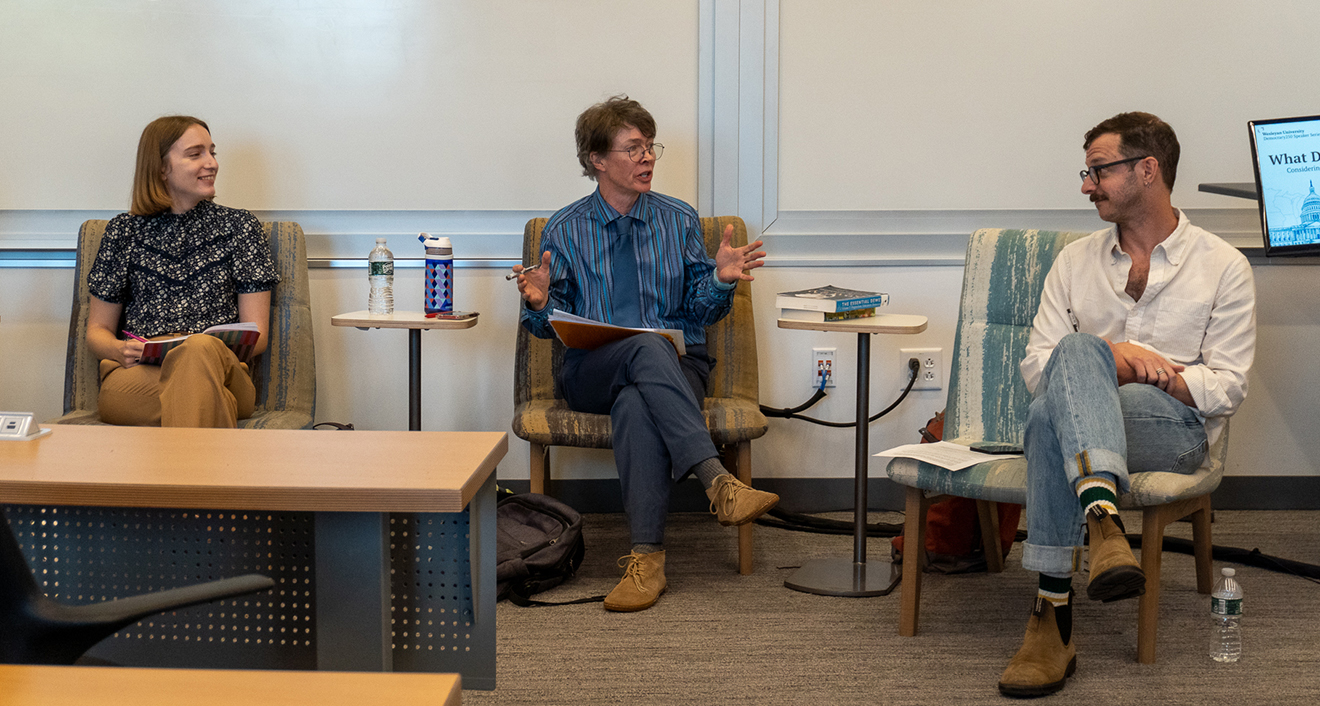
With less than two months before the midterm elections, Wesleyan students and faculty gathered in the Frank Center for Public Affairs on Sept. 16 for a provocative conversation: “What Do We Owe Democracy? A Panel Discussion Considering the Meaning of Voting and Civic Participation.” The event was the first in the Democracy250 series of talks, which are designed to reimagine civic participation as the United States marks its 250th anniversary.
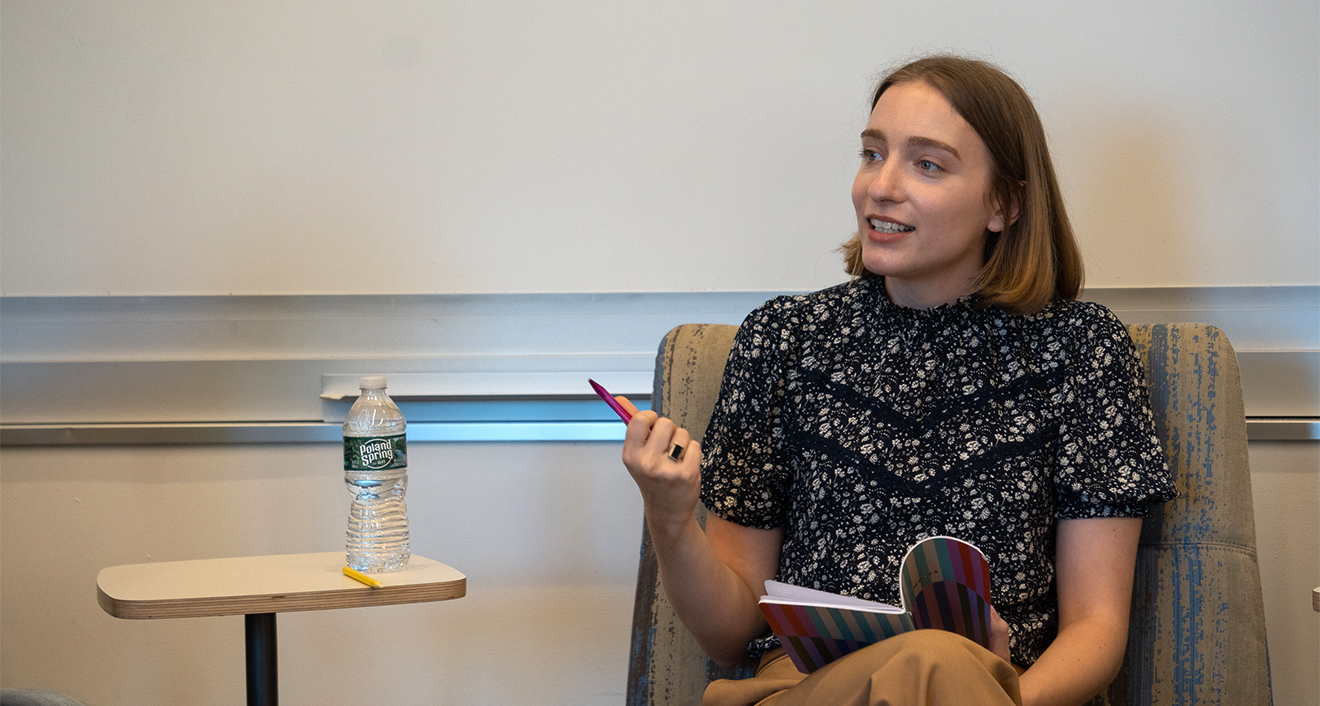
“We're going to explore what voting and civic participation mean and what people can reasonably expect from democracy in return,” said Democracy250 Fellow Charlie McGill ’25. The four talks in the series are “going to help us think more deeply about what democracy is, the challenges it presents, and how we can strengthen it for the future.”
Three faculty panelists kicked off the conversation with opening remarks. Abigail Breuker, the Provost’s Democracy Fellow who teaches in Classical Studies, started off with an ancient perspective. Aristotle, Breuker said, defined citizens as the people who participated in government, which gave those people—land-owning males at the time—a sense of ownership over their democracy.
To the concepts of participation and ownership, Breuker added the idea of civic friendship. “It is through dialogue with people who we treat as our friends in some sort of significant way that we are able to grow our collective knowledge and grow our basis of knowledge—to not just become kind of a society ruled by those who have more knowledge, but to actually share that knowledge around,” she said. “It also allows us to treat one another as partners in our community.”
Associate Professor of Philosophy Elise Springer cautioned against reducing the idea of democratic participation to the act of voting. Springer teaches a course on American pragmatists, including John Dewey, a philosopher, psychologist, and democratic theorist. “Dewey treats democracy not as a what but as a how to do things [democratically].” The how includes bringing “democratic intelligence,” which they said is inherently social, to whatever you do.
“It's really to think about collaborating and consulting widely and seeking out divergent perspectives, and then working through why your accounts might be in tension with each other,” Springer said. “If we start from that process, we end up with, I think, a much more interesting way of thinking about participation.”
The third panelist, Associate Professor of Government Justin Peck, also resisted the notion of telling individuals to be engaged in any specific way. Referring to Abraham Lincoln’s famous “house divided” speech, Peck said Lincoln is “telling us that responsible political action follows from reflection on where we are kind of like in the stream of history.”
There’s no one answer to the question of what responsible civic behavior looks like, Peck said. “It will reflect your own judgment about where things currently stand, where the constellation of social, economic, and political forces, how they are shaping up, and in which direction are we moving,” he said. “And after you've made an assessment of that, then you can come to some conclusion about what responsible civic action looks like.”
Participation Then and Now
In ancient Greece, civic participation did include citizens voting on every decision made in government—from taxation to war—said Breuker, but it was not limited to that. Athenian males also played various roles in government. “Part of participating was not only just casting your votes in the assembly but participating in the conversation that went on in the assembly,” she said.
By contrast, in the United States there was no definition of civic responsibility, according to Peck. However, “I think there was a recognition that our system hinges and pivots in some important way on elections. That's how our [system] functions. And so representation is important,” he said.
Harkening back to Dewey’s background, Springer said civic participation at the local level was considered important. “So in Vermont, everybody shows up to their town meeting,” they said. “Local politics really was that kind of thing.” To participate, citizens needed to engage with each other. “What John Dewey does in his account of education is precisely to say, if we're really going to have a democracy that's meaningfully a democracy, citizens need to think completely differently. Democracies need to reconsider what it is for people to learn—to think of education not as handing down truths, but as fostering the skills of learning from each other so that people can meaningfully engage.”
The Future of Democracy
Exploring the question of how America became a democracy and its future, Peck said the founders faced completely different circumstances governing a large country with no security threats. “Then you could construct this whole thing because you're basically living in this context that made democracy possible,” he said. But given that today the United States is a global superpower in the age of AI, the question of our future as a democracy is less obvious. “It might be democratic in a completely different way, but it may not be the way that we sitting here in this room understand it,” he said.
To strengthen our democracy at a time when we have an entrenched two-party system, Springer returned to the idea of focusing on how we engage and suggested thinking more from the ground up. “Stop thinking that our fundamental layer of engagement is national and start thinking about how do I engage with how democracy works here? And how do I make interventions so that we can practice doing things through social intelligence?” they said. “Expect that we're not going to hit the national level right away, but that's how change would happen.”
Breuker agreed, especially given that local politics tend to impact people’s lives more. “We have to build the change… not even just at the local government level, but the individual community level, before we can even think about making changes at a higher level,” she said. “It's not a question about what does democracy owe us, what do we owe democracy. It's a question about, what do we owe us? What do we owe each other?”
Democracy250 is part of the University’s four-year initiative, Renewing Democracy’s Promise, which brings higher education institutions, students, scholars, and community organizations together in a space where we stop studying democracy from a distance and directly practice it through the ongoing steps of engaging in dialogue, building community, and taking action.