
How South Korea's Alliance with the U.S. Shapes Its Global Role
A dedication to public service was instilled in Kang Kyung-Wha, ambassador plenipotentiary and extraordinary of the Republic of Korea to the United States, by her father at a young age. Her father was one of the first broadcasters on the Korean Broadcasting System, a public television network, and he repeatedly turned down opportunities to work at private networks.
“He always said his work is in public service,” Kang said. “He's in this not to make money, not to make a comfortable living, but to do public service. So, the sense of public service was with me during my childhood years.”
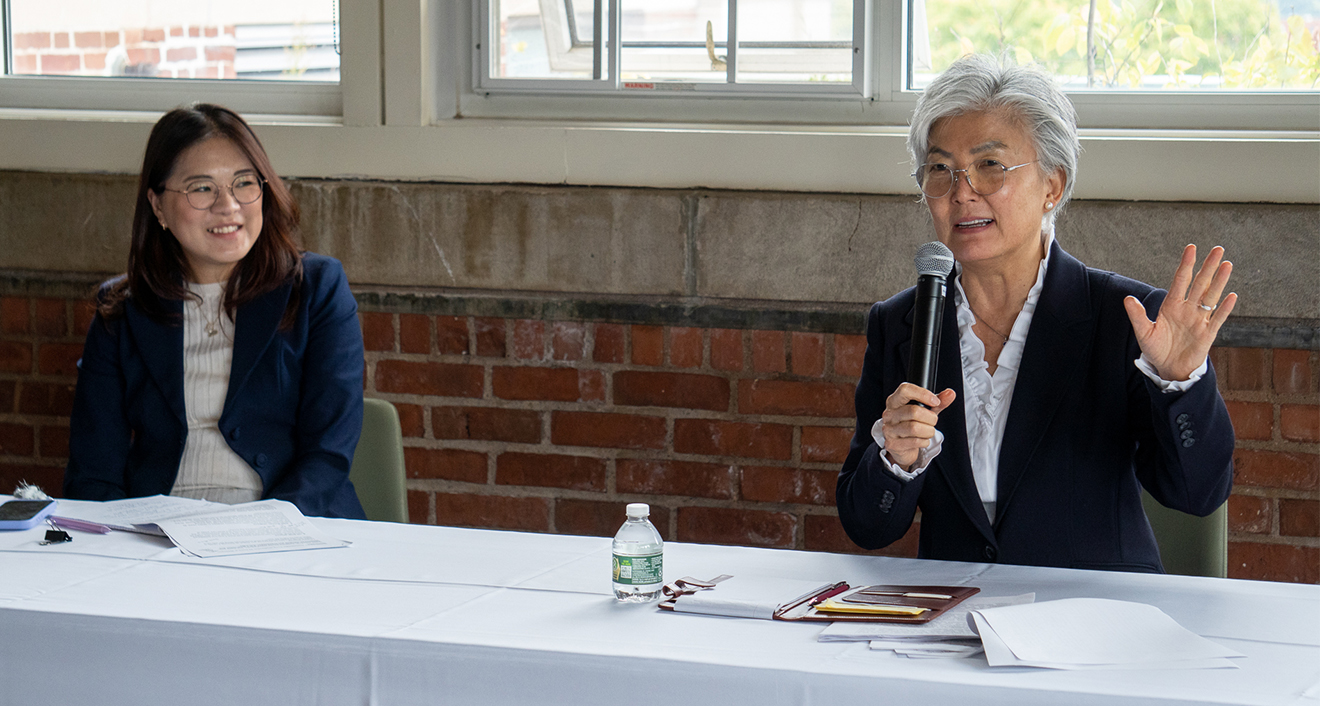
Kang discussed her career in public service during a talk in Allbritton Hall on Sept. 25, which was moderated by Joan Cho, associate professor of East Asian Studies, and organized by Cho and Scott Aalgaard, associate professor and chair of East Asian Studies. She also gave insight into the Republic of Korea’s (ROK) alliance with the United States, relations with North Korea, growing interest in Korean culture, and the nature of diplomacy.
U.S.-Korea Alliance and Korean Defense
The U.S. alliance with South Korea began in the early 1950s following the Korean War and stands as one of America’s most significant military arrangements in Asia, with around 28,500 troops stationed in the country as of 2026. As part of this alliance, the United States and South Korea have a mutual defense treaty that guarantees the two nations confront any external threats or aggression together. Kang said that over the course of this partnership, South Korea has grown from a war-torn nation with few resources to one of the top market economies in the world, largely driven by the technology sector. She said that South Korea has now taken up the primary responsibility to ensure peace and security on the Korean Peninsula, while America provides support.
“We're a very vibrant, and always raucous, democracy,” Kang said. “Korea now is a country that contributes a lot more to the alliance than at the beginning. It's now becoming more of a balanced, equal partnership that's complementary. Korea can do a lot for the U.S. while the U.S. continues to be our most important partner in providing safety and security on the Korean Peninsula.”
As part of this support, the U.S. provides South Korea with a nuclear umbrella, which is a guarantee that the United States will use its nuclear capabilities to defend the nation in the case of a nuclear attack. This safety blanket is crucial for its security from neighboring North Korea.
Kang said that the nation’s relations with North Korea have changed in the last decade. Until recently, the two sides had a shared goal of peaceful reunification; they were not foreign countries to one another but partners toward unification. Then following the collapse of the United States and North Korea’s negotiations over its nuclear program at a summit in Hanoi, Vietnam in 2019, North Korea shut its door to South Korea, redefined it as a foreign nation, and declared it as North Korea’s no. 1 hostile enemy, she said.
“There has been zero engagement, zero communication between South and North Korea,” Kang said. “If that is the given stance of the North, our goal then has to be, in the first sense, keep things stable, don't let anything happen on the border. Beyond stability, we want to reengage with the North in dialogue on its nuclear program and peaceful coexistence.”
Korean Trade and Culture
Alongside security efforts, the two nations also have a strong trade relationship following a free trade agreement that came into effect in 2012, Kang said. Since the pact, Korean companies have made advancements in semiconductors and microchips that have been key factors in the recent artificial intelligence boom, she said. Korean beauty products have also been increasing in popularity.
South Korea’s culture has permeated global culture in the last decade, partly stemming from the rise in popularity of K-Pop groups like BTS, SEVENTEEN, and BLACKPINK. Kang also highlighted increasing interest in other forms of Korean storytelling, like K-drama and literature.
She said this has helped to enhance Korea’s profile and credibility globally, especially with young people, and has helped to ease diplomatic discussions at the human level. She said whenever a negotiating partner mentions their child is a fan of BTS or another band, she will bring them merchandise at their next meeting. “Diplomacy, in the end, is about human beings talking to each other,” Kang said. “And if anything can smooth the way, I'm all for that.”
Kang’s visit concluded with taking audience questions from a packed room of students and faculty. Audience members asked her about Korean classical music, making an impact within large institutions, sustainability, the influence of large technology companies, and responding to changes in U.S. foreign policy.