

Studying America’s Rivals: Alumnus Shares Foreign Policy Lessons
Throughout his 24-year career at the U.S. Department of State, David Abramson ’87, P’23 was driven by one central theme: He had a desire to understand the nations and organizations that the United States government viewed as enemies.
This desire often led Abramson, often unknowingly, to anticipate key moments in U.S. foreign relations. Before joining the State Department where he worked as an analyst specializing in Russian foreign policy, Central Asia, and Russia-China relations, he studied Russian at Wesleyan and spent a semester abroad in Moscow in 1986. While abroad in Moscow, he witnessed the early stages of former leader of the Soviet Union Mikhail Gorbachev’s push for reform, which led to the end of the Cold War in 1991.
“The only reform that Gorbachev had introduced at that point was the campaign against alcoholism, so you really didn't get a feel for any of the changes to come,” said Abramson. “I was very grateful that I was able to see firsthand the surveillance state and secrecy that pervaded the Soviet Union (USSR) and, in particular, Moscow where I was studying.”
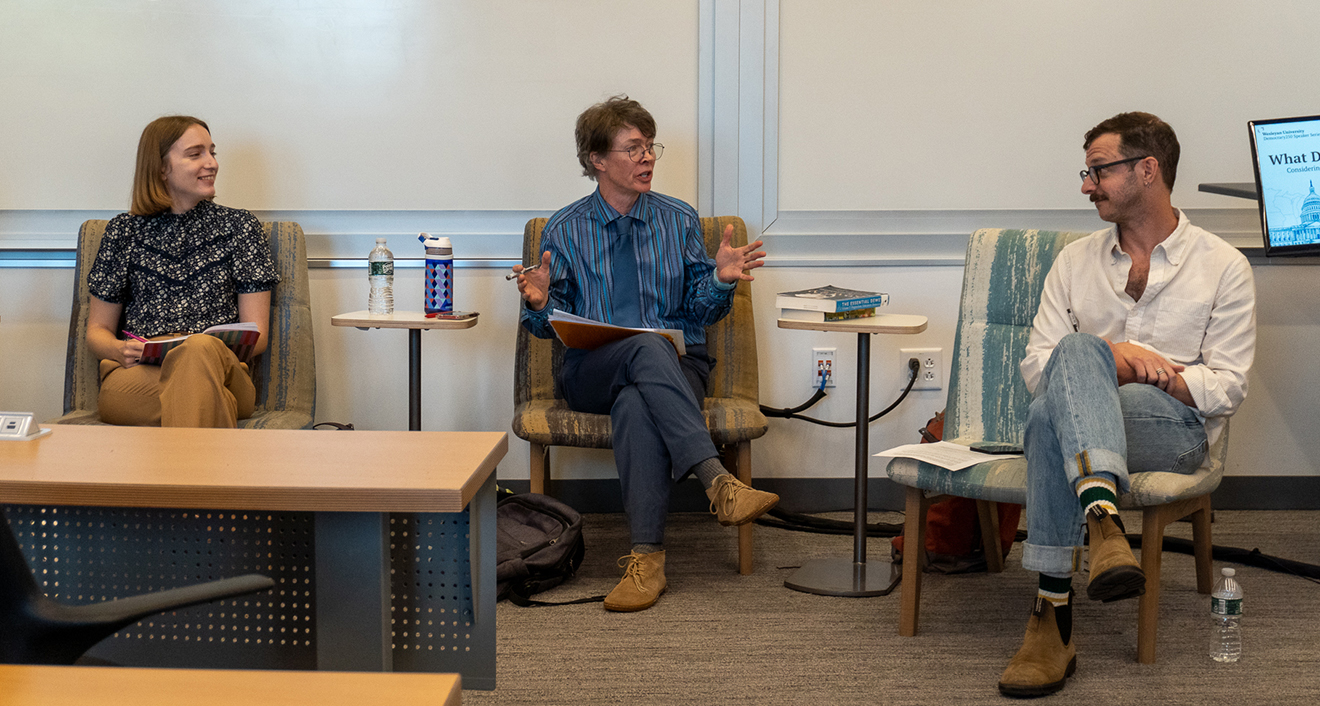
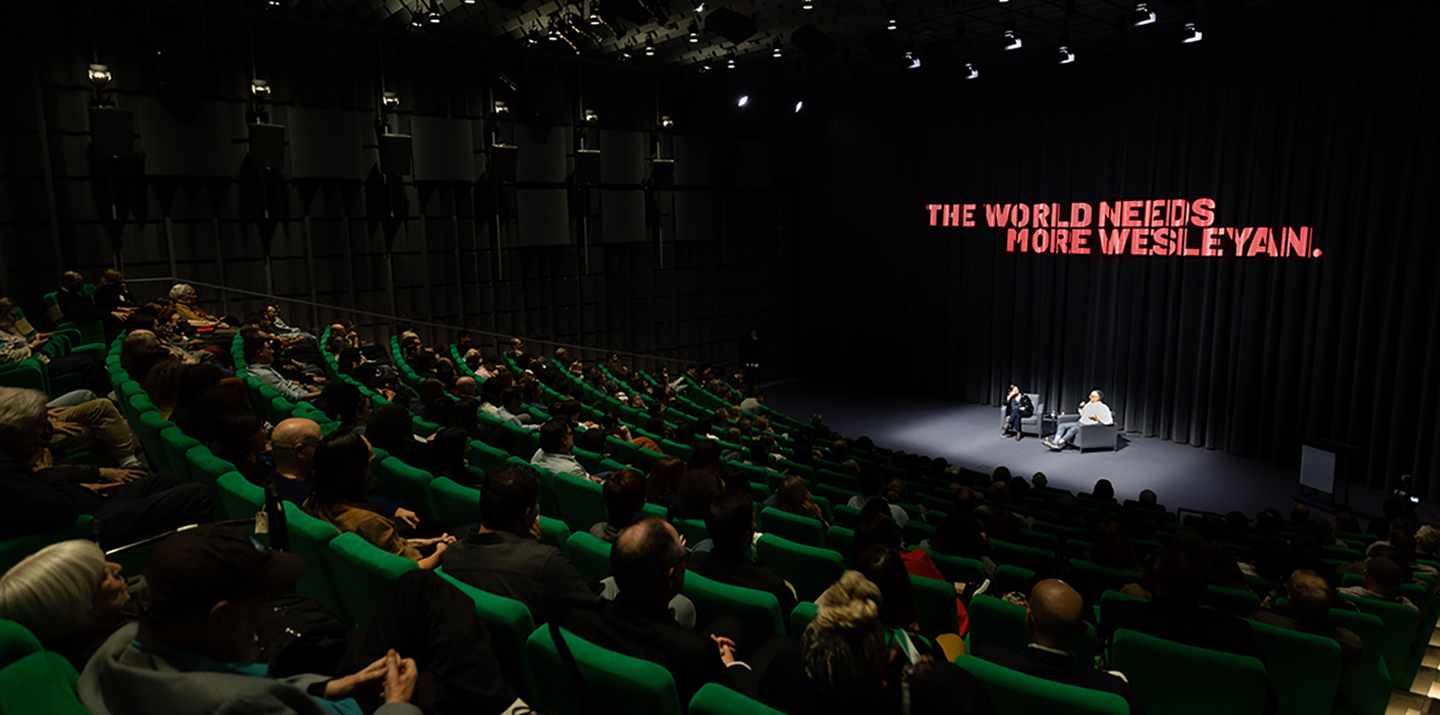
Abramson shared lessons from his career and insight on Russia, China, and competing versions of U.S. foreign policy—from international engagement to rising isolationism—at a talk in the Frank Center for Public Affairs on Sept. 17. The lecture was organized by Russian, East European and Eurasian Studies, the government department, and the College of Social Studies.
Insight on Foreign Relations
After graduating from Wesleyan, Abramson took an interest in nationalism as it exploded throughout the USSR in the late 1980s. He studied cultural anthropology, with a focus on Central Asia, in graduate school at Indiana University in 1991, starting right as the Soviet Union collapsed and created a societal decline in Russia that ultimately led to the rise of Russian President Vladimir Putin, he said. After earning his PhD, he began a postdoc at Brown University focusing on growing interest in Islam in Central Asia in 1997, which led to a fellowship at the State Department in the Office of International Religious Freedom. He started in September 2001, just days before the attacks on 9/11.
Abramson observed that a growing sense of disillusionment globally with liberal and Western-style democracy in the 25 years that followed the 9/11 attacks was not just due to the rise of extremism. He credited the U.S. wars in Afghanistan and Iraq one decade after “winning” the Cold war as a factor in the decreasing trust in our democratic system, as well as China’s emergence as a global power and Russia’s desire to reassert itself as a global power.
After 12 years as an analyst of Central Asia within the State Department’s Bureau of Intelligence and Research, he switched focus to analyzing Russian foreign policy, in the same bureau, concentrating on the relationship between Russia and China. “That partnership plays a key role in emerging global dynamics and has lasted longer than most anticipated,” he said.
He explained that Russia and China are not constrained by an alliance. This gives the two nations flexibility to be partners on matters that serve their respective interests without the obligations a formal alliance often requires—which can include mutual defense agreements. “I think the fact that it's much more transactional and self-interested explains some of the longevity of that relationship today,” he said. “Given the transactional nature of it, it's also a weakness because we see that Russia and China are doing things for their own interests.”
For instance, Russia’s access to the Arctic is important for its security since it’s the one overseas area that they control and can prevent China from gaining too much influence, he said. Russia is also careful to keep certain military technology out of China’s hands. Then on China’s side, they invest little in Russia, aside from liquified natural gas infrastructure in the Yamal Peninsula in the Arctic Circle. “China is not interested in investing a lot in Russia because they are very wary that Russia might, if relations were to decline, seize those assets,” Abramson said.
While some have argued that the main opponents to Western democracy—Russia, China, Iran, and North Korea—may form an alliance similar to the Axis Powers during World War II, Abramson rejects this notion. “I see those countries as working together, to varying degrees, bilaterally, sometimes very effectively, but they're not teaming up in some way to counter the U.S.”
Abramson concluded his talk by sharing some takeaways from his career studying Russia and the collapse of the Soviet Union and applied them to trends in U.S. foreign policy. He said he believes that the federal government’s strategic shift toward a more isolationist view—where diplomatic treaties and aid infrastructure have been shed—will lead to new partnerships between nations that used to rely on the U.S.
“If the U.S. is no longer seen as reliable as it once was for a number of countries, that doesn't mean that they're going to stop working with the U.S., but they're going to find other partners to also work with,” Abramson said. “I don't read this necessarily as the U.S. in decline, but there's a period of uncertainty where countries are going to be involved with multiple multilateral organizations.”