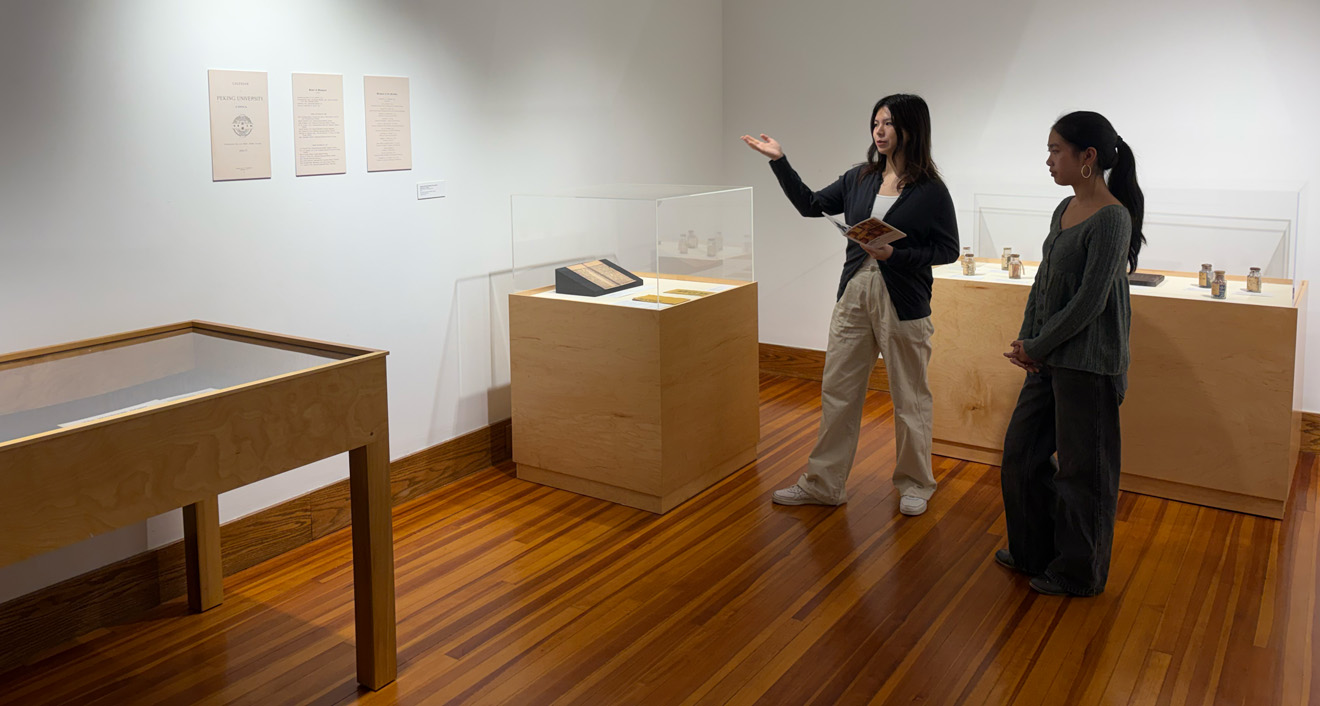
Currently a Kim-Frank Multilingual Writing Fellow, Chu studied history and theater, while Li is double-majoring in anthropology and art studio with a minor in East Asian Studies. The pair was inspired to curate the exhibition when they worked as research assistants for Associate Professor of History, East Asian Studies, and Science and Technology StudiesYing Jia Tan. They investigated the Wesleyan alumni who went to China as Methodist missionaries in the 19th century, and the relationship between China and the United States.
Convinced of a calling to bring forth social and spiritual transformation, the Wesleyan missionaries founded schools (including Peking University, the first Western-style university in China), opened medical clinics, and preached the gospel of Christ across cities and provinces. “We played a part in shaping, literally, the center of Chinese education,” Chu said.
To generate public interest and curiosity in their work in a distant and foreign land, and to raise funds to sustain their mission, Wesleyan alumni sent thousands of objects home to the United States, which helped to produce a “knowable” China by giving shape to that country for American audiences back home.
Originally part of the Wesleyan Museum of Natural History (1871–1957), these objects provide the basis for the exhibition, which invites viewers to probe the limits of how such collecting and archival practices create meaning. Many of the objects are presented for the first time in over a century. Chu said they would like visitors to the exhibition to imagine being a 19th-century visitor seeing China through these objects, and to think about the longer history of Wesleyan's engagement with East Asia.
“We first approached this exhibition with a pretty critical point of view—criticizing the cultural imperialism that comes with it,” Li said. “But then when we did more research and read more of their letters and their first-hand accounts, we realized how they're genuinely passionate about the cause, and how much they actually helped the people who were there.”
Chu noted that Moses Clark White, class of 1845, had the Bible translated into the vernacular way of speaking in Fuzhou, China, and appealed to existing local religious belief systems and religions by appropriating Taoist and Buddhist imagery into the version of Protestant Christianity he published. “These people were fervent believers in Jesus Christ, and fervent believers in modernity, in the forces of education, of Western medicine,” Chu said. “So they really took it all on themselves to go to this totally unknown country across the ocean to start something anew.”
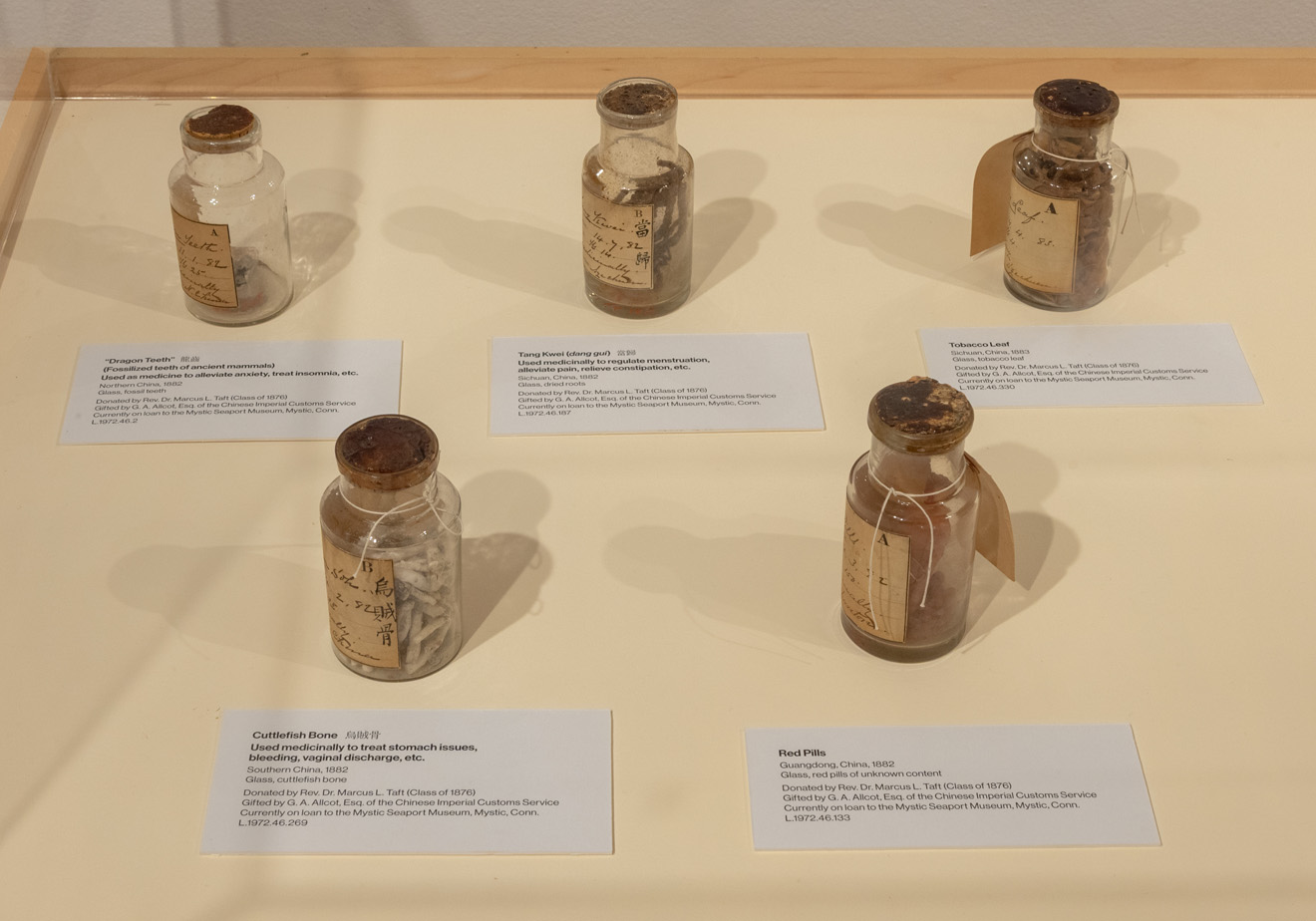
After Wesleyan’s Museum of Natural History closed, its collections were dispersed across various holdings on- and off-campus, including the Mystic Seaport Museum. In the summer of 2025, Archaeology Collections Manager, Visiting Professor of History, and Adjunct Assistant Professor of Archaeology and East Asian Studies Wendi Field Murray reached out to Chu and Li when she learned that over 400 bottles of various herbal specimens from Chinese trade routes collected by Wesleyan alumni had been stored in Mystic since 1972. Eight glass bottles are on display in the exhibition "Collecting China: Missionary Assemblages of a Distant World, 1844–1911" in the College of East Asian Studies Gallery. All specimens were originally donated by Wesleyan alumni and are on loan to the Mystic Seaport Museum. These specimens include "Dragon Teeth" (top left - fossilized teeth of ancient mammals used as medicine to alleviate anxiety and treat insomnia). Photo by John Giammatteo. “We went into their storage and we looked through all the bottles they have,” Li said. “I think we started with a list of 27 bottles, knowing that we can only fit eight into our exhibition.”
“We're glad to have brought them back, alongside other traces of China's trade with others,” Chu said. “Hopefully we can bring them back and show all of them.”
This exhibition was previously displayed earlier this year in Olin Library, and was curated as part of a tutorial in curatorial practice led by Assistant Director of Exhibitions and Assistant Curator of Education Rosemary Lennox and Associate Director and Curator of Visual Arts Benjamin Chaffee ’00. Exhibition support was provided by the College of East Asian Studies.