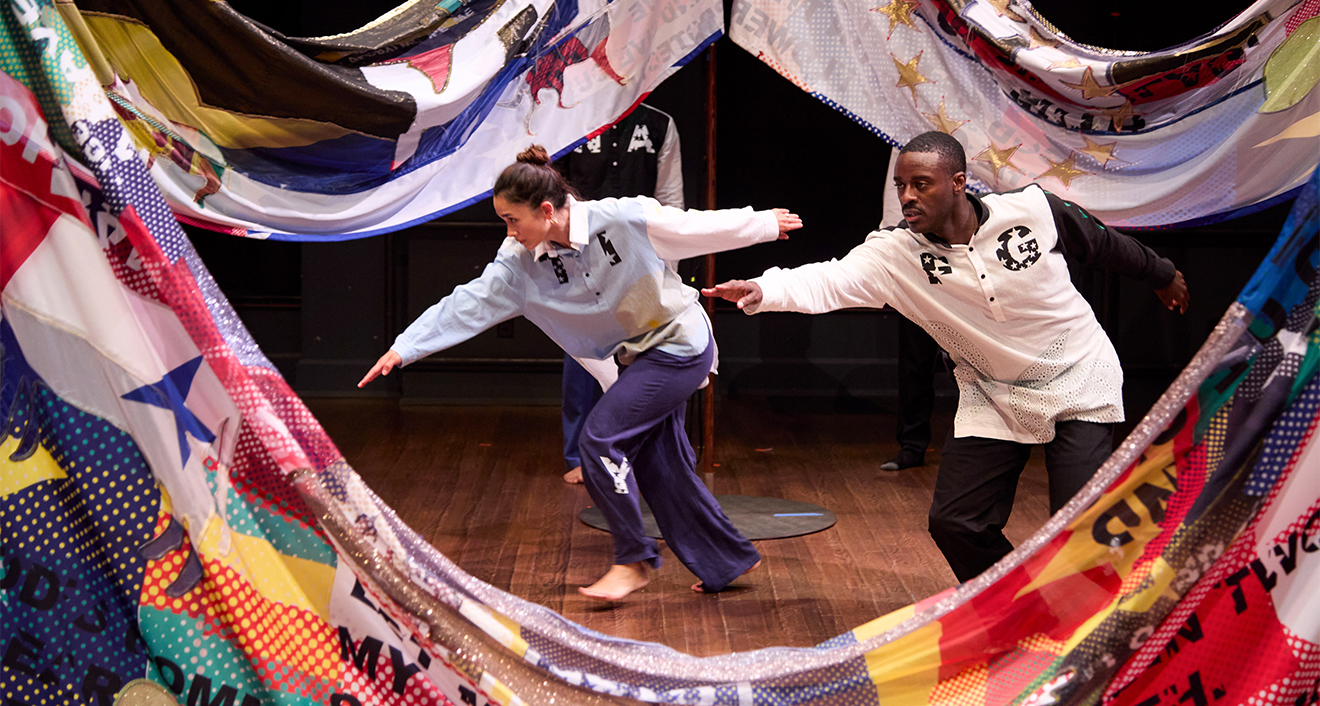
On November 5, American artist, musician, and composer Stephen Prina shared insights into his work and process as part of the exhibition, Mozart’s Chair, on display in the Ezra and Cecile Zilkha Gallery through February 28, 2027.
The group exhibition features international works in a variety of media—sculpture, painting, installation, performance, and sound—that examine the relationship between contemporary art and furniture. Examining the performative nature of the gallery space with related music and theater events, Mozart's Chair considers furniture a precursor that enables action or becomes a record of actions.
Curated by Associate Director and Curator of Visual Arts Benjamin Chaffee ’00, the works systematically blur the lines between foreground and background, asking how furniture informs who we are, what we make, and how we understand the possibilities of our bodies.
Prina works across a variety of media, including musical performances. His pieces connect through long-term projects that he frequently rearranges and re-presents across different exhibition and associative contexts. “I've often described my work as a relay race,” Prina said. “I may bring a certain set of relationships together with one work, and then a couple of works down the line, I will draw an element from that to the current work.”
His work can be seen in public collections at the Tate, London; The Museum of Modern Art (MoMA), New York; and the Whitney Museum of American Art, among others. His solo exhibition, A Lick and Promise (2025), at MoMA was the first in-depth survey to focus on his performances, drawing out a central theme in his work: time, and the way it shifts cultural values.
Born in 1954 in Galesburg, Illinois, Prina received his BFA from the Northern Illinois University and an MFA from the California Institute of the Arts. He is professor of Art, Film, and Visual Studies, Emeritus, at Harvard University. Chaffee met Prina in Boston two decades ago, finding connection in their mutual interest in contemporary music and art.
In his installation in the North Gallery of Zilkha Gallery, Prina shares an element from his larger project Galesburg, Illinois+, which was first exhibited at the Kunst Halle in St. Gallen, Switzerland in 2015, followed by exhibitions in Germany, New York, and Los Angeles. The original project celebrates and re-narrativizes his hometown.
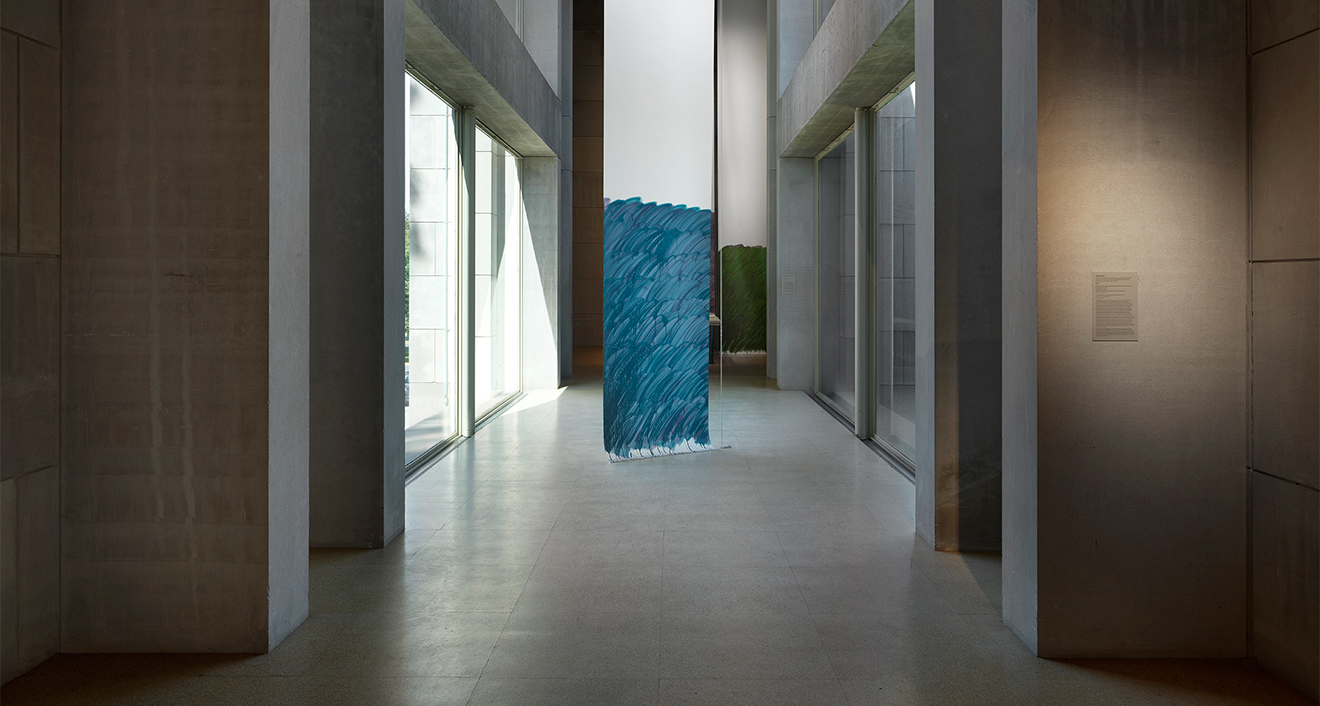
Prina said he had often avoided his personal history and anecdotes prior to this body of work. “If I were to make a work that is generated by autobiography, what would it look like?” Prina asked as he created his Galesburg, Illinois+ project. “What form would it take?” Stephen Prina's work installed in the Ezra and Cecile Zilkha Gallery as part of the "Mozart's Chair" exhibition. The work, "Blind No. 28, Twenty-five-foot Ceiling or Lower, PANTONE® 7666CP/PANTONE® 7666CP, PANTONE® 7666CP/PANTONE® 5405CP, PANTONE® 625CP/PANTONE® 5757CP" (2015), was created using acrylic on linen, a window blind mechanism, Rookwood Pottery 1920, Festzeltgarnitur, and fabric. Photo by Dario Lasagni. Prina's installation at Wesleyan draws from his own history while capturing the specific moment of its creation—from a matchbook image from the Harbor Lights Supper Club where he performed pop music in the 1970s, to custom Swiss fabric dyed in the Pantone Color of the Year, and vintage Rookwood Pottery bookends sourced from eBay. His wider project also collapses together references to two other Galesburg natives through photographs of a sculpture by Dorothea Tanning, books by Carl Sandburg, and photos of Sandburg with Marilyn Monroe.
Prina described the influence of composer John Cage on his own work. Cage introduced new ways of organizing musical materials and systems to play off each other, collide, and produce a variety of unexpected results, which often remain topical and contemporary. “I was permanently damaged by John Cage,” Prina said. “Once I came in contact with his work, things were never quite the same, in many different ways.”
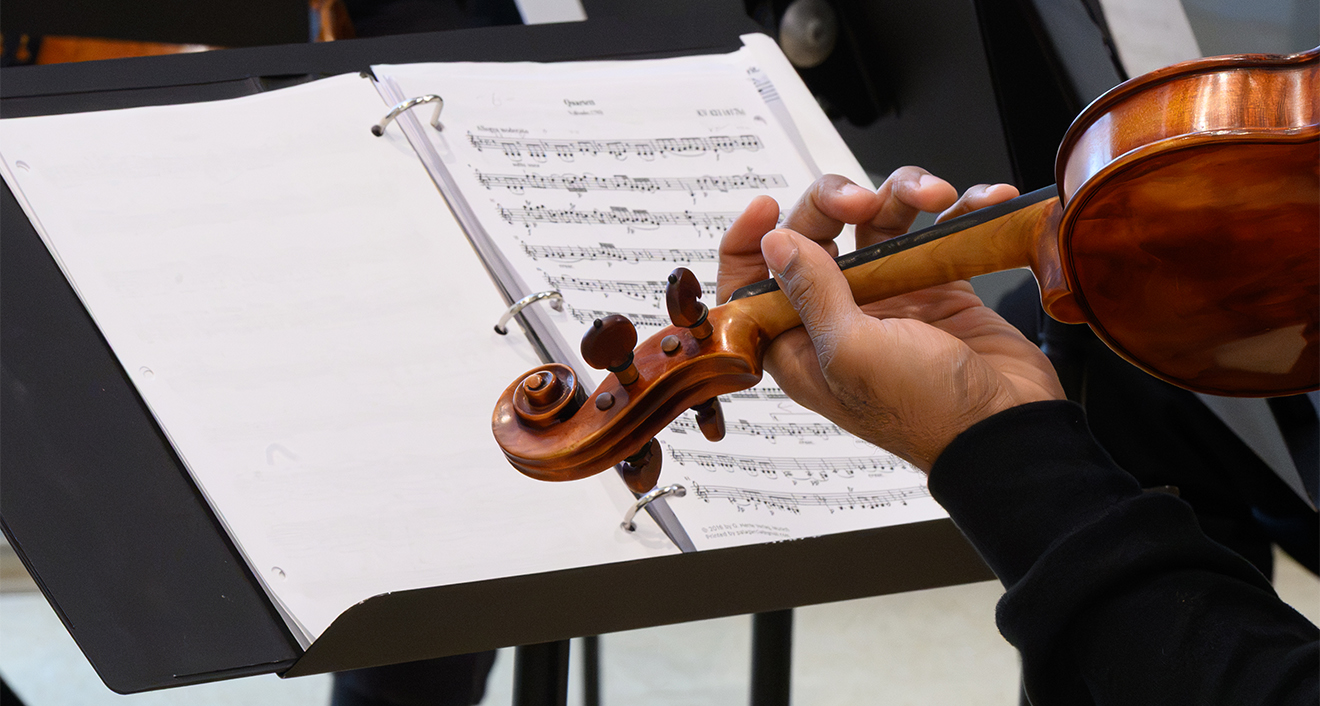
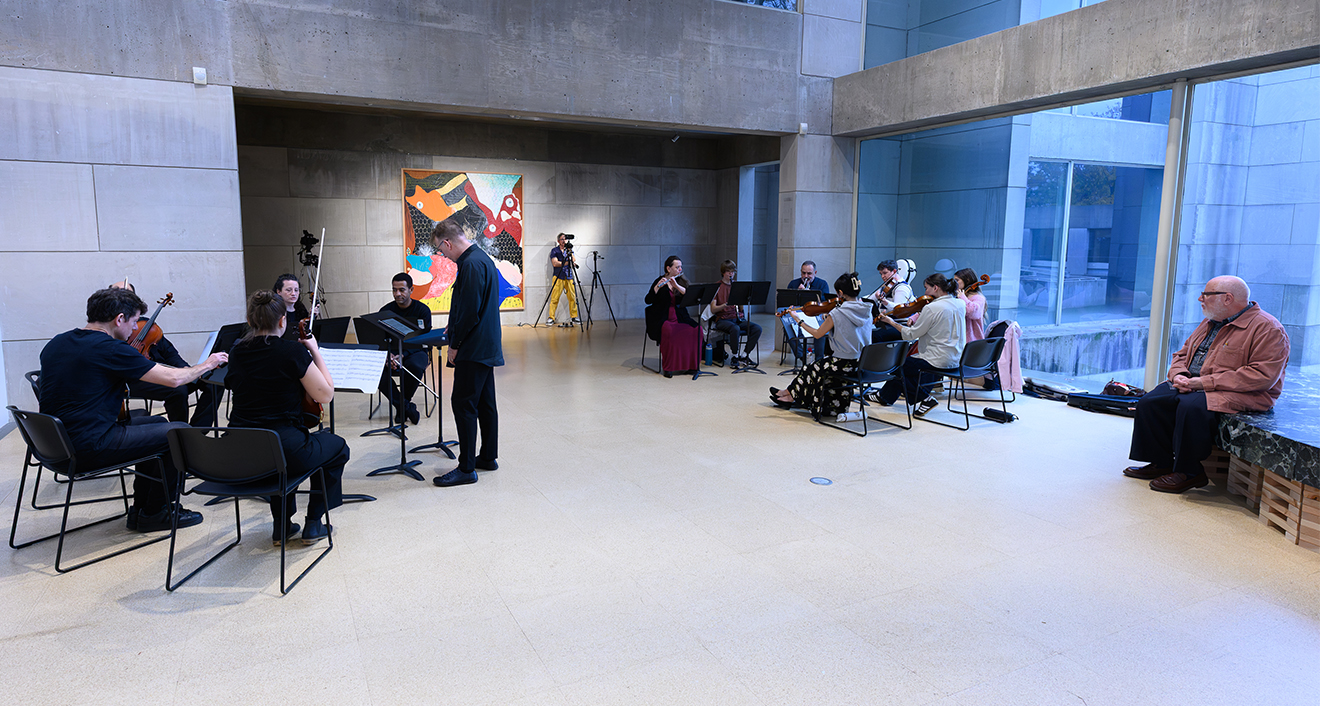
Prina later recalled that while he was a 21-year-old undergraduate student majoring in painting and minoring in music composition in 1976, he had a profound experience while seeing Wesleyan’s John Spencer Camp Professor of Music Emeritus Alvin Lucier perform his experimental work “Bird and Person Dyning” (1975) in a gallery at Northern Illinois University. “I had never heard anything like that,” Prina said. “I had never seen anything like that. It truly affected me, and I've never been able to forget that...The idea that this was happening in an art gallery—not on a concert stage, and not in another kind of place—the idea that this can happen anywhere.” Stephen Prina (at right) watches the second performance (at left) of his composition “String Quartet for Six Players” (1976) in the Ezra and Cecile Zilkha Gallery. At center, Nadya Potemkina, Director of Private Music Lessons, and Adjunct Associate Professor of Music, leads a small ensemble in a reprise performance of Erik Satie’s “Musiques d’ ameublement: Tapisserie en fer forgé” (1917–18) from a series of works by the artist which translate to “Furniture Music.” Photo by Mark Brendel for Perceptions Photography. On November 7, the New York-based Either/Or Ensemble was joined by John Biatowas, director of Wesleyan’s Chamber Music Ensemble, and Music and Audiovisual Archivist Alex Waterman to perform Prina’s “String Quartet for Six Players” (1976) in Zilkha Gallery. “This is the earliest work that I claim as a work by me,” Prina said.
The work takes as source material the first 12-minute movement of Wolfgang Amadeus Mozart’s String Quartet No. 15 in d minor, a textbook example of the sonata form—a foundational musical structure used widely in classical music since the mid-18th century. “I thought, ‘well, all the structure is there in Mozart,’” Prina recalled. “What I want to do is reorganize the structure in some way. I want to meet Mozart halfway and turn it into something else.”
Prina doubled the violin parts and introduced a six-sided die tossed intermittently by a conductor, the roll of which determines which musician begins again at the top of the composition, while the remaining players continue with the work, which can ultimately stretch the duration of the piece to a half hour or more. The musicians performed the composition twice, as each performance is unique due to the chance and uncertainty of the roll of the dice. “So, gradually the score is unraveled,” Prina said.
“I try to leave myself open for that which was not planned,” Prina said of his approach to his work.
In the wall text about Prina’s work in the gallery, Chaffee notes that the inclusion of this musical performance is the closest that the Mozart’s Chair exhibition comes to the promise of its title. “The promise of this exhibition—the agency we can find in (or recover from) the systems of objects that surround us—is most palpable in these related performances,” said Chaffee.